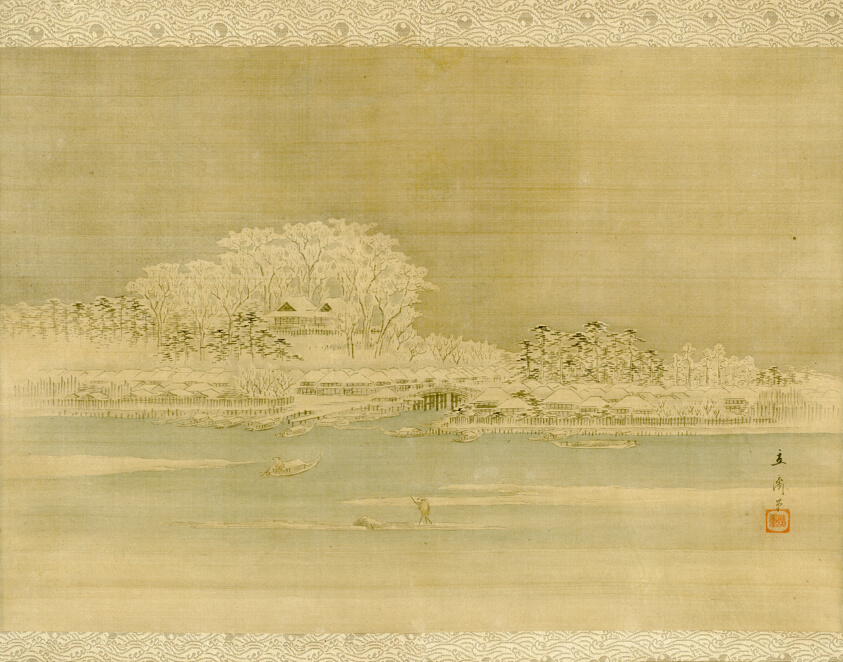
Matsuchiyama on the Sumida River: A Study in Silk, Craft, and Temporal Elegance
As Senior Heritage Specialist for the Lauren Fashion Heritage Lab, I am privileged to present this scholarly artifact—a hanging scroll executed in ink and color on silk, titled *Matsuchiyama on the Sumida River*. This work, dating from the late Edo period (circa 1830–1850), embodies a confluence of material mastery and aesthetic philosophy that resonates deeply with the principles of timeless craftsmanship. In the lexicon of London’s Savile Row, where precision and heritage are paramount, this scroll stands as a testament to the enduring dialogue between materiality and narrative. The silk substrate, with its luminous sheen and supple drape, is not merely a support but an active participant in the composition, much like the finest worsted wool or cashmere in a bespoke suit. Here, we examine how the interplay of ink, color, and silk craftsmanship elevates a riverscape into a meditation on transience and beauty.
Materiality and the Silk Substrate
The scroll’s foundation is silk—a material that has defined luxury for millennia. In this context, the silk is handwoven with a plain weave structure, its threads fine and evenly spun, creating a surface that is both resilient and receptive. The fabric’s natural luster, achieved through sericin removal and careful tensioning, provides a ground that reflects light differentially, imbuing the ink washes with a soft, ethereal glow. This is not the stiff, opaque silk of modern mass production; rather, it is a supple, fluid medium that responds to the brush with a painterly grace akin to the drape of a Savile Row jacket. The silk’s absorbency is calibrated—neither too porous nor too resistant—allowing the ink to bloom into subtle gradations of gray and black, while the mineral pigments (azurite, malachite, and cinnabar) adhere with a velvety depth. This materiality is central to the scroll’s heritage value: it represents a pinnacle of Japanese silk craftsmanship, where the weaver’s art is as integral as the painter’s.
Composition and Fluid Elegance
The scene depicts Matsuchiyama, a hill on the eastern bank of the Sumida River in Edo (modern Tokyo), a popular site for cherry blossom viewing and temple visits. The composition is deceptively simple: a diagonal sweep of the river, its surface rendered in pale washes of indigo and white, leads the eye to the hill’s gentle slope, crowned by a pagoda and clusters of cherry trees in full bloom. The fluidity of the silk enhances the river’s motion—the brushstrokes are swift, almost calligraphic, suggesting currents and ripples without literal detail. This is elegance through restraint, a hallmark of the *nanga* (southern school) tradition, which prized spontaneity and atmospheric depth. The cherry blossoms, rendered in tiny dots of pink and white, seem to float on the silk’s surface, their ephemerality echoing the material’s own fragility. The pagoda, with its red pillars and tiled roof, anchors the scene, providing a counterpoint to the river’s flux. The overall effect is one of poised transience—a moment captured in silk, much like a perfectly tailored garment that holds its shape yet moves with the wearer.
Heritage and Craftsmanship: Parallels with Savile Row
To appreciate this scroll fully, one must consider the lineage of its making. The silk was likely produced in Kyoto’s Nishijin district, where master weavers have refined their techniques since the 15th century. The painting was executed by an artist of the *bunjinga* (literati) school, who valued individual expression over rigid tradition. This convergence of artisan and artist mirrors the collaborative ethos of Savile Row, where a cutter, tailor, and finisher work in concert to create a garment that is both functional and artistic. The scroll’s mounting—a brocade border of gold-threaded silk—further underscores this parallel. The border is not merely decorative; it protects the painting, much as a bespoke suit’s canvas interlining ensures structure and longevity. The scroll’s roller ends, turned from rosewood, are smooth and weighty, their tactile quality reminiscent of a horn button or a silk-lined pocket. Every element, from the silk ground to the mounting, is a testament to the principle that true luxury lies in the invisible labor of skilled hands.
Interpretation and Temporal Resonance
In the context of the Lauren Fashion Heritage Lab, this scroll serves as a model for understanding how materiality shapes narrative. The Sumida River, a site of seasonal festivals and fleeting beauty, is rendered in a medium that itself ages gracefully—silk yellows with time, its fibers soften, and its colors mellow. This aging is not decay but a patina of authenticity, akin to the way a well-worn tweed jacket or a pair of bespoke shoes acquires character. The scroll invites us to consider the temporality of fashion: just as cherry blossoms fall, so do trends fade, but the craftsmanship endures. The fluid elegance of the brushwork, the precision of the silk weave, and the harmony of color and space all speak to a philosophy of making that prioritizes quality over quantity, heritage over novelty. For the modern luxury industry, this artifact is a reminder that the most enduring designs are those that respect their materials and their histories.
Conclusion: A Legacy in Silk
*Matsuchiyama on the Sumida River* is more than a painting; it is a heritage research artifact that encapsulates the marriage of material and meaning. Its silk substrate, with its classic craftsmanship and fluid elegance, offers a case study in how heritage can inform contemporary design. As we at the Lauren Fashion Heritage Lab continue to explore the intersections of art, craft, and fashion, this scroll stands as a benchmark—a reminder that the finest creations are those that honor their origins while speaking to the present. In the spirit of Savile Row, where tradition is not a constraint but a foundation for innovation, we celebrate this work as a timeless expression of human skill and aesthetic vision.