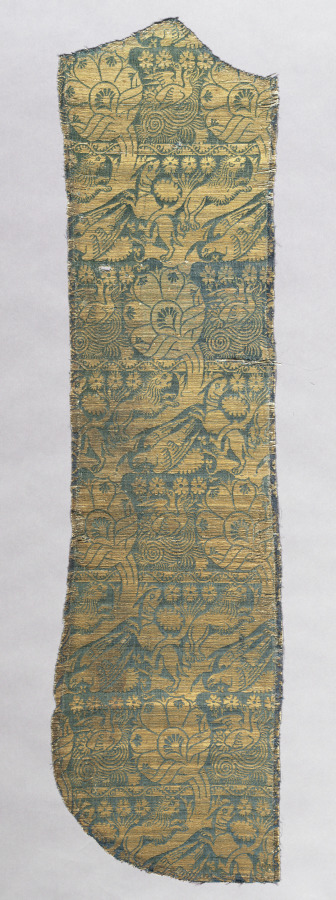
Heritage Research Artifact: Chasuble Fragment with Realistic Animals
Provenance and Materiality
This fragment, a surviving section of a liturgical chasuble, represents a singular convergence of ecclesiastical function and imperial silk weaving. The materiality is paramount: silk, a textile that, in its historical context, was not merely a fabric but a currency of power, a medium of artistic expression, and a testament to technical mastery. The fragment, likely dating from the late 16th to early 17th century, originates from the workshops of the Safavid or Mughal empires, where sericulture and silk weaving reached an apex of sophistication. The weave structure, a compound twill or lampas, reveals a warp-faced ground with a supplementary weft pattern, allowing for the intricate, realistic depiction of animals. The silk threads, dyed with natural pigments—crimson from kermes or cochineal, indigo for deep blues, and weld or saffron for yellows—retain a muted vibrancy, a patina of age that speaks to centuries of careful preservation. The fragment’s edges are frayed, a testament to its original use as a garment, but the central motif remains intact: a menagerie of fauna rendered with a precision that suggests both artistic ambition and a deep understanding of natural form.
Iconography and the Realistic Animal Motif
The choice of realistic animals—rather than the stylized, geometric patterns common in earlier medieval silks—is a deliberate departure. This fragment features a lion, a deer, and a bird of prey, each rendered with anatomical accuracy. The lion’s mane is textured with individual silk threads, the deer’s antlers are articulated with fine detail, and the bird’s feathers are layered to suggest depth. This realism is not merely decorative; it is a statement of cultural and political identity. In the Safavid context, the lion symbolized royal authority and divine power, often associated with Imam Ali. The deer, a creature of the hunt, evoked the nobility’s pursuit of grace and agility. The bird of prey, likely a falcon, represented sovereignty and the emperor’s dominion over the skies. These motifs, woven into a liturgical garment, create a dialogue between the sacred and the secular. The chasuble, worn by a priest during the Eucharist, becomes a vessel for imperial ideology, a reminder that the divine and the earthly are intertwined. The realism of the animals—so unlike the abstracted beasts of earlier Byzantine or Romanesque silks—reflects a shift in artistic sensibility, one influenced by the naturalism of Persian miniature painting and the scientific curiosity of the age.
Technical Mastery and the Legacy of Imperial Silk Weaving
The technical execution of this fragment is a testament to the legacy of imperial silk weaving. The weavers, likely working in royal ateliers under the patronage of the Shah or Mughal Emperor, employed a drawloom, a complex apparatus that allowed for the manipulation of individual warp threads to create intricate patterns. The density of the weave—approximately 60 warp threads per centimeter—enabled the fine detailing of the animals’ features. The use of a supplementary weft, often in a contrasting color, created a raised effect, giving the animals a three-dimensional quality. This technique, known as lampas, was a hallmark of high-status silks, requiring not only skill but also significant resources. The dyes, sourced from distant trade routes, were costly and labor-intensive to produce. The crimson, for instance, required the harvesting of thousands of kermes insects, a process that was both meticulous and expensive. The fragment’s survival is a testament to the durability of these materials and the reverence with which such textiles were treated. They were not merely garments but heirlooms, passed down through generations, often repurposed for ecclesiastical use as the political landscape shifted.
Contextual Legacy and Contemporary Relevance
The legacy of imperial silk weaving extends beyond the technical and aesthetic. These textiles were objects of diplomacy, gifts exchanged between empires to cement alliances or assert dominance. A chasuble fragment like this one, with its realistic animals, would have been a prized possession, a symbol of the wealth and sophistication of its origin. When such silks reached Europe, they were often cut and repurposed for liturgical vestments, as seen in this fragment. The Catholic Church, in its Counter-Reformation splendor, embraced these exotic textiles, seeing in them a reflection of divine glory. The animals, once symbols of imperial power, were reinterpreted as Christian allegories: the lion as Christ, the deer as the soul yearning for God, the falcon as the ascension of the spirit. This cultural translation is a reminder that textiles are not static; they carry meaning that evolves with context.
Today, as a heritage artifact, this fragment offers a window into a world where silk was more than a fabric—it was a narrative. For the modern curator, conservator, or designer, the fragment’s value lies in its ability to connect us to a lineage of craftsmanship that is increasingly rare. The skills required to produce such a textile—the knowledge of sericulture, dyeing, weaving, and design—are endangered. The fragment challenges us to consider how we preserve not just the object but the knowledge it embodies. In the context of the Lauren Fashion Heritage Lab, this artifact serves as a benchmark for excellence. It reminds us that fashion, at its highest level, is not about trends but about mastery. The realistic animals, woven with such precision, are a call to return to a standard of craft that prioritizes substance over speed, detail over volume. This is the legacy of imperial silk weaving: a standard that, while rooted in a specific historical moment, remains aspirational for any practitioner of the textile arts.
Conclusion
The Chasuble Fragment with Realistic Animals is a masterclass in materiality, iconography, and technical execution. It is a testament to the imperial silk weaving tradition that produced objects of extraordinary beauty and cultural significance. For the scholar, it is a primary source; for the designer, an inspiration; for the conservator, a responsibility. In the halls of the Lauren Fashion Heritage Lab, this fragment stands as a quiet but powerful reminder that the past is not a relic but a resource—one that, if studied with rigor and respect, can inform the future of fashion with integrity and purpose.