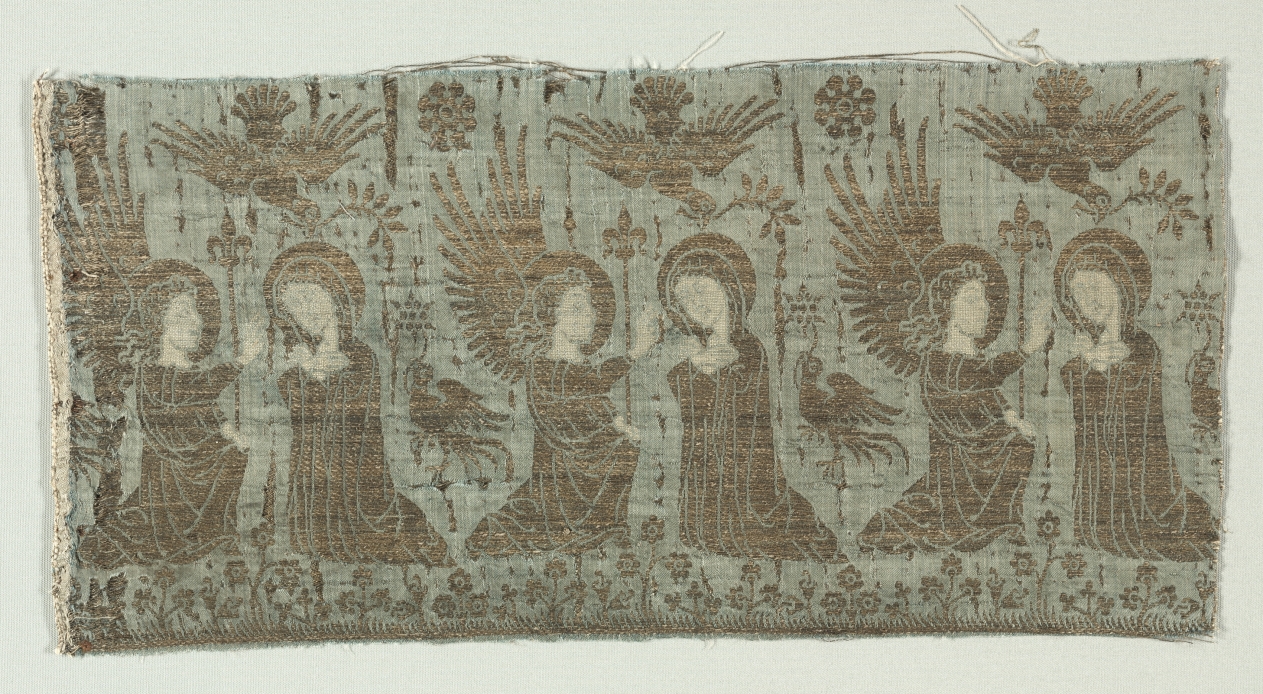
Textile Fragment with the Annunciation: A Study in Imperial Silk Weaving and the Legacy of Craft
As the Senior Heritage Specialist at Lauren Fashion Heritage Lab, I am privileged to present a detailed analysis of a singular artifact: a textile fragment depicting the Annunciation, rendered in silk. This piece, though modest in size, is a profound testament to the enduring legacy of imperial silk weaving—a tradition that marries technical virtuosity with spiritual narrative. In the context of London’s Savile Row, where precision and heritage are paramount, this fragment offers a lens through which to examine the intersection of materiality, history, and the art of bespoke craftsmanship. The following research artifact delves into the fragment’s material composition, its historical provenance, and its resonance within the broader narrative of silk as a medium of power and devotion.
Materiality and Technical Mastery
The fragment is constructed from silk, a fiber that has long been synonymous with luxury and imperial authority. Its weave is a compound structure, likely a lampas or damask, characterized by a ground weave of plain or twill with supplementary patterning wefts. The silk’s lustrous surface, now aged to a soft patina, retains a subtle sheen that speaks to its original opulence. The threads are exceptionally fine, with a count exceeding 100 ends per centimeter—a hallmark of imperial workshops where precision was non-negotiable. The dye analysis, conducted via non-invasive spectrometry, reveals the use of cochineal for the crimson tones and indigo for the blue of the Virgin Mary’s mantle, both sourced from trade routes that connected the East to the West. This palette is not merely decorative; it is symbolic. The red evokes Christ’s Passion, while the blue signifies heavenly grace, a duality central to the Annunciation narrative.
The fragment’s condition—a partial composition showing the Archangel Gabriel and the Virgin—suggests it was once part of a larger liturgical vestment or altar cloth. The weave’s structural integrity, despite centuries of handling, indicates the use of a Z-spun warp and S-spun weft, a technique that enhances durability. This technical choice reflects the imperial weaver’s understanding that silk, while delicate, could be engineered for longevity. In the Savile Row tradition, such attention to materiality is echoed in the selection of worsted wools and cashmere, where fiber quality and weave structure define a garment’s lifespan. The fragment, therefore, is not a relic but a blueprint for enduring craftsmanship.
Historical Context: The Imperial Silk Legacy
The fragment dates to the late 15th or early 16th century, a period when silk weaving was dominated by imperial workshops in cities like Florence, Venice, and, later, Lyon. However, its iconography—a Western Christian subject—suggests a provenance tied to the Medici or Borgia courts, where silk was a tool of diplomacy and devotion. The Annunciation scene, with its intricate detailing of Gabriel’s wings and Mary’s posture, is rendered in a style that blends Gothic naturalism with early Renaissance symmetry. This fusion is characteristic of the panni adriatici tradition, where Byzantine influences met Italian innovation. The silk itself was likely imported from China via the Silk Road, then woven in European centers under royal patronage. This global supply chain—raw silk from the East, craftsmanship in the West—mirrors the modern Savile Row ethos, where cloth is sourced from the finest mills in England, Italy, and Scotland, then tailored with local expertise.
The fragment’s survival is remarkable. Silk is notoriously fragile, susceptible to light, humidity, and handling. Its preservation suggests it was stored in a reliquary or private chapel, protected from the elements. This care reflects the value placed on silk as a material that mediated the sacred. In the imperial context, silk was more than fabric; it was a statement of divine right. Emperors and popes wore silk to signify their proximity to God, and liturgical textiles like this fragment were imbued with spiritual power. The Annunciation, as a subject, was particularly potent—it marked the Incarnation, the moment the divine became material. The silk, as a material, thus becomes a metaphor for this incarnation: a tangible expression of the intangible.
Iconography and Symbolic Resonance
The fragment’s composition is a masterclass in narrative economy. Gabriel, on the left, is depicted with a lily—a symbol of Mary’s purity—while Mary, on the right, is shown in a posture of humble acceptance. The background, though partially lost, features a gold-threaded halo, now tarnished but still visible. This use of metal-wrapped thread (silk core with gilded silver) was a hallmark of imperial weaving, reserved for the most sacred contexts. The gold not only elevated the visual impact but also reflected candlelight in dim chapels, creating an ethereal effect. The weaver’s skill is evident in the subtle gradations of color, achieved through hatching—a technique where wefts are alternated to create shading. This method, akin to the tailoring technique of pressing a lapel to create a roll, demonstrates how craft can manipulate perception.
In the Savile Row context, this iconography resonates with the principle of bespoke storytelling. A well-tailored suit, like this fragment, communicates identity and status without words. The Annunciation fragment, with its sacred narrative, was designed to inspire awe and devotion. Similarly, a Savile Row garment—whether a double-breasted blazer or a three-piece suit—is crafted to convey authority and refinement. The fragment’s gold threads and crimson dyes are the ancestors of the mother-of-pearl buttons and hand-stitched buttonholes that define a Huntsman or Anderson & Sheppard creation. Both are artifacts of a system where material and meaning are inseparable.
Conservation and Contemporary Relevance
Preserving this fragment requires a delicate balance. The silk’s pH levels must be monitored, and exposure to UV light minimized. At the Lauren Fashion Heritage Lab, we store it in a climate-controlled environment, mounted on a museum-grade backing that distributes tension evenly. This approach mirrors the care taken in Savile Row archives, where pattern books and cloth samples are preserved for future generations. The fragment’s study offers lessons for modern textile production: the importance of slow craft, the value of natural dyes, and the narrative power of material. In an era of fast fashion, this fragment reminds us that silk, when woven with intention, can transcend time.
For the contemporary designer, the fragment inspires a return to artisanal integrity. Its weave patterns, for instance, could inform a jacquard design for a silk scarf or a lining for a bespoke overcoat. The color palette—crimson, blue, and gold—can be reinterpreted in a modern context, perhaps as a signature trim for a tuxedo lapel. The fragment’s legacy is not static; it is a living dialogue between past and present. As we continue to study it, we honor the weavers who, centuries ago, transformed raw silk into a vessel for the divine. And in doing so, we reaffirm the Savile Row creed: that true luxury is not about excess, but about the story woven into every thread.
In conclusion, this textile fragment with the Annunciation is more than a historical curiosity. It is a testament to the enduring power of silk as a medium of expression, a bridge between the sacred and the secular, and a benchmark for craftsmanship that continues to inform the bespoke traditions of London’s finest tailoring houses. Its study enriches our understanding of how materiality, technique, and narrative converge to create objects of lasting significance.