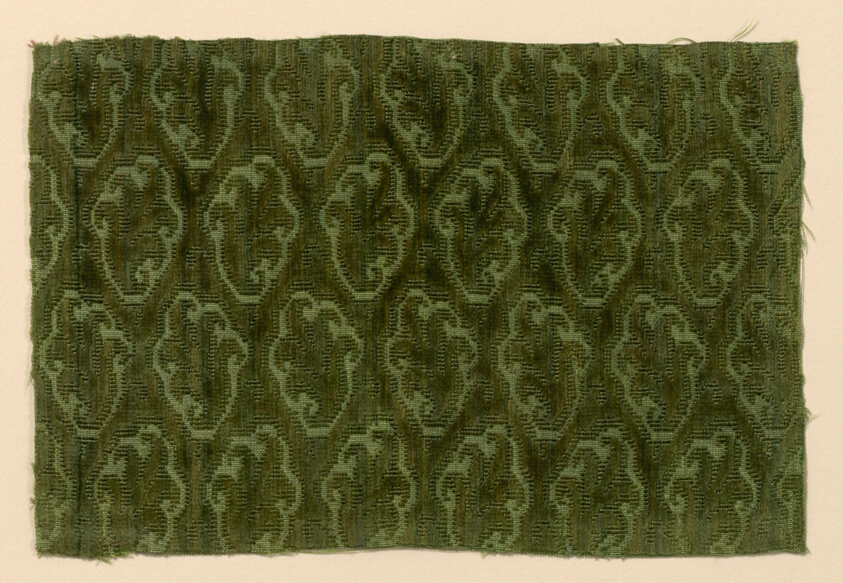
The Fragment as a Testament: Deconstructing Velvet’s Architectural Elegance
In the hushed ateliers of London’s Savile Row, where precision meets artistry, a fragment of silk velvet is never merely a remnant. It is a distilled narrative of craftsmanship, a microcosm of the discipline that defines classic tailoring. At the Lauren Fashion Heritage Lab, we approach such fragments not as discarded ends, but as primary sources—artifacts that reveal the tensile strength, tactile memory, and structural integrity of a material that has clothed empires and defined elegance. The subject before us is a silk velvet fragment, woven in a plain weave base with supplementary pile warps that create a complex interplay of cut, uncut, and voided velvet. This is not a simple textile; it is a study in controlled opulence, a lesson in how luxury is engineered from the loom upward.
Materiality and the Language of the Loom
To understand this fragment is to understand the grammar of silk craftsmanship. The foundation is a plain weave, the most fundamental of interlacings, where warp and weft cross in a simple over-under rhythm. This provides a stable, unyielding base—the canvas upon which the velvet’s drama unfolds. The supplementary pile warps are the protagonists. They are introduced as an additional set of yarns, rising from the ground weave to create the plush surface we recognize as velvet. In this fragment, the pile is not uniform. It is a deliberate composition of cut velvet, where loops are sheared to create a soft, reflective nap; uncut velvet, where loops remain intact, offering a matte, textured surface; and voided velvet, where the pile is entirely absent, revealing the flat, lustrous ground weave beneath. This tripartite structure is not decorative whimsy; it is a technical feat of weaving, requiring precise control of tension, shedding, and cutting mechanisms. The result is a fabric that breathes—a surface that shifts in light, depth, and shadow, much like the lapel of a bespoke jacket that catches the eye from across a room.
From a materiality perspective, this fragment embodies the paradox of silk: it is simultaneously delicate and resilient. The silk filament, derived from the cocoon of the Bombyx mori, possesses a tensile strength comparable to steel on a per-weight basis. Yet, its sheen and drape suggest fragility. The velvet construction amplifies this duality. The cut pile, when brushed, creates a luminous, almost liquid surface, while the uncut loops introduce a tactile resistance—a subtle invitation to touch. The voided areas, often used in heraldic or floral motifs, provide visual breathing room, preventing the fabric from becoming visually overwhelming. In the context of Savile Row, where restraint is the highest form of elegance, this fragment teaches us that luxury is not about excess but about controlled contrast. A master tailor would use such a velvet for a smoking jacket or a waistcoat, knowing that the play of cut and uncut surfaces would create a three-dimensional effect that no solid fabric could achieve.
Fluid Elegance and the Savile Row Ethos
The phrase “fluid elegance” is often misapplied to fabrics that merely drape well. True fluid elegance, as embodied by this fragment, is a function of structural intelligence. The plain weave base ensures that the fabric does not distort under its own weight; the supplementary pile warps add body without stiffness. This is a textile that moves with the wearer, not against them. In the hands of a Savile Row cutter, such a velvet would be treated with the same respect as a worsted wool or a cashmere suiting. The cutting process would account for the pile direction—ensuring that the nap falls uniformly, often from collar to hem, to maximize light reflection and minimize shading inconsistencies. The voided areas, if part of a pattern, would be meticulously aligned at seams, a practice that can add hours to the construction of a single garment. This is not mere decoration; it is an investment in visual harmony.
Historically, silk velvet has been associated with courtly splendor and ecclesiastical grandeur. But on Savile Row, it is reinterpreted through a lens of understatement. The fragment we study might have originated from a 19th-century Lyon loom, destined for a Russian imperial court. Yet, in the context of modern tailoring, it becomes a statement of quiet confidence. The cut velvet catches the light like a well-polished shoe; the uncut loops offer a matte counterpoint, like the brushed finish of a silver watch case. The voided areas reveal the ground weave, a reminder that even the most opulent fabric has a foundation—a backbone, if you will. This is the essence of the Savile Row ethos: luxury that never shouts, but always commands attention.
Conservation and the Art of the Fragment
As a heritage artifact, this fragment presents unique conservation challenges. Silk is a protein fiber, susceptible to light damage, humidity, and mechanical stress. The supplementary pile warps are particularly vulnerable; the cut pile can shed, and the uncut loops can snag. Voided areas, being the ground weave, are often the first to show wear, as they lack the protective pile layer. In the Lab, we store such fragments in acid-free tissue, in dark, climate-controlled environments. But we also study them actively. We use microscopy to examine the twist of the pile yarns, the density of the loops per inch, and the integrity of the weave. We document the fragment’s provenance, its condition, and its potential for replication. For a modern tailor, this fragment is not just a historical curiosity; it is a reference point. It tells us how to achieve a specific luster, a particular hand feel, a precise balance of texture and sheen. It is a benchmark for quality in an age of mass production.
In conclusion, this silk velvet fragment is far more than a piece of cloth. It is a document of human ingenuity, a record of aesthetic ambition, and a tool for future craftsmanship. At the Lauren Fashion Heritage Lab, we honor it not as a relic, but as a living standard. It reminds us that true elegance is never accidental—it is woven, thread by thread, with intention and skill. And on Savile Row, where every stitch is a statement, that is the only kind of elegance worth pursuing.