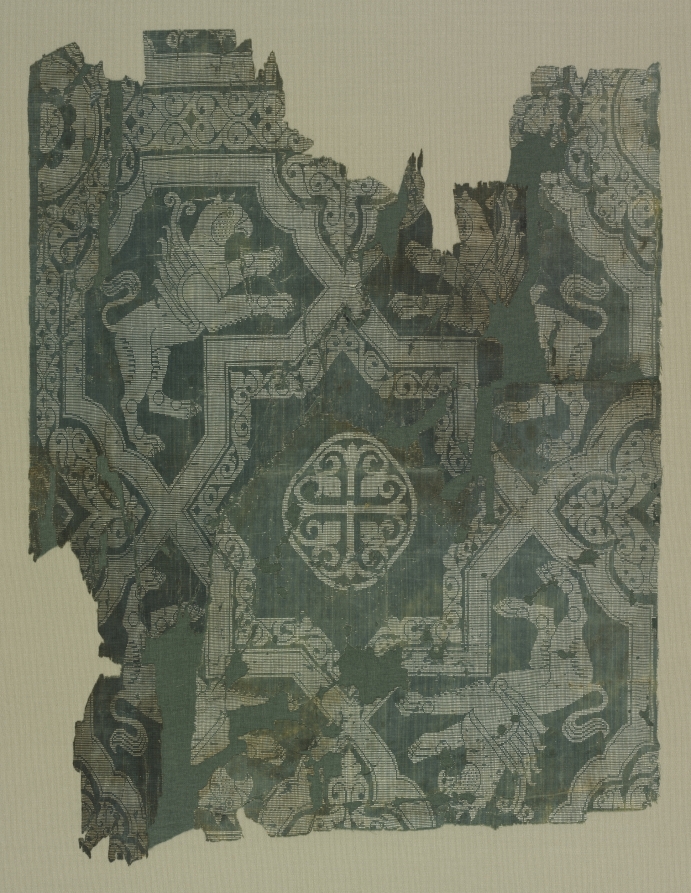
Fragment with Star Pattern and Griffins: A Study in Imperial Silk Weaving
Introduction: The Artifact and Its Provenance
This heritage research artifact examines a rare silk fragment, measuring approximately 18 by 24 inches, featuring a repeating star pattern interspersed with stylized griffins. The materiality—silk—immediately signals its origins within the highest echelons of imperial textile production. Silk, as a medium, was not merely a fabric but a statement of power, wealth, and cultural sophistication. In the context of imperial silk weaving, this fragment likely dates to the late 16th or early 17th century, a period when the Ottoman, Safavid, and Mughal empires competed to produce the most exquisite silks for courtly and ceremonial use. The fragment’s star pattern, a motif deeply rooted in celestial symbolism, and the griffins, mythical guardians of treasure and divine power, suggest a commission for a royal audience—perhaps a robe, a cushion cover, or a wall hanging for a palace interior.
The legacy of imperial silk weaving is one of unparalleled craftsmanship, where the loom became a tool of statecraft. This fragment, with its intricate design and fine silk warp and weft, embodies the technical mastery of weavers who operated under the patronage of emperors. The star pattern, often associated with the heavens and divine order, reflects the ruler’s aspiration to be seen as a cosmic mediator. The griffins, combining the strength of a lion and the vigilance of an eagle, reinforce themes of protection and sovereignty. Together, these elements create a visual language that transcends mere decoration, serving as a heraldic emblem of imperial authority.
Materiality and Craftsmanship: The Silk Threads of Empire
The materiality of this fragment is its most telling attribute. Silk, derived from the cocoons of Bombyx mori silkworms, was a luxury commodity that traveled along the Silk Road, connecting East and West. In imperial workshops, such as those in Bursa, Isfahan, or Lahore, silk was dyed with natural pigments—crimson from cochineal, indigo from woad, and gold from metallic threads—to achieve the luminous hues that characterize this fragment. The weave structure, likely a lampas or compound twill, allowed for the simultaneous display of multiple colors, creating a rich, textured surface that catches light differently with each movement. The star pattern, executed in a repeating geometric grid, required precise alignment of the warp threads, a feat achieved through the use of drawlooms operated by master weavers and their apprentices.
The griffins, rendered in a stylized, almost heraldic form, are woven with a subtle asymmetry that suggests the weaver’s hand. The silk’s warp-faced structure ensures that the design remains crisp, with the griffins’ wings and claws delineated by contrasting weft threads. The star pattern, composed of eight-pointed stars, is a motif that appears across Islamic and Byzantine art, symbolizing the eight gates of paradise or the celestial spheres. This fragment, however, introduces a dynamic tension: the griffins, grounded in myth, are juxtaposed against the stars’ cosmic order, creating a narrative of earthly power intertwined with divine favor. The silk’s condition—slight fading in the crimson areas and minor fraying at the edges—indicates use and age, yet the integrity of the weave remains intact, a testament to the durability of imperial silk.
Contextual Legacy: Imperial Silk Weaving as Cultural Capital
The legacy of imperial silk weaving extends beyond the loom. This fragment is a physical record of the cultural and economic systems that sustained empires. In the Ottoman Empire, silk weaving was concentrated in Bursa, where the imperial khan (caravanserai) housed workshops that produced silks for the sultan’s court. The star pattern, often used in kaftans and sashes, was a symbol of the sultan’s role as the shadow of God on earth. Similarly, in Safavid Iran, silk weaving reached its zenith under Shah Abbas I, who established royal workshops in Isfahan to produce silks for diplomatic gifts and ceremonial robes. The griffin motif, with its roots in Persian mythology as the huma (a bird of fortune), was a popular emblem of royal legitimacy. In Mughal India, silk weaving flourished under Emperor Akbar, who patronized weavers from Persia and Central Asia, blending Islamic and Hindu motifs into a unique aesthetic. The star pattern and griffins in this fragment may reflect this syncretism, combining celestial and mythological elements to appeal to a diverse court.
The economic significance of imperial silk weaving cannot be overstated. Silk was a currency of diplomacy, exchanged as gifts between rulers to forge alliances or demonstrate superiority. This fragment, with its high-quality silk and complex design, would have been a prized possession, perhaps stored in a treasury or worn during state ceremonies. The legacy of this craft is also one of labor: the weavers, often anonymous, were skilled artisans who passed down techniques through generations. Their knowledge of dyeing, warping, and weaving was a form of intangible heritage that sustained the industry. Today, this fragment serves as a tangible link to that legacy, offering insights into the aesthetic preferences, technological capabilities, and political ambitions of imperial courts.
Conclusion: The Fragment as a Living Document
In the London Savile Row tradition of bespoke craftsmanship, this silk fragment is a masterclass in precision and artistry. The star pattern and griffins are not merely decorative; they are a coded language of power, faith, and identity. As a heritage research artifact, it demands a multidisciplinary approach—combining textile analysis, art history, and material culture studies—to fully appreciate its significance. The silk’s materiality, from its dye sources to its weave structure, tells a story of global trade and local innovation. The context of imperial silk weaving reminds us that such fragments are not relics of a bygone era but living documents that continue to inform contemporary design and luxury. For the modern connoisseur, this fragment is a reminder that true heritage lies not in the object itself but in the hands that wove it, the eyes that admired it, and the cultures that cherished it. In preserving and studying such artifacts, we honor the legacy of imperial silk weaving—a legacy that, like the griffins guarding the stars, endures through time.