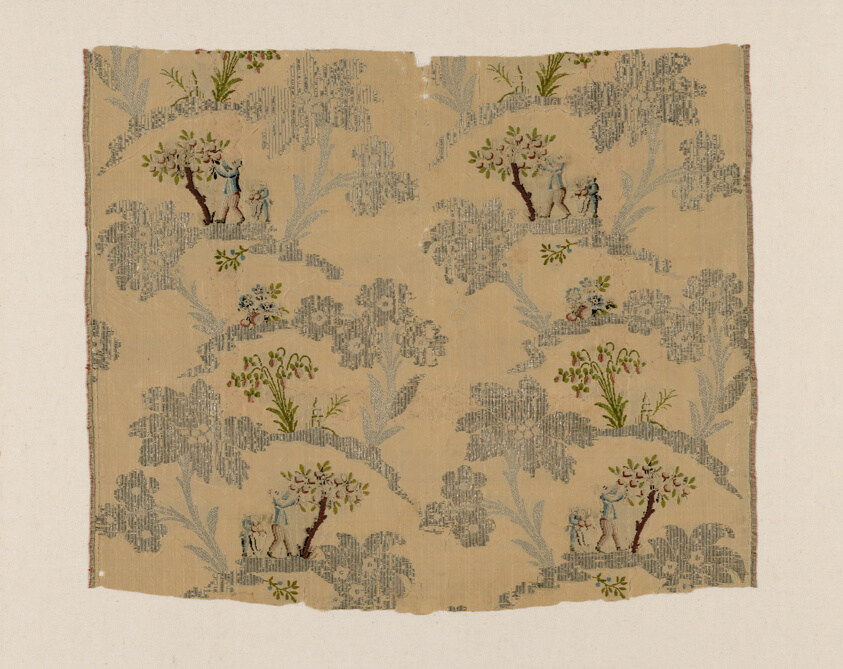
A Fragmentary Discourse on Excellence
To consider the fragment is to engage with a fundamental truth of our craft: that integrity of construction reveals itself at every scale, and that true quality is indivisible. A garment, in its finished splendour, speaks to the client in the language of silhouette and drape. But we, as custodians of a sartorial tradition, must listen to a more granular dialect. The submitted artifact—a fragment of silk brocade, incorporating silvered-metal strips—provides such a conversation. It is a forensic exhibit, a testament to principles that transcend time and trend.
Deconstruction of a Principle: Material Alliance
The foundation, as ever, is cloth. Here, a weft-rib plain weave of silk establishes the ground. This is not a mere substrate; the rib provides a subtle, inherent texture and a resilient body, a canvas with its own quiet authority. Upon this, the narrative is elaborated. The supplementary brocading wefts and patterning wefts are not applied after the fact; they are integral to the structure, woven into the very being of the fabric. This is the first, and perhaps most critical, lesson: ornamentation must be structural, not superficial.
The materials in concert—silk and silvered-metal—present a study in harmonious contrast. The silk, organic and hygroscopic, possesses a fluid elegance, a capacity for soft, luminous reflection. The silvered-metal strips, whether used independently or wrapped about a silk core, introduce a element of disciplined rigour. Their reflection is sharp, declarative. Together, they achieve a balance of suppleness and splendour, of movement and fixed light. The metal, for all its apparent austerity, is pliant enough to be woven; the silk, for all its softness, is robust enough to bear the partnership. This is a material alliance negotiated with profound understanding, resulting in a composite entity greater than the sum of its parts.
The Architecture of the Weave: A Matter of Tension and Release
Examining the fragment’s technical disposition—the weft-rib plain weave with supplementary brocading wefts—one is drawn to the mechanical poetry of its creation. The loom’s operation is a precise ballet of tension and release. The foundational weave establishes a regular, reliable rhythm. Into this rhythm, the brocading wefts are introduced, not as interruptions, but as controlled elaborations. They float across specific warps to create the pattern, their path dictated by a pre-meditated, artistic logic as exacting as any bespoke paper pattern.
This method stands in stark opposition to later, cheaper expediencies like surface embroidery or appliqué. Here, the pattern is not *on* the cloth; it *is* the cloth. The integrity of the ground is never compromised; it is instead enhanced, its strength leveraged to support the decorative scheme. The result is a fabric of singular cohesion, where the risk of embellishment detaching or distorting the base is nullified by the unity of construction. The endurance of the design is guaranteed by the very method of its birth.
Patina and Provenance: The Silence of the Fragment
A full garment declares its provenance through cut, label, and the unmistakable impression it leaves upon the wearer and observer. A fragment is more circumspect. Its provenance is encoded in the patience of its weave, in the quality of its materials now softened by time, and in the very fact of its survival. The silk, though possibly fragile at the edges, retains a memory of its loft and handle. The silvered metal, perhaps tarnished in places, speaks of atmosphere and age, its matte passages contrasting with the brighter highlights—a natural antiquing no chemical process can authentically replicate.
This fragment, devoid of context, becomes a universal exemplar. It could hail from an 18th-century French court waistcoat, a 1930s evening cape, or a contemporary haute couture bodice. Its value lies not in a specific date, but in its demonstration of perennial principles: the right materials, worked with correct technique, yield an object of timeless beauty and resilience. It is a physical manifesto stating that luxury is not an aesthetic but a methodology.
Conclusion: The Fragment as a Bespoke Proposition
For the modern atelier, this artifact is not a relic but a reference. It champions an ethos where fabric development is seen as an extension of tailoring. The dialogue between the soft and the hard, the pliant and the precise, mirrors the tailor’s own interplay between canvas and cloth, structure and flow. The fragment’s fluid elegance is not accidental; it is engineered, woven into existence with intent.
Therefore, let this fragment be displayed not as a museum piece behind glass, but as a standard in the cutting room. Let it remind us that before a single line is chalked, the character of the cloth is paramount. That the most exquisite cut can be undermined by inferior materials, just as the finest materials can be rendered gauche by poor construction. In its silence, this swatch of silk and silver speaks volumes. It articulates a creed of integral beauty, where every element, from the smallest weft to the overarching design, is committed to a singular, enduring purpose. This is not merely heritage; it is the ongoing blueprint for excellence.