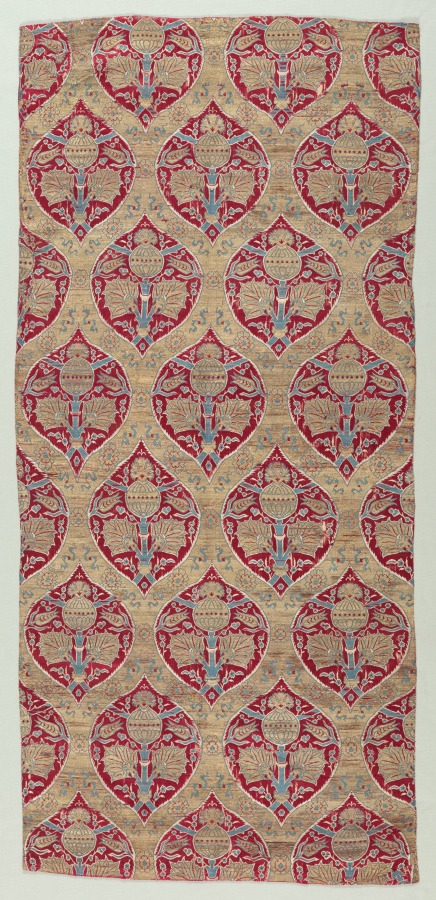
The Ogival Lattice: A Cartography of Imperial Order in Woven Silk
To consider the ogival lattice in silk is to engage not merely with a decorative motif, but with a profound articulation of imperial ideology, rendered in the most supple and demanding of mediums. It represents a confluence of mathematical precision, botanical observation, and sovereign assertion—a quiet manifesto of control and harmony, expressed through the shuttle and the loom. The horizontal iteration of this design, in particular, transforms the fabric into a heraldic landscape, a mapped territory of cultivated beauty under the aegis of imperial patronage.
The Architecture of the Motif: From Pointed Arch to Woven Empire
The term ‘ogival’ derives, of course, from architecture—the pointed arch, that soaring emblem of Gothic aspiration. Its translation into textile design was neither accidental nor purely aesthetic. It signified a transfer of symbolic capital from the immutable stone of cathedral and palace to the fluid, wearable silk of court and ceremony. The arch, in its woven form, becomes a contained, repeatable unit of space—a niche, a portal, a defined field. Within this architecturally-derived framework, the lattice is installed. This is not a random trellis, but a deliberate grid, a geometric ordering of nature. It creates a series of identical, sovereign compartments, each awaiting its inhabitant.
The horizontal emphasis of the design is of critical import. Unlike a vertical repeat, which suggests ascent and hierarchy, a strong horizontal progression speaks of expanse, continuity, and stability. It maps the fabric as a domain, unfurling laterally like a scroll of surveyed land. Within each ogival compartment, framed by the lattice, the flora is arranged—highly stylised blossoms, perhaps peonies for wealth and honour, or lotus for purity, their stems and leaves conforming to the gracious curve of the arch. Nature is present, but nature curated, disciplined, and contained by the imperial hand. The silk becomes a testament to the empire’s ability to impose a benevolent, beautiful order upon the organic world.
Materiality as Message: The Sovereign Medium
The execution of this complex cartography in silk is non-negotiable. Lesser fabrics could not bear the weight of such symbolism. Silk, from its mythic origins in the Imperial Chinese courts, was the prerogative of power. Its production—the meticulous cultivation of the mulberry grove, the patient rearing of the silkworm, the intricate reeling of the filament, and finally, the mastery of the draw-loom—was itself a mirror of the ordered, stratified society that produced it. The horizontal ogival lattice, often realised in damask or lampas weaves, exploits the very physics of silk: the way light cascades across the contrasting satin and tabby surfaces, making the pattern emerge and recede with the wearer’s movement. This is a living, kinetic art.
The design demanded the most skilled artisans, organised within imperial or princely workshops. The creation of the pattern chain, the programming of the loom, was an act of high technical intellect. To weave it was an exercise in sustained concentration. Thus, the finished bolt of cloth is a material archive of specialised labour, state-sponsored infrastructure, and artistic tradition—a concentration of capital and knowledge as dense as the motif it displays. Wearing or displaying such silk was never simply about adornment; it was a direct, tactile communication of one’s position within, or allegiance to, that powerful system of production and meaning.
A Legacy in the Lateral: From Imperial Looms to Modern Consciousness
The legacy of this imperial silk weaving tradition, as embodied by the horizontal ogival lattice, is one of enduring grammar. It established a visual syntax for luxury—one where complexity serves harmony, and where beauty is inseparable from intellectual structure. We see its echoes not in literal reproduction, but in the principles it enshrined: the dignity of the repeat, the authority of the geometric frame, the elevation of craft to the level of high art.
In a contemporary context, to engage with such an artifact is to understand that true luxury resides in this depth of narrative and execution. It is a reminder that the most sophisticated designs are often those that balance fluidity with rigour, that create rhythm through restraint. The horizontal flow of the ogival lattice teaches a lesson in composed grandeur. It does not shout; it unfolds. It asserts not through blatant display, but through the quiet, undeniable authority of perfect, considered order—an order woven, quite literally, into the very fibre of the cloth.
Therefore, this silk specimen is more than a relic. It is a benchmark. It represents a pinnacle where material, motif, and meaning were in absolute alignment, serving a vision of world-ordering civilisation. To analyse it is to appreciate that the most potent heritage is that which provides not just a pattern to copy, but a philosophy of making to comprehend—a philosophy where every line, every intersection, and every shimmering surface is an integral part of a vast, woven declaration of empire.