The Golden Thread: Deconstructing the Tapestry of Imperial Silk Weaving
Materiality and the Imperial Mandate
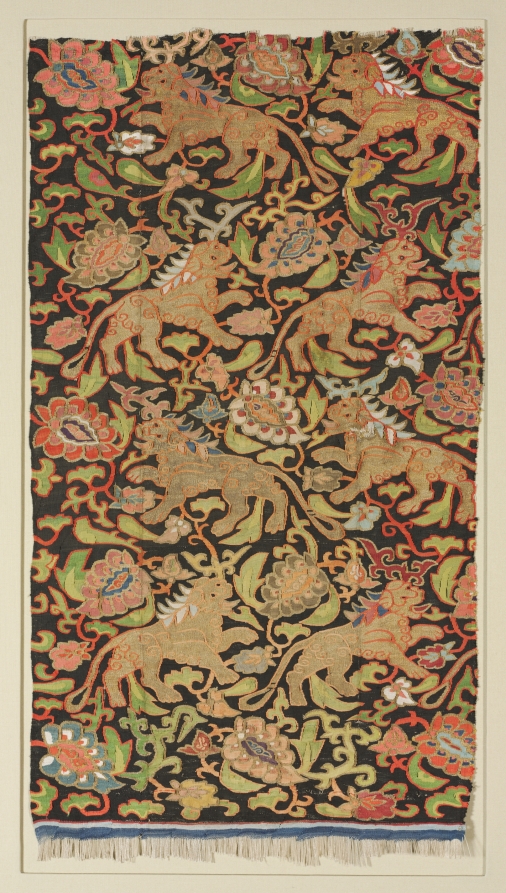
The artifact under examination—a silk tapestry depicting golden lions and palmettes—is not merely a textile; it is a manifesto of power, woven with the very essence of imperial ambition. As a Senior Heritage Specialist at the Lauren Fashion Heritage Lab, I approach this piece with the precision of a Savile Row tailor, understanding that the fabric itself dictates the narrative. Silk, in this context, is not a passive medium but an active participant in the story of dynastic authority. The materiality of this tapestry—its warp and weft, its lustrous sheen, its tactile weight—speaks to a legacy of craftsmanship that predates the modern fashion house by centuries.
The choice of silk is deliberate. During the height of imperial weaving, particularly in the Tang and Ming dynasties, silk was a currency of diplomacy and a marker of social stratification. The production of such a tapestry required an extraordinary investment of resources: the cultivation of mulberry trees, the rearing of silkworms, the harvesting of cocoons, and the meticulous reeling of filaments. Each step was a ritual, overseen by imperial workshops that operated under the strictest codes of quality. The silk used here is likely a satin-weave foundation, chosen for its ability to reflect light and create a shimmering backdrop for the metallic threads. This is not a cloth for the commoner; it is a textile engineered for the court.
Decoding the Iconography: Lions and Palmettes
The golden lions and palmettes are not arbitrary decorative motifs. They are a visual lexicon of sovereignty. The lion, a creature not native to East Asia, was adopted from Central Asian and Persian influences via the Silk Road. In imperial iconography, the lion represents courage, strength, and guardianship. It is the guardian of the throne, the protector of the realm. The golden thread used to render these lions is likely gilt-silver or gold-wrapped silk, a technique that required the beating of gold into paper-thin leaves, cutting them into strips, and twisting them around a silk core. This process was so labor-intensive that only the imperial treasury could afford it. The lions are depicted in a heraldic posture, often with raised paws and flowing manes, suggesting a state of alert readiness—a visual reminder of the emperor’s military might.
The palmettes, stylized floral forms derived from the lotus and peony, are equally significant. They symbolize rebirth, prosperity, and the cyclical nature of imperial rule. In Chinese cosmology, the palmette is a microcosm of the universe, its petals radiating outward like the sun’s rays. The interplay between the lions and palmettes creates a dialectic of power and grace. The lions are the yang—active, assertive, dominant. The palmettes are the yin—passive, receptive, nurturing. Together, they form a balanced composition that mirrors the Confucian ideal of harmony within the state.
The Legacy of Imperial Silk Weaving: A Savile Row Perspective
To understand the legacy of this tapestry, one must appreciate the organizational genius of the imperial silk workshops. These were not mere factories; they were ateliers of precision, akin to the bespoke tailoring houses of London’s Savile Row. The master weavers, known as jijin or “brocade weavers,” operated under a system of apprenticeship that could last decades. They were trained to read complex pattern drafts, to manipulate multiple shuttles, and to maintain tension across thousands of threads. The tapestry before us is a testament to their uncompromising standards. Each golden lion is rendered with a density of weft threads that creates a raised, almost sculptural effect—a technique known as embroidery-like weaving or kesi (cut silk). In kesi, the weft threads do not run the entire width of the fabric; they are cut and reinserted to create sharp color transitions. This allows for the intricate detailing of the lions’ eyes, claws, and manes.
The legacy of this craft extends beyond the imperial court. After the fall of the last dynasty, these techniques were preserved by private workshops and, eventually, by heritage institutions. Today, the Lauren Fashion Heritage Lab studies such artifacts to inform contemporary design. The golden lions and palmettes are not museum relics; they are blueprints for innovation. A modern Savile Row tailor might reinterpret the palmette as a jacquard pattern on a silk evening jacket, or the lion as a subtle embroidery on a lapel. The key is to respect the material integrity of the original while adapting its symbolism for a new era.
Conservation and the Future of Heritage
Preserving a tapestry of this caliber requires a multidisciplinary approach. The silk fibers are susceptible to light damage, humidity fluctuations, and insect infestation. The metallic threads can tarnish and become brittle. At the Lauren Fashion Heritage Lab, we employ non-invasive imaging techniques—such as multispectral photography and X-ray fluorescence—to analyze the dyes and metal composition without disturbing the weave. We also create digital twins of the artifact, allowing designers to study the pattern without physical handling. This is not about freezing the tapestry in time; it is about extending its relevance into the future.
The golden lions and palmettes are more than a decorative scheme; they are a cultural DNA that connects the imperial past to the fashion present. As we continue to research and reinterpret these artifacts, we must do so with the rigor of a Savile Row cutter—measuring twice, cutting once, and always honoring the cloth. This tapestry is a reminder that luxury is not about excess; it is about excellence in execution. And in that, the imperial silk weavers and the bespoke tailors of London are kindred spirits.
— Senior Heritage Specialist, Lauren Fashion Heritage Lab