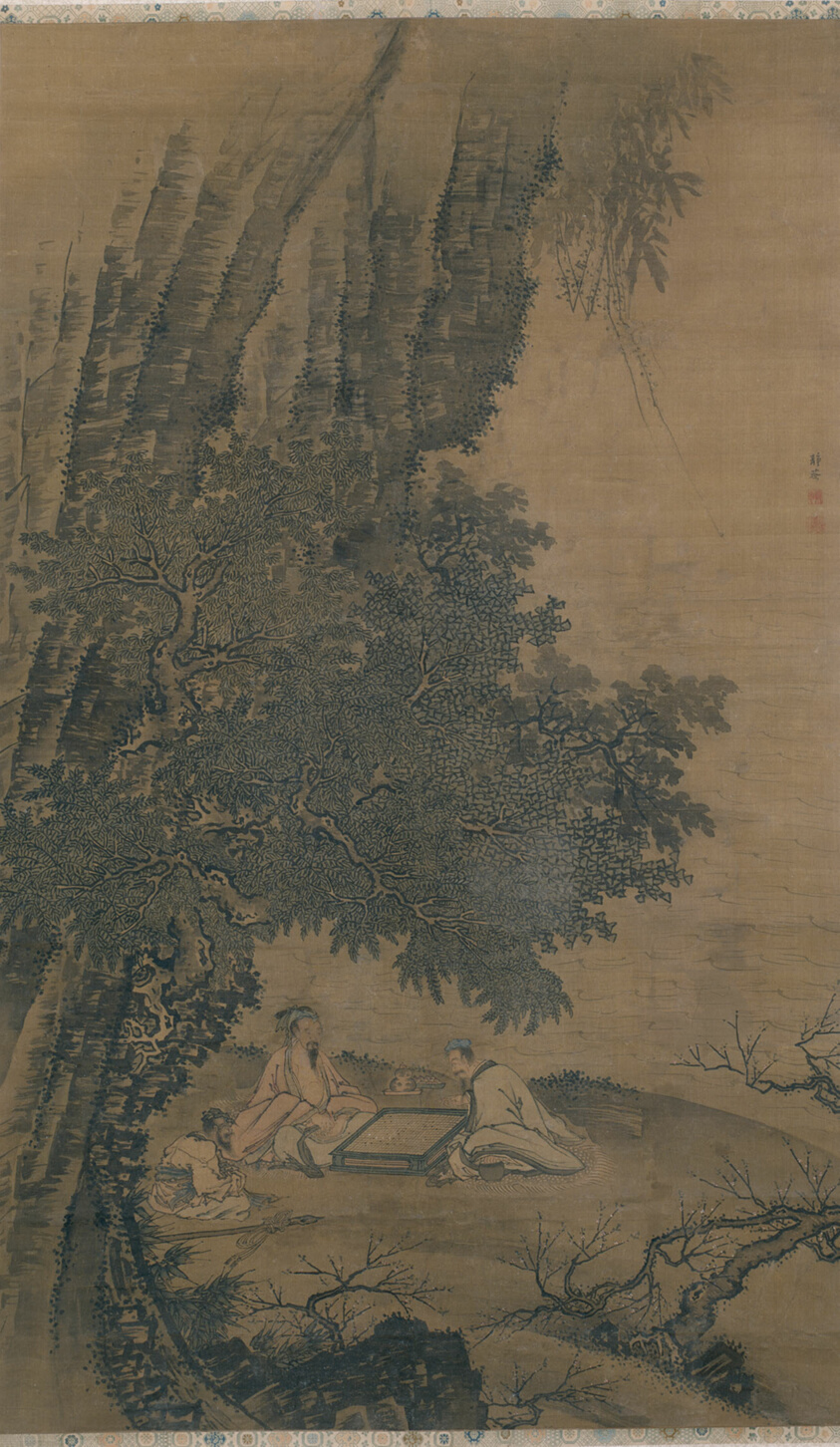
The Artifact as a Confluence of Craft and Philosophy
In the hallowed corridors of heritage preservation, where the tactile memory of luxury converges with the intellectual rigor of historical inquiry, we encounter a singular artifact: Landscape with Daoist Immortals Playing Weiqi. This hanging scroll, executed in ink and colors on silk, is not merely a decorative object; it is a testament to the symbiotic relationship between material mastery and metaphysical aspiration. As a Senior Heritage Specialist for the Lauren Fashion Heritage Lab, I approach this piece through the lens of materiality—specifically, the silk substrate—as the foundational narrative that elevates the painting from a visual representation to a tactile and philosophical experience. The scroll embodies the quintessence of classic silk craftsmanship, where fluid elegance is not an afterthought but the very medium through which the Daoist ideal of harmonious transcendence is rendered tangible.
The Silk Substrate: A Foundation of Prestige and Precision
Silk, as a material, has long been synonymous with refinement, durability, and a certain ethereal luminosity that no other textile can replicate. In the context of this hanging scroll, the silk serves as both a canvas and a collaborator. The weavers of this era—likely from the renowned workshops of Suzhou or Hangzhou—achieved a density and uniformity that allowed for the absorption of ink and mineral pigments without compromising the fabric’s inherent sheen. The warp and weft are so finely calibrated that the silk appears almost liquid, a quality that the artist exploits to evoke mist, water, and the transient boundaries between the mortal and immortal realms. This is not a passive support; it is an active participant in the visual dialogue. The ink, when applied, does not sit on the surface but rather melds with the silk’s fibers, creating a depth that mimics the layered atmospheres of a Daoist landscape. The colors—vermillion, azurite, malachite green—are ground from minerals and bound with animal glue, their opacity contrasting with the silk’s translucency to produce a shimmering effect that shifts with ambient light. This materiality is the first lesson in heritage: that the object’s physical composition dictates its aesthetic and symbolic potential.
Weiqi as a Metaphor for Strategic Harmony
The subject matter—Daoist immortals engaged in a game of weiqi, or Go—is a masterstroke of conceptual alignment with the silk medium. Weiqi, an ancient board game of strategy, is predicated on the balance of opposing forces, the ebb and flow of territory, and the pursuit of equilibrium through calculated moves. Similarly, the silk scroll demands a balance between the fluidity of the brushstroke and the rigidity of the weave. The immortals, depicted with elongated limbs and serene expressions, are not merely playing a game; they are enacting a microcosm of the Daoist principle of wu wei, or effortless action. Their robes, painted with sweeping, continuous lines, echo the silk’s own drape, while the weiqi board—a grid of black and white stones—mirrors the binary nature of ink on silk: light and dark, presence and absence. The landscape surrounding them—craggy peaks, twisted pines, and cascading waterfalls—is rendered with a calligraphic economy that respects the silk’s tensile strength. The artist has avoided overworking the surface, allowing the silk’s natural texture to suggest the roughness of stone or the softness of clouds. This restraint is a hallmark of classic silk craftsmanship, where the material is never subjugated but rather guided.
The Hanging Scroll Format: A Ritual of Unfurling
The scroll’s format—a hanging scroll, or kakejiku—further amplifies its material and symbolic significance. Unlike a framed painting, which is static and fixed, a hanging scroll is an object of ritualized viewing. It is stored rolled, protected by a silk brocade border, and unfurled only for contemplation. This act of unfurling is a physical engagement with the silk’s flexibility and memory. The scroll’s mounting, typically composed of multiple layers of silk and paper, ensures that the painting remains taut yet supple, resisting the brittleness that can afflict aged textiles. The top and bottom rollers, often made of sandalwood or jade, add weight and balance, while the silk cords and tassels provide a tactile counterpoint to the painted surface. In the context of a Savile Row sensibility—where tailoring is about the cut, the cloth, and the wearer’s relationship to the garment—the hanging scroll is a bespoke object. It is tailored to its environment, designed to be hung in a scholar’s studio or a monastic hall, where the interplay of light and shadow would animate the silk’s surface. The immortals, frozen in their eternal game, become companions to the viewer, their weiqi stones a silent invitation to ponder the strategic harmonies of existence.
Preservation and the Legacy of Silk
From a conservation standpoint, this artifact presents both challenges and opportunities. Silk is hygroscopic, sensitive to light, and prone to oxidation. The mineral pigments, while stable, can flake if the silk loses its flexibility. Our role at the Lauren Fashion Heritage Lab is to ensure that the material integrity of the scroll is preserved for future generations, not as a static relic but as a living document of craftsmanship. This involves controlled humidity, UV-filtered lighting, and periodic remounting using traditional techniques. The scroll’s silk is a repository of knowledge—the weaver’s skill, the painter’s hand, and the collector’s reverence. It is a reminder that heritage is not merely about the past but about the continuity of practice. The Daoist immortals, in their timeless game, embody this continuity. They play on, indifferent to the passage of centuries, while the silk that bears their image holds the memory of every unfurling, every gaze, every breath of air that has touched its surface.
Conclusion: The Enduring Dialogue
Landscape with Daoist Immortals Playing Weiqi is, ultimately, a dialogue between material and meaning. The silk is not a neutral carrier but a resonant medium that amplifies the painting’s philosophical depth. Its fluid elegance mirrors the Daoist ideal of yielding strength, while its meticulous craftsmanship reflects the discipline required to achieve transcendence. For the heritage specialist, this artifact is a case study in how luxury—defined here as the marriage of rare materials and exceptional skill—can serve as a vessel for the most profound human inquiries. As we continue to study and preserve such objects, we honor not only the artists and artisans of the past but also the enduring power of silk to convey the ineffable. In the quiet space of a gallery, beneath the soft glow of conservation lighting, the immortals play on, their weiqi stones clicking against the board, a sound that echoes through the silk’s fibers and into the heart of our shared heritage.