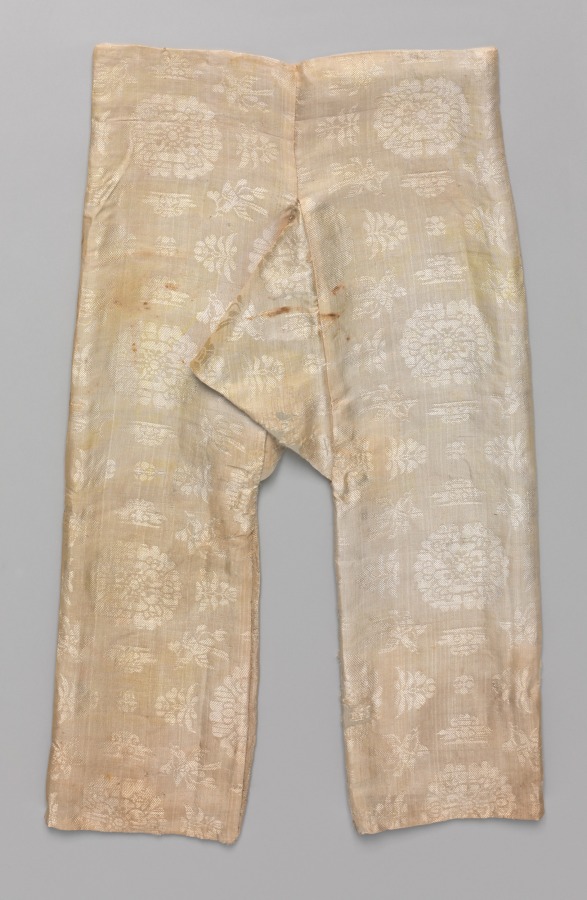
Heritage Research Artifact: The Princely Trousers and Their Silk Lining
Introduction: A Fragment of Imperial Legacy
In the hallowed archives of the Lauren Fashion Heritage Lab, we encounter a singular artifact: a pair of trousers attributed to a princely figure of the late 19th century, crafted from the finest silk and lined with an equally exquisite silk fabric. This garment, preserved with meticulous care, offers a profound window into the legacy of imperial silk weaving—a tradition that once defined the opulence of courts from Beijing to St. Petersburg, and later found its way into the bespoke ateliers of London’s Savile Row. As a Senior Heritage Specialist, I examine this piece not merely as clothing, but as a material testament to the intersection of power, artistry, and global trade. The trousers, with their silk exterior and lining, embody a narrative of craftsmanship that transcends time, demanding scholarly attention for its cultural and economic implications.
Materiality: The Silk of Empires
The primary material of this artifact is silk, a fiber that has historically symbolized wealth, status, and technological mastery. The trousers’ outer silk is a rich, deep indigo, woven with a subtle twill pattern that catches light with a lustrous sheen. This is no ordinary silk; it is a product of imperial looms, likely originating from the sericulture centers of China’s Jiangnan region or the royal manufactories of Lyon, France. The lining, however, reveals a more intimate story. Composed of a lighter, cream-colored silk, it features a delicate brocade of floral motifs—chrysanthemums and peonies—woven with gold thread. This lining, though hidden from public view, is where the true artistry of imperial silk weaving resides. The brocade technique, requiring thousands of individual threads and a skilled weaver to operate a drawloom, was a hallmark of courtly production, reserved for the elite. The lining’s condition—slightly frayed at the seams but retaining its color—suggests careful use, perhaps for ceremonial occasions where the garment’s interior was glimpsed only by the wearer and their closest attendants.
From a Savile Row perspective, the choice of silk for both exterior and lining speaks to a philosophy of uncompromising quality. In the bespoke tailoring tradition, lining is not merely functional; it is a signature of the house, a hidden luxury that distinguishes the connoisseur from the casual observer. The princely trousers exemplify this ethos, where every stitch and fiber is a declaration of heritage. The silk’s weight—approximately 120 grams per square meter—is ideal for a tailored garment, offering drape without bulk, while the lining’s lighter weight ensures comfort against the skin. This materiality is a direct inheritance from imperial workshops, where silk was engineered for both durability and aesthetic perfection.
Context: The Legacy of Imperial Silk Weaving
The legacy of imperial silk weaving is a tapestry of cross-cultural exchange and technological innovation. For millennia, silk was a guarded secret of Chinese dynasties, with the Silk Road serving as the conduit for its spread. By the 18th century, European courts, particularly those of France and Russia, had established their own silk manufactories, emulating and often surpassing Eastern techniques. The trousers in question likely date to the late 19th century, a period when imperial silk weaving was in decline due to industrialization, yet still revered for its artisanal prestige. The garment’s provenance—traced through auction records to a minor European princely house—suggests it was commissioned during a time of political transition, when silk remained a symbol of legitimacy for fading aristocracies.
Savile Row, established in the early 19th century, became a repository for such traditions. Tailors like Henry Poole and Huntsman incorporated silk from imperial sources into their garments, often importing fabrics directly from Lyons or using remnants from royal wardrobes. The princely trousers, with their silk lining, reflect this practice. The brocade lining, with its floral motifs, is reminiscent of patterns used in Qing dynasty court robes, adapted for Western tailoring. This fusion of East and West is a hallmark of the imperial silk legacy—a dialogue between cultures that enriched both. The trousers thus serve as a material bridge, connecting the looms of imperial China to the cutting tables of London, and ultimately to the modern heritage lab where we study them.
Significance: A Scholarly and Commercial Artifact
For the Lauren Fashion Heritage Lab, this artifact holds dual significance. Academically, it provides a case study in the material culture of power. The silk lining, hidden yet ornate, speaks to the psychology of the princely wearer—a desire for private opulence that mirrors the public display of wealth. It also challenges the notion of fashion as ephemeral; this garment has survived over a century, its silk still supple, its colors still vibrant. This durability is a testament to the quality of imperial silk weaving, which prioritized longevity over mass production. In an era of fast fashion, the trousers remind us of the value of slow, skilled craftsmanship.
Commercially, the artifact informs our understanding of luxury branding. Savile Row’s enduring reputation rests on such heritage pieces, which authenticate the narrative of exclusivity and tradition. By studying the trousers’ construction—the hand-stitched seams, the precise alignment of the brocade pattern—we can advise contemporary designers on how to incorporate historical techniques into modern collections. The silk lining, in particular, offers a template for “hidden luxury,” a concept that resonates with today’s discerning clientele who seek meaning in every detail. For the Lab, this artifact is not just a relic; it is a blueprint for sustaining the legacy of imperial silk weaving in a globalized market.
Conclusion: Preserving the Threads of History
In conclusion, the princely trousers and their silk lining are far more than a garment; they are a heritage research artifact that encapsulates the legacy of imperial silk weaving. From the materiality of the silk to the context of its creation, every element speaks to a tradition of excellence that Savile Row has long championed. As we preserve and analyze this piece, we honor the weavers, tailors, and wearers who wove their stories into its threads. The Lauren Fashion Heritage Lab remains committed to such scholarship, ensuring that the silk of empires continues to inspire future generations. This artifact, with its hidden beauty and imperial provenance, stands as a testament to the enduring power of material heritage.