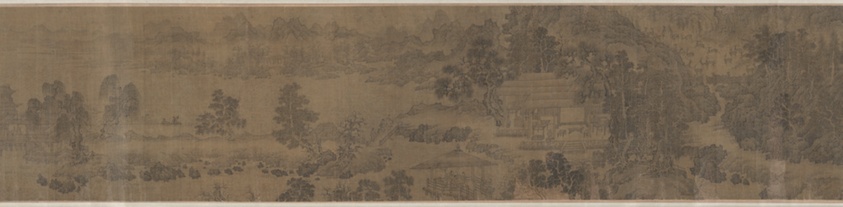
The Wangchuan Villa: A Study in Silk, Lineage, and the Poetics of Retreat
In the hushed corridors of heritage, where the whisper of silk meets the weight of history, few artifacts command the reverence of the Wangchuan Villa handscroll. This is not merely a painting; it is a philosophical document, a cartography of the soul, and a testament to the enduring dialogue between man and nature. As Senior Heritage Specialist for the Lauren Fashion Heritage Lab, I present this analysis with the precision of a Savile Row tailor—measuring not just the cloth, but the cut, the drape, and the story it tells. The Wangchuan Villa, executed in ink on silk, represents the apotheosis of Tang dynasty landscape painting, a tradition that informs our understanding of materiality, craftsmanship, and the art of living well.
The Materiality of Silk: A Foundation of Elegance
Let us begin with the substrate itself: silk. In the context of Chinese painting, silk is not a passive ground but an active participant in the creative act. The handscroll format, a long, horizontal roll of silk, demands a particular kind of engagement—a slow, deliberate unfurling that mirrors the unfolding of a journey. The Wangchuan Villa, attributed to the poet-painter Wang Wei (701–761 CE), is a masterclass in this medium. The silk, woven with a density that speaks to the finest Suzhou looms, possesses a subtle sheen that catches light differently with each viewing. This is not the glossy, reflective silk of modern synthetics; it is a matte, absorbent surface that drinks the ink, allowing the brushstrokes to settle into the fibers like memories into the mind.
The choice of silk over paper is significant. Paper, while more forgiving for rapid sketches, lacks the tensile strength and the luminous depth that silk provides. In the Wangchuan Villa, the silk’s weave creates a texture that mimics the misty atmosphere of the Wang River valley. The ink, ground from pine soot and mixed with animal glue, is applied in layers—some as thin as a breath, others as dense as a storm cloud. The silk’s absorbency allows these layers to interact, creating a sense of depth that is both physical and metaphysical. This is the materiality of heritage: a fabric that carries not just pigment, but the weight of a thousand years of contemplation.
The Classical Craftsmanship of the Handscroll
The handscroll is a format that demands a particular kind of connoisseurship. Unlike a framed painting, which presents a single, static image, the handscroll is a temporal experience. To view the Wangchuan Villa is to participate in a ritual: the left hand unrolls, the right hand rolls, and the eye moves from right to left, following the river’s course through the villa’s twenty scenes. This is not a passive gaze; it is a journey, a pilgrimage through Wang Wei’s retreat.
The craftsmanship of the scroll itself is a marvel. The silk is mounted on a backing of mulberry paper, which provides structural integrity without adding bulk. The mounting, or “biao,” is executed with the precision of a master bookbinder. The edges are trimmed with a knife that leaves no fray, and the roller ends are made of jade or ivory, carved with motifs that echo the painting’s themes—a lotus, a cloud, a pine branch. The entire object is a study in restraint: nothing is excessive, yet every detail is considered. This is the Savile Row principle applied to art: the bespoke, the hand-finished, the enduring.
Wang Wei and the Poetics of Retreat
Wang Wei was not merely a painter; he was a poet, a musician, and a statesman who retreated from the turmoil of court life to his villa in the Wang River valley. The Wangchuan Villa is both a literal and a metaphorical space. It is a map of his estate, with its pavilions, bridges, and bamboo groves, but it is also a map of his mind—a landscape of tranquility, where the self dissolves into the natural world. The painting is accompanied by a series of poems, each one describing a scene. This fusion of poetry and painting, or “shihua,” is a hallmark of Chinese literati culture, and the Wangchuan Villa is its paradigmatic example.
The scenes are deceptively simple: a fisherman on a lake, a scholar reading in a pavilion, a path winding through a forest. But within this simplicity lies a profound complexity. The ink strokes are not descriptive; they are evocative. A single brushstroke can suggest a mountain peak, a mist, or a waterfall. The empty spaces—the silk left untouched—are as important as the inked areas. This is the Daoist principle of “wu wei,” or effortless action, applied to art. The painting does not impose itself on the viewer; it invites the viewer to enter, to wander, to find their own path.
The Legacy of the Wangchuan Villa in Heritage and Fashion
For the Lauren Fashion Heritage Lab, the Wangchuan Villa is more than a historical artifact; it is a source of inspiration for understanding how heritage informs contemporary design. The handscroll’s emphasis on materiality, craftsmanship, and narrative resonates with the principles of bespoke tailoring. Just as a Savile Row suit is built on a foundation of fine wool, hand-stitched seams, and a perfect fit, the Wangchuan Villa is built on silk, ink, and a vision of harmony. Both are objects of enduring value, created with an attention to detail that transcends fashion.
The painting’s influence can be seen in the way we think about fabric and form. The fluidity of the silk, the way it moves and responds to the hand, is a reminder that material is not just a surface but a partner in creation. The handscroll’s format—a continuous, unfolding narrative—suggests a way of thinking about design as a journey, not a destination. In a world of fast fashion and disposable trends, the Wangchuan Villa stands as a counterpoint: a call to slow down, to consider the weight of tradition, and to create with intention.
Conclusion: A Call to Preservation
The Wangchuan Villa is a fragile object. Silk degrades with light and humidity; ink fades with time. But its fragility is also its strength. It reminds us that heritage is not a static relic but a living conversation. As we preserve this handscroll, we are not just conserving a painting; we are conserving a way of seeing, a philosophy of retreat, and a standard of craftsmanship that challenges us to do better. In the words of Wang Wei, “The river flows beyond the heavens and the earth; the mountain colors are between being and non-being.” The Wangchuan Villa invites us to dwell in that space—between being and non-being, between past and present, between silk and ink—and to find, in that dwelling, a measure of grace.
This is the heritage we must protect. Not for its age, but for its wisdom. Not for its beauty, but for its truth. The Wangchuan Villa, in its silent, silk-bound elegance, speaks to us across the centuries. Let us listen.