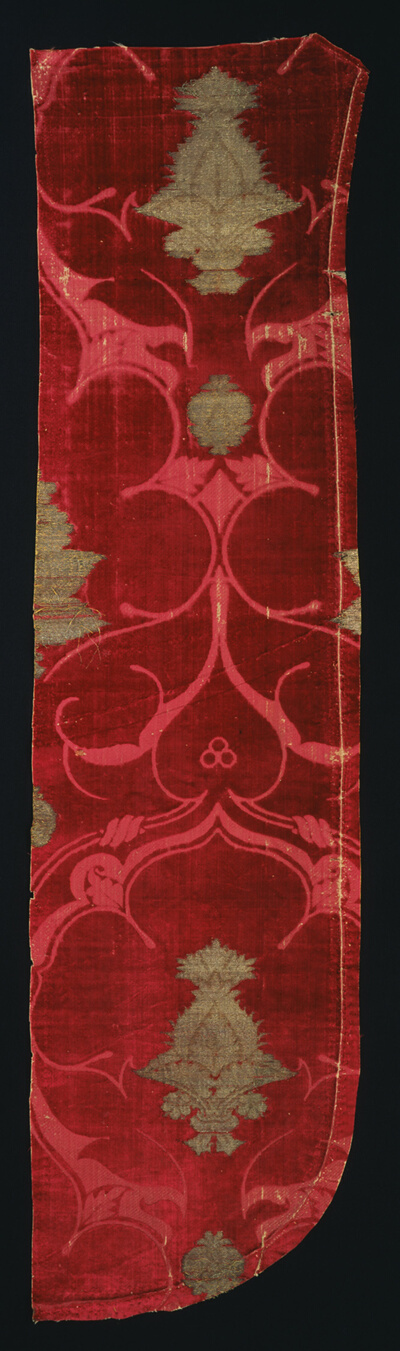
The Fragment as Testament: Deconstructing the Artifact of a Chasuble
Within the hallowed archives of the Lauren Fashion Heritage Lab, we encounter not merely a remnant of cloth, but a profound narrative encoded in silk and gilt. This fragment, excised from a chasuble—the outermost liturgical vestment worn by clergy during the Eucharist—represents a pinnacle of Renaissance textile artistry. It is a document of faith, power, and the relentless pursuit of perfection that defines the very ethos of Savile Row. To study this piece is to understand the language of luxury before the word was commodified; it is to read the grammar of a hand-loomed masterpiece that speaks of a time when cloth was the ultimate currency of status and devotion.
Materiality: The Alchemy of Silk and Metal
The physical composition of this fragment is a study in deliberate opulence. The ground fabric is a silk satin weave, a structure chosen for its luminous, unbroken surface—a canvas of light. Upon this, the artisan has introduced gilt-metal-strip-wrapped silk as supplementary brocading wefts. This is not mere decoration; it is an architectural intervention. The metal, flattened into gossamer-thin strips and wound around a silk core, is bound by the main warps in a twill interlacing. This technical choice is critical: the twill binding creates a subtle, diagonal ribbing that catches light differently from the satin ground, offering a visual counterpoint of texture and reflectivity. The gold does not sit flat; it moves, breathes, and shimmers with the wearer’s every gesture.
Yet, the most arresting feature is the cut, voided velvet. Here, supplementary pile warps rise from the ground, only to be sheared away in precise, negative spaces. The "voided" technique leaves the satin ground exposed in patterns, while the cut pile creates a dense, plush surface. This is a dialogue between height and depth, between the soft, tactile nap of the velvet and the hard, reflective gleam of the metal. The contrast is not accidental; it is a calculated tension, much like the interplay between a tailored jacket’s structured shoulder and the fluid drape of its lapel. The craftsmanship required to execute this on a handloom, with the precision of a master tailor’s basting stitch, is staggering. Each thread was a decision, each cut a commitment.
Context: The Liturgical and the Luxurious
To understand this fragment, we must contextualize its original purpose. The chasuble, derived from the Latin casula (little house), was the garment of the celebrant. It was worn during the most sacred moments of the Mass, a vestment that enveloped the priest in a cocoon of sacred symbolism. The silk and gold were not vanity; they were a visual theology. Gold thread represented the divine light of God; the rich silk, the purity of the Virgin. The voided velvet, with its interplay of presence and absence, could be read as a metaphor for the incarnation—the Word made flesh, the divine made tangible.
This artifact likely dates from the 15th or 16th century, a period when Italian and Flemish weaving centers—Florence, Venice, Bruges—produced textiles of such complexity that they were traded as diplomatic gifts, often worth more than the land they adorned. The chasuble from which this fragment came would have been commissioned by a wealthy patron—a cardinal, a merchant prince, a royal house. It was an object of immense financial and spiritual investment. The fact that it has been reduced to a fragment is a poignant reminder of the ravages of time, liturgical reform, and the pragmatic repurposing of sacred objects. Yet, in its fragmentation, it gains a new eloquence. It becomes a synecdoche, a part that stands for the whole, a whisper of the grandeur that once was.
Design Language: The Fluidity of Elegance
The design motifs, though now only partially visible, would have followed a rigorous logic. The voided velvet likely formed a pattern of pomegranates, thistles, or artichokes—symbols of fertility, resurrection, and eternal life. These forms would have been rendered with a fluid, almost calligraphic grace, their stems and leaves curving in a rhythm that mimics the natural world. The gilt-metal-strip brocading would have highlighted the central veins of leaves or the seeds of the fruit, creating a chiaroscuro effect of light and shadow. This is not a static pattern; it is a composition in motion, designed to be seen in the flickering candlelight of a cathedral, where the gold would catch the flames and the velvet would absorb the shadows.
This fluid elegance is the very quality that resonates with the Savile Row sensibility. A great suit is not a rigid structure; it is a second skin that moves with the body. The best tailoring understands the interplay of light and fabric, of texture and silhouette. This chasuble fragment embodies that same principle. The satin ground provides the foundation, the velvet offers depth, and the gold thread provides the accent—a lapel flower, a silk lining, a mother-of-pearl button. It is a lesson in restraint and excess, in knowing when to shine and when to recede.
Preservation and Legacy: The Artifact in the Archive
As a heritage specialist, I approach this fragment with a reverence that borders on the clinical. Its condition—the slight fraying at the edges, the loss of some pile, the tarnishing of the metal—is not a flaw but a feature. It is the patina of authenticity. The Lab’s role is not to restore it to a fictional original state, but to preserve its current truth. We store it in a climate-controlled, light-limited environment, mounted on acid-free board, its fibers supported by a backing of undyed silk organza. Every handling is documented, every fiber analyzed under polarized light microscopy to understand its dye composition (likely kermes for the red, woad or indigo for the blue, and weld for the yellow).
This fragment is a masterclass in material storytelling. It tells us about the global trade routes that brought silk from China, gold from Africa, and dyes from the Mediterranean. It tells us about the skill of the weaver, who could coordinate hundreds of warp threads to create a pattern that would take months to complete. It tells us about the patron who commissioned it, the priest who wore it, and the congregation who beheld it. In a world of fast fashion and disposable luxury, this fragment stands as a rebuke. It demands that we slow down, that we consider the weight of a thread, the cost of a color, the meaning of a pattern.
In the end, this is not just a piece of silk. It is a fragment of history, a relic of a time when cloth was the highest form of art. And in the hallowed halls of the Lauren Fashion Heritage Lab, it continues to teach us what true elegance—fluid, complex, and enduring—really means.