The Lampas of Saint Librada: A Testament to Imperial Silk Weaving
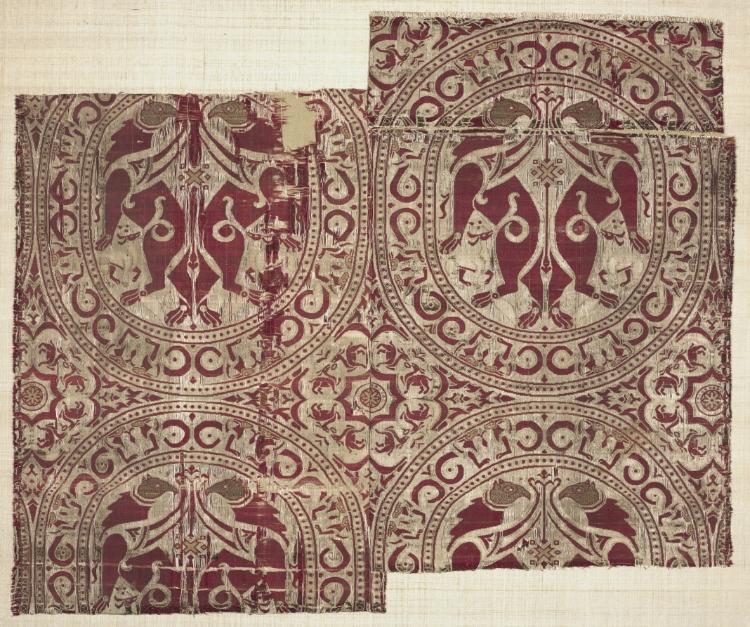
In the hushed, hallowed silence of the Sigüenza Cathedral, within the gilded confines of the Reliquary of Saint Librada, lies a fragment of textile history that speaks with the authority of empires. This is a lampas weave, executed in silk, featuring a repeating motif of griffins enclosed within intricate roundels. To the discerning eye of a heritage specialist, this is not merely a decorative fabric; it is a material document of power, trade, and the enduring legacy of imperial silk weaving. As a Senior Heritage Specialist at the Lauren Fashion Heritage Lab, I present this artifact as a case study in the confluence of artistic ambition, technical mastery, and the silent, enduring language of luxury.
Materiality and Technique: The Silk Lampas
The foundation of this artifact’s significance lies in its materiality. Silk, a fibre of unparalleled lustre and strength, was the currency of empires. In the medieval world, silk was not a commodity; it was a statement of sovereignty, a marker of divine right, and a tangible link to the exotic East. The lampas weave, a compound structure where a pattern weft floats over a ground weave to create a raised, almost sculptural design, was the pinnacle of this art form. Here, the griffins are not painted or embroidered; they are woven into the very structure of the fabric, their forms emerging from the interplay of warp and weft. This technique, perfected in the imperial workshops of Byzantium and later adopted by the Islamic caliphates and Norman Sicily, required a level of technical precision that was the preserve of the most skilled artisans. The silk itself, likely sourced from the Sericultural heartlands of China or the sophisticated silk farms of the Mediterranean, was a testament to the global supply chains that underpinned medieval luxury.
The choice of the griffin—a mythical creature with the body of a lion and the head and wings of an eagle—is equally deliberate. In heraldic and symbolic language, the griffin represents vigilance, strength, and the union of earthly and celestial power. Placed within a roundel, a motif borrowed from Sassanian and Byzantine art, the griffin becomes a symbol of cosmic order, a guardian of the sacred. This iconography, repeated across the fabric, transforms the lampas from a mere textile into a narrative of protection and authority, perfectly suited for the reliquary of a saint.
Context: The Legacy of Imperial Silk Weaving
To understand the lampas of Saint Librada, one must situate it within the broader legacy of imperial silk weaving. The tradition begins in the Eastern Roman Empire, where the state-controlled silk workshops of Constantinople produced fabrics for the imperial court and the Church. These textiles, known as serica, were not just garments; they were instruments of diplomacy, gifts to foreign rulers, and the visual language of Byzantine orthodoxy. The roundel motif, with its symmetrical, repeating patterns, became a hallmark of this tradition, influencing weaving centres from Persia to the Iberian Peninsula.
By the 12th and 13th centuries, the centre of silk weaving had shifted to the Islamic world, particularly in Al-Andalus (Islamic Spain) and Sicily. The Norman kings of Sicily, inheritors of Byzantine and Islamic techniques, established royal workshops that produced some of the most exquisite silks in the medieval world. The lampas with griffins in roundels from Sigüenza likely dates from this period, a product of the cross-cultural exchange that defined the Mediterranean. The fabric’s presence in a Spanish cathedral is no accident; it reflects the movement of luxury goods along trade routes, the patronage of the Church, and the enduring desire to clothe the sacred in the finest materials available.
The Reliquary of Saint Librada: A Sacred Context
The reliquary itself is a masterpiece of goldsmithing, but it is the silk that provides the inner sanctum, the lining that directly touches the saint’s remains. This is a profound detail. In medieval Christianity, the reliquary was not merely a container; it was a vessel of the divine. The silk, with its imperial associations and protective iconography, served to elevate the relic, to frame it within a context of celestial authority. The griffins, guardians of the sacred, watch over the saint’s bones, while the roundels echo the cosmic order of the heavens. This fabric was chosen with intention, its material and symbolic properties carefully calibrated to honour the saint and to communicate her power to the faithful.
From a conservation perspective, the lampas is a fragile survivor. Silk, while strong, is susceptible to light, humidity, and handling. The fact that this textile has endured for over 800 years, albeit in a fragmentary state, is a testament to the skill of its weavers and the reverence of its custodians. The colours, likely once vibrant with madder reds, indigo blues, and saffron yellows, have faded to a muted palette, but the structure of the weave remains clear. This is a fabric that has witnessed history, that has been touched by hands of priests, pilgrims, and now, heritage specialists.
Conclusion: The Enduring Legacy
The lampas with griffins in roundels from the Reliquary of Saint Librada is more than a historical curiosity; it is a masterclass in the power of material culture. It speaks to the ambition of empires, the skill of artisans, and the enduring human desire to clothe the sacred in the finest materials. As a Senior Heritage Specialist, I see in this fabric a lesson for the modern luxury industry. The lampas is not a product of mass production; it is a bespoke creation, woven with intention, designed to last for centuries. In an age of fast fashion and disposable luxury, the lampas of Saint Librada reminds us that true luxury is not about novelty, but about permanence, craftsmanship, and meaning.
For the Lauren Fashion Heritage Lab, this artifact serves as a benchmark for excellence. It challenges us to consider how we can revive the principles of imperial silk weaving—not as a nostalgic exercise, but as a model for sustainable, meaningful luxury. The griffins still guard their treasure, and the silk still whispers of a world where fabric was a language of power. It is our duty to listen, to learn, and to ensure that this legacy endures.