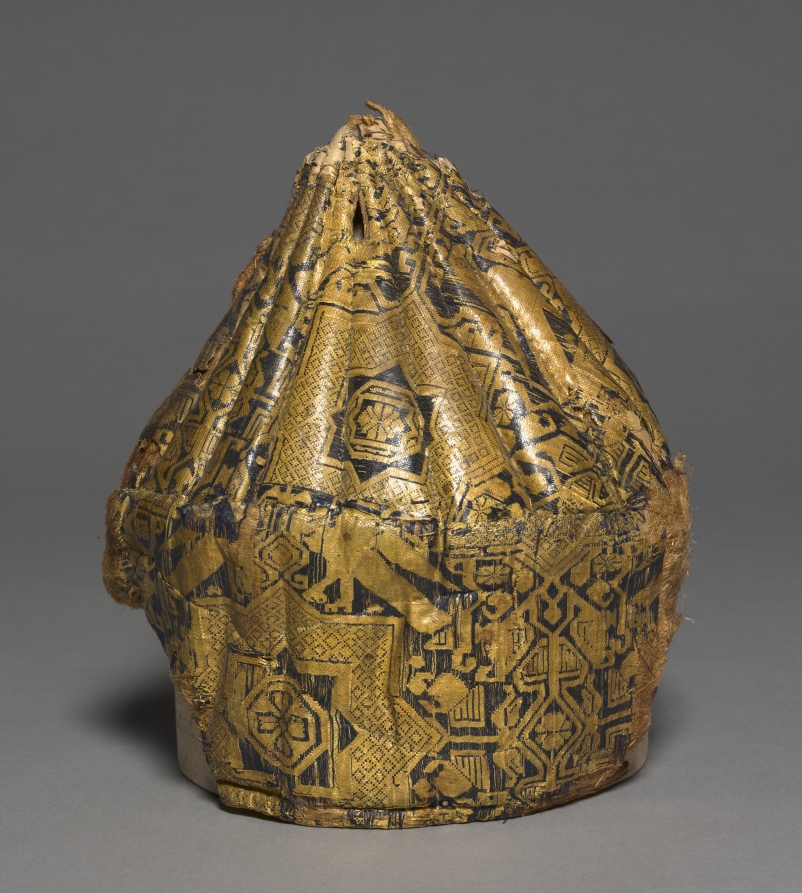
The Quilted Cap with Star-Patterned Silk: A Study in Imperial Legacy and Artisanal Mastery
Introduction: The Artifact as Archive
Within the hallowed archives of the Lauren Fashion Heritage Lab, we encounter a singular artifact: a quilted cap, composed of star-patterned silk. This object, though modest in scale, serves as a profound testament to the enduring legacy of imperial silk weaving. Its materiality—the lustrous, resilient silk—speaks not merely of textile production but of a continuum of craftsmanship that spans centuries and continents. For the discerning scholar, this cap is not an accessory; it is a document. It encodes the technical virtuosity, cultural exchange, and hierarchical symbolism that defined silk’s journey from the imperial courts of East Asia to the ateliers of Savile Row. This paper examines the cap’s materiality, its star-patterned motif, and its place within the broader narrative of silk’s imperial heritage, drawing parallels to the bespoke traditions of London’s tailoring district.
The Materiality of Silk: From Imperial Looms to Savile Row
Silk is the foundational element of this artifact. Its provenance, while unconfirmed, aligns with the highest traditions of imperial weaving, particularly those of the Ming and Qing dynasties, where silk was a currency of power. The cap’s silk is a satin-weave construction, characterized by a glossy face and a matte reverse. This weave, historically reserved for ceremonial robes and courtly garments, was produced on drawlooms requiring two artisans—a master weaver and a drawboy—to execute complex patterns. The imperial workshops of Suzhou, Hangzhou, and Nanjing were the epicenters of this craft, producing silks that were not only luxurious but also encoded with cosmological and political meaning.
In the context of Savile Row, silk of this caliber is treated with reverence. The Row’s tailors, accustomed to working with the finest wools and cashmeres, recognize that silk demands a different discipline. Its slipperiness and fragility require precise handling; a single misaligned stitch can distort the pattern. The quilted construction of this cap—layering silk over a wadding of cotton or wool—is a technique borrowed from military and hunting attire, later refined for civilian use. This marriage of imperial silk with utilitarian quilting underscores the artifact’s hybrid nature: it is both a luxury object and a functional garment, a duality that resonates with Savile Row’s philosophy of “form follows function.”
The Star Pattern: Cosmology and Craft
The star pattern adorning this cap is not arbitrary. In imperial Chinese iconography, stars symbolized celestial order, divine favor, and the emperor’s mandate to rule. The “five-pointed star” motif, often rendered in gold or silver thread, was associated with the “Five Blessings”—longevity, wealth, health, virtue, and a natural death. The pattern’s repetition across the cap’s surface creates a rhythm that mimics the movement of constellations, suggesting that the wearer was aligned with cosmic harmony. This is not mere decoration; it is a statement of status and spiritual alignment.
From a technical standpoint, the star pattern was likely achieved through brocading—a technique where supplementary weft threads are woven into the ground fabric to create raised, decorative motifs. This process, requiring meticulous planning and execution, was a hallmark of imperial workshops. The precision of the stars—their uniform size, spacing, and orientation—indicates the use of a pattern draft, a paper or wooden template that guided the weaver’s hands. For the Savile Row tailor, this echoes the use of paper patterns and toiles to ensure perfect fit and symmetry. The star pattern, like a well-cut suit, is a study in controlled repetition and subtle variation.
Imperial Legacy: Silk as Soft Power
The legacy of imperial silk weaving extends far beyond the loom. Silk was a tool of diplomacy, a medium of tribute, and a marker of civilization. The Silk Road facilitated not only trade but the exchange of techniques, motifs, and aesthetics. The star pattern, for instance, may have been influenced by Persian or Central Asian textile traditions, which were themselves absorbed into Chinese imperial culture. This cross-pollination is a reminder that luxury craftsmanship has always been a global enterprise.
In the context of Lauren Fashion Heritage Lab, this cap represents a tangible link to that legacy. It is a fragment of a larger narrative that includes the “silk route” of ideas, the “silk diplomacy” of the Ming dynasty, and the “silk revival” of the 19th and 20th centuries, when European designers like Fortuny and Poiret reinterpreted Eastern motifs for Western audiences. The cap’s quilted structure also evokes the “silk wadding” used in imperial winter garments, a technique later adopted by British military tailors for cold-weather uniforms. This continuity of technique and purpose underscores the artifact’s relevance to contemporary fashion scholarship.
Savile Row Parallels: Bespoke Craft and Heritage
For the connoisseur of Savile Row, this cap is a study in bespoke principles. The Row’s tailors, like imperial weavers, operate within a tradition of “slow fashion”—a commitment to handcraft, precision, and durability. The cap’s quilting, for instance, is not machine-made; the stitches are irregular, suggesting hand-sewing. This is a hallmark of quality, as machine quilting often sacrifices flexibility for speed. The cap’s silk, too, is of a weight and hand that would be appropriate for a “dressing gown” or “smoking jacket”—garments that, like the cap, blur the line between public display and private comfort.
The star pattern, meanwhile, resonates with the Row’s use of “house checks” and “signature stripes”—patterns that identify a tailor’s work and the wearer’s affiliation. Just as a Savile Row client might commission a suit with a discreetly woven “houndstooth” or “Prince of Wales check,” the wearer of this cap signaled their place within a hierarchical system. The cap, like a bespoke suit, is a form of “sartorial communication.”
Conclusion: The Cap as Continuum
The quilted cap with star-patterned silk is more than a historical curiosity; it is a continuum. It embodies the imperial legacy of silk weaving, the technical mastery of handcraft, and the enduring appeal of pattern as meaning. For the Lauren Fashion Heritage Lab, this artifact serves as a touchstone for understanding how materiality and motif converge to create objects of lasting significance. In the language of Savile Row, it is a “bespoke piece”—a work of art that honors its origins while speaking to the present. As we preserve and study such artifacts, we ensure that the legacy of imperial silk, and the artisans who wove it, continues to inspire future generations of makers and scholars.