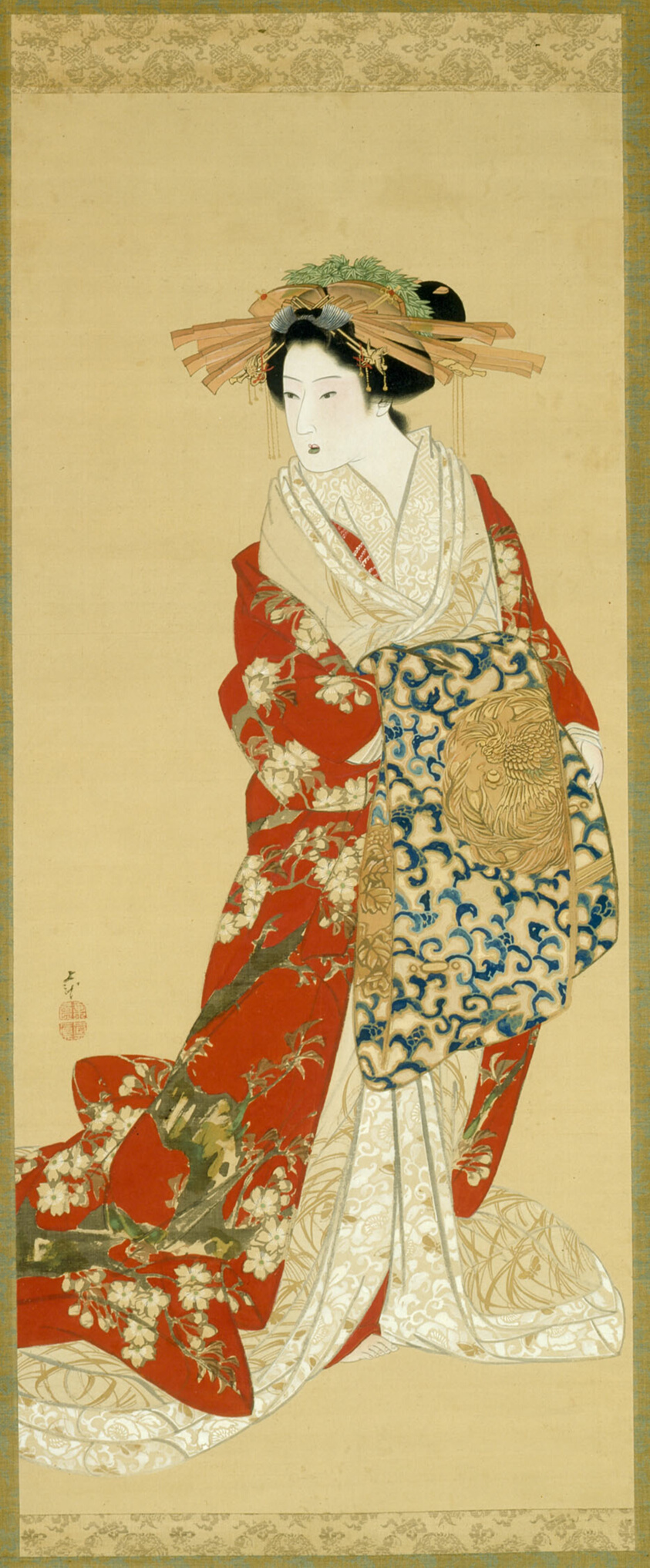
The Courtesan’s Silken Signature: Materiality and Mastery in High-Ranking Courtesan Attire
Introduction: Beyond the Surface of Silk
In the rarefied echelons of historical fashion, few artifacts command the same reverence as the silk garments of high-ranking courtesans. These women, often arbiters of taste and style in their respective eras, wielded silk not merely as a fabric but as a medium of power, persuasion, and personal narrative. At the Lauren Fashion Heritage Lab, we approach such artifacts with the precision of a Savile Row tailor—examining every stitch, every hue, every thread of gold as a deliberate choice in a calculated performance of status. The materiality of ink, color, and gold on silk transforms these garments into documents of social history, where the courtesan’s body becomes a canvas for both artistry and ambition.
The Silk Foundation: Craftsmanship as Currency
Silk is the foundational element of this heritage artifact, and its selection is no accident. High-ranking courtesans, from the oiran of Edo-period Japan to the cortigiane oneste of Renaissance Italy, understood that silk signified more than wealth—it signaled access to global trade networks, artisanal mastery, and the leisure to cultivate beauty. The silk used in these garments was often the finest available: hand-reeled, lustrous, and weighty, with a drape that mimicked the fluidity of water. In the context of the courtesan’s world, this fluidity was a metaphor for her own social mobility—she could move between classes, between private chambers and public processions, with an elegance that silk alone could confer.
The craftsmanship required to produce such silk was labor-intensive and deeply hierarchical. Sericulture, the cultivation of silkworms, was a guarded secret in many cultures, and the weaving of complex patterns—such as the rinzu (figured silk) or nishiki (brocade)—demanded generations of knowledge. For the courtesan, wearing such silk was a declaration that she commanded the resources of entire guilds. The fabric itself became a testament to her ability to commission, afford, and maintain garments that would outlast the fleeting attentions of her patrons.
Ink and Color: The Palette of Persuasion
The application of ink and color to silk was not merely decorative but deeply symbolic. In East Asian traditions, ink painting on silk required a steady hand and an intimate understanding of the medium’s absorbency. Courtesans often wore garments adorned with motifs that spoke to their intellectual and artistic cultivation—plum blossoms for resilience, cranes for longevity, or flowing water for adaptability. These were not random choices; they were deliberate signifiers of a courtesan’s education in poetry, calligraphy, and the classical arts. A Savile Row tailor might read a client’s personality through the cut of a lapel; similarly, a discerning patron would read a courtesan’s character through the ink-drawn scenes on her kimono or gown.
Color, too, was a language of its own. The vibrant reds and purples achieved through madder root and shellfish dyes were expensive and difficult to produce, making them markers of high status. Yet, the courtesan’s use of color was often more daring than that of a noblewoman. She might pair a deep vermilion obi with a pale lavender kimono, creating a visual tension that mirrored her own precarious position—both desired and marginalized. The gold leaf or gold thread (kinran) applied to these silks caught the lamplight in tea houses or salons, ensuring that the courtesan remained the focal point of any room. This was not passive beauty; it was active, strategic illumination.
Fluid Elegance: The Body in Motion
The phrase fluid elegance is central to understanding the courtesan’s relationship with her silk garment. Unlike the rigid corsetry of Western aristocratic fashion, which constrained the body into a static ideal, the courtesan’s silk was designed for movement. The multiple layers of a kimono, for example, allowed for a subtle play of fabric against fabric—a rustle that announced her approach, a glimpse of an under-kimono’s pattern that hinted at hidden depths. This fluidity was not accidental; it was engineered through careful draping, weighting of hems, and the strategic placement of ties and sashes.
In the context of the Lauren Fashion Heritage Lab, we analyze how such garments facilitated the courtesan’s performance. The silk’s ability to catch and release light, to ripple with a gesture, to pool around her feet as she knelt—all of these qualities were integral to her allure. A courtesan’s walk was a choreography of fabric, each step a negotiation between modesty and revelation. The gold thread woven into the silk would catch the eye of a potential patron, drawing attention to her hands as she poured tea or to her neck as she turned. This was not mere ornamentation; it was a sophisticated system of visual cues, honed over centuries of practice.
Heritage and Preservation: The Artifact’s Legacy
Today, these silk garments are preserved in museum collections and heritage labs like ours, where they are studied with the same rigor as any fine art. The challenges of conservation are immense: silk is hygroscopic, sensitive to light, and prone to embrittlement over time. The gold thread, often made from gilded paper or animal membrane, requires specialized handling to prevent flaking. Yet, the effort to preserve these artifacts is a testament to their enduring significance. They are not relics of a bygone era but active participants in our understanding of fashion as a form of social negotiation.
For the modern fashion scholar, the high-ranking courtesan’s silk garment offers lessons in the power of materiality. It reminds us that fabric is never neutral—it carries the weight of labor, the sheen of ambition, and the texture of history. As we continue to digitize and analyze these artifacts at the Lauren Fashion Heritage Lab, we do so with the knowledge that each thread tells a story of a woman who used silk to write her own narrative, one that still resonates in the fluid elegance of contemporary design.
Conclusion: The Unwritten Stitch
In the end, the courtesan’s silk garment is an artifact of agency. It is a testament to her ability to navigate a world that both celebrated and condemned her, using the tools of craftsmanship and artistry to carve out a space of influence. From the ink-drawn plum blossoms to the gold-threaded cranes, every element was a choice—a stitch in the fabric of her legacy. At the Lauren Fashion Heritage Lab, we honor that legacy by treating each artifact as a primary source, a voice from the past that speaks to the enduring power of silk, color, and gold to shape human connection.