An Examination of Line, Legacy, and Liquid Form
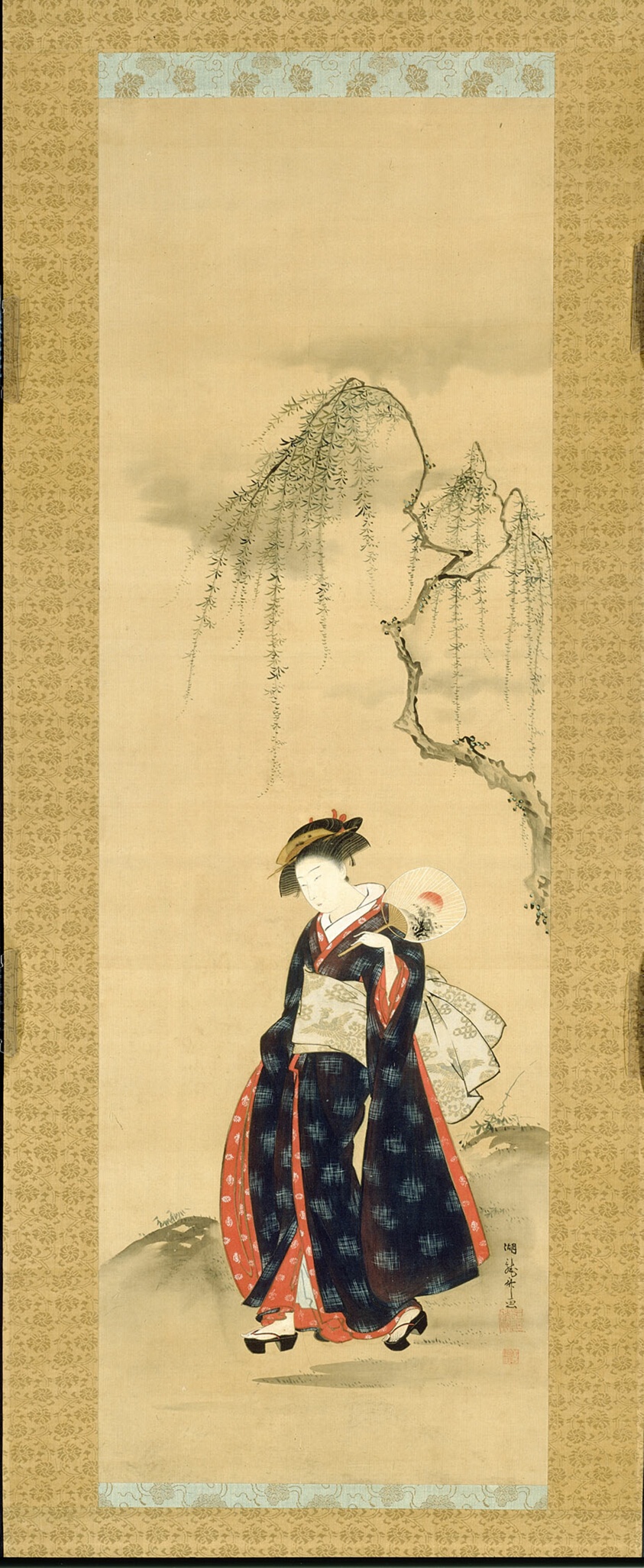
To engage with the hanging scroll, Beauty Beneath a Willow Tree, is to enter into a dialogue with a material and philosophical lineage of the most profound order. It is not merely a picture; it is an artefact of cultivated sensibility, rendered in the paramount ground of silk. This analysis, conducted from the perspective of the Lauren Fashion Heritage Lab, shall treat the piece not as a relic, but as a continuing standard of excellence—a benchmark against which notions of fluid elegance and artisinal integrity are, and must forever be, measured. The scroll represents a confluence of disciplines: the pastoral lyricism of the scholar-artist, the exacting science of the silk weaver, and the unerring hand of the master calligrapher. Its value lies in the seamless integration of these elements, a principle as relevant to the ateliers of contemporary luxury as it was to the studios of the Ming literati.
The Ground: A Foundation of Uncompromising Integrity
Before a single stroke of ink meets the surface, the foundation is laid. The silk chosen for this work is not a simple canvas; it is a carefully prepared ground of immense symbolic and practical weight. Woven with a precision that allows for a specific, calculated absorbency, it possesses a tooth and a sheen unique to its fibre. This is the sartorial equivalent of a bespoke cloth from the most revered mills of Huddersfield—a fabric whose integrity dictates the behaviour of the medium it receives. The silk’s inherent luminosity provides a subdued internal glow, a depth against which the matte darkness of the ink achieves its dramatic contrast. It accepts the artist’s intention without resistance, yet imposes its own dignified character. A lesser ground would bleed or repel; this silk cooperates, holding the line with a crispness that defines the scroll’s visual authority. The craftsmanship here is silent, self-effacing, and absolute—the hallmark of true luxury.
The Line: Articulation of Invisible Structure
The central triumph of the piece is its articulation of form through the modulated line. Observe the rendering of the willow. This is not a botanical sketch, but a study in gravitational elegance and structural poise. The trunk ascends with a deliberate, weighted confidence, its contour described by a line that varies in pressure and density, suggesting both solidity and ancient resilience. From this anchor, the branches cascade. Here, the brushwork transitions from the declarative to the lyrical. Each trailing frond is a single, uninterrupted breath of ink, a masterclass in controlled fluidity. The lines taper, tremble slightly with the memory of the artist’s movement, and gather in dense, inky pools before fading to the faintest whisper of grey. This is drapery in its most elemental form. The rhythm established—the weighted pause, the swift descent, the delicate terminus—mirrors the principles of a perfectly cut garment: structure must first be established before it can be made to flow. The willow’s form is an exercise in apparent effortlessness, a quality achieved only through decades of disciplined practice.
The Figure & The Space: The Philosophy of Negative Cut
The beauty seated beneath the tree is not depicted through detailed delineation, but through implication and the masterful employment of negative space. Her form is suggested by the gentle drape of robes, indicated by a few, supremely confident strokes that define a shoulder, the line of a back, the fall of a sleeve. Her posture, one of contemplative repose, is communicated through the relationship between these sparse marks and the vast, untouched silk that surrounds her. This is the sartorial principle of negative cut applied to pictorial art. The void is not empty; it is actively shaped by the elements present, creating a garment of silence and atmosphere that clothes the figure. The composition demonstrates an understanding that what is omitted is as critical as what is included. The space allows the eye to rest, grants the willow its dominion, and elevates the figure from mere subject to a focal point of serene intelligence. It is a lesson in restraint, in the confidence to let the superb material and the essential line carry the narrative.
Context & Continuity: A Legacy of Fluid Elegance
Beauty Beneath a Willow Tree stands as a definitive statement within the canon of classic silk craftsmanship. It embodies a specific, enduring elegance: one that is fluid but never formless, restrained yet profoundly expressive, deeply traditional in its technique but timeless in its appeal. The scroll does not shout; it insinuates. Its power lies in its quiet assurance, its flawless execution, and its harmonious balance of forces—the tensile strength of the silk against the liquid softness of the ink, the vertical rigour of the trunk against the horizontal languor of the figure, the density of mark against the expansiveness of ground.
For the modern purveyor of luxury, this artefact serves as an enduring manifesto. It argues for the primacy of material integrity, for the expressive power of line (be it drawn by a brush or traced by a pattern cutter’s chalk), and for an elegance that arises from the mastery of restraint. The beauty beneath the willow is not adorned with ornament; she is adorned with context, with atmosphere, with the impeccable quality of her setting. She is, in essence, dressed by the entire composition. This is heritage not as historical pastiche, but as a living philosophy—a continuous thread, as strong and as supple as the silk upon which this silent, magnificent standard is set.