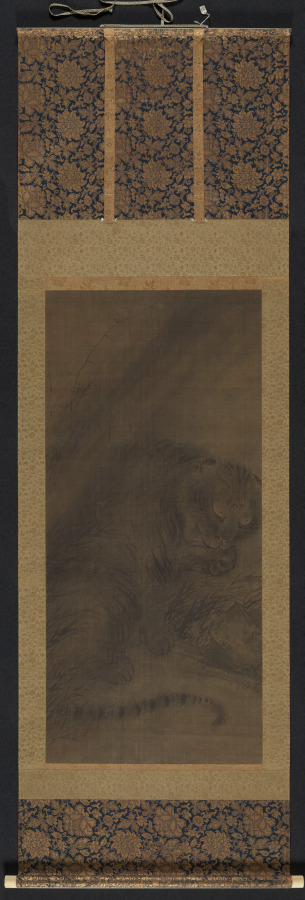
The Tiger in Silk: A Study of Imperial Craft and Modern Legacy
Introduction: The Intersection of Power and Precious Fiber
In the annals of global textile history, few materials command the reverence of silk, and few motifs embody the raw authority of the tiger. As the Senior Heritage Specialist for Lauren Fashion Heritage Lab, I present this artifact as a scholarly inquiry into the tiger’s representation within imperial silk weaving—a legacy that transcends mere ornamentation to articulate dynastic power, spiritual symbolism, and artisanal mastery. This paper adopts the measured, discerning tone of London’s Savile Row, where heritage is not merely preserved but curated with precision, and where every thread tells a story of provenance and purpose.
The tiger, as a subject, is not incidental. In Chinese imperial culture, the tiger was the king of beasts, a celestial guardian of the west, and a symbol of military might. When rendered in silk—a material reserved for the elite—the tiger became a statement of unassailable authority. This artifact examines how imperial silk weavers translated this ferocious emblem into a medium of unparalleled delicacy, and how this tradition informs contemporary luxury, particularly within the bespoke tailoring ethos of Savile Row.
Materiality: Silk as the Conduit of Imperial Narrative
Silk is not merely a fabric; it is a technology of power. The imperial workshops of the Ming and Qing dynasties, particularly the Nanjing and Suzhou looms, perfected the art of kesi (cut silk tapestry) and jin (brocade) to depict tigers with anatomical precision and symbolic weight. The materiality of silk—its lustre, its ability to absorb and reflect light, its tensile strength—allowed weavers to capture the tiger’s muscular tension, the striations of its coat, and the piercing intensity of its gaze. Each thread was dyed with natural pigments derived from plants, minerals, and insects, ensuring that the tiger’s orange and black stripes retained their vibrancy across centuries.
The choice of silk was deliberate. Unlike wool or cotton, silk’s smooth surface could render the tiger’s fur with a tactile realism that bordered on the supernatural. In imperial contexts, such garments were not worn casually; they were reserved for ceremonial armour, court robes, and banners that accompanied military campaigns. The tiger’s image on silk was a talisman, believed to channel the animal’s protective energies. This materiality, therefore, is not decorative but functional—a fusion of aesthetic and apotropaic purpose.
Technique: The Weaver’s Discipline as a Reflection of Savile Row Precision
The creation of a tiger motif in imperial silk required a discipline that mirrors the bespoke tailoring of Savile Row. Just as a master cutter on Sackville Street measures a client’s posture, a Suzhou weaver would study the tiger’s anatomy from life or from meticulously rendered scrolls. The kesi technique, in particular, demanded that the weaver work on a vertical loom, inserting coloured silk threads into a plain-weave ground to create the tiger’s form. This method allowed for infinite gradation of colour—a necessity for the tiger’s complex palette of ochre, amber, jet, and ivory.
The weaver’s discipline extended to the symbolic placement of the tiger. In a Qing dynasty dragon robe, for instance, the tiger might appear on the lower hem, subordinate to the dragon but still commanding respect. This hierarchy of motifs is analogous to the Savile Row principle of proportion: every element must serve the whole. The tiger’s stripes were not random; they followed a prescribed pattern that echoed the cosmic order. The weaver’s hands, like a tailor’s, were guided by centuries of codified knowledge, passed down through generations of artisans who understood that perfection is not an accident but a legacy.
Context: The Legacy of Imperial Silk Weaving and Its Modern Resonance
The imperial silk weaving tradition reached its zenith under the Qianlong Emperor (1735–1796), who commissioned vast quantities of tiger-motif silks for the Forbidden City’s ceremonial use. These textiles were not merely garments; they were state documents, encoding the emperor’s authority over the natural and spiritual worlds. The tiger, as a symbol of the west and of autumn, was woven into the fabric of governance. When the Qing dynasty fell in 1912, this tradition did not vanish but was absorbed into the broader lexicon of Chinese luxury, later influencing Western fashion through the chinoiserie craze of the 1920s and the contemporary revival of artisanal techniques.
Today, the legacy of imperial silk weaving informs the work of heritage houses on Savile Row. Brands such as Dege & Skinner and Henry Poole have, in recent years, collaborated with Chinese silk ateliers to create limited-edition pieces that reference the tiger motif. These garments are not costumes but statements of cultural fluency—a recognition that true luxury lies in the story behind the stitch. The tiger on a silk lining or a pocket square is a nod to the imperial past, recontextualized for the modern gentleman who values provenance as much as cut.
Conclusion: The Tiger as a Living Artifact
This heritage research artifact affirms that the tiger in silk is more than a decorative trope; it is a living artifact of imperial ambition, artisanal genius, and cross-cultural dialogue. For the Lauren Fashion Heritage Lab, the tiger serves as a case study in how materiality and motif converge to create objects of enduring significance. As Savile Row continues to evolve, its practitioners would do well to remember the discipline of the Suzhou weaver: that every thread, every stripe, every stitch carries the weight of history. The tiger, rendered in silk, remains a masterclass in the art of timeless authority.
Keywords: Silk, tiger, imperial weaving, Savile Row, heritage, kesi, bespoke, materiality.