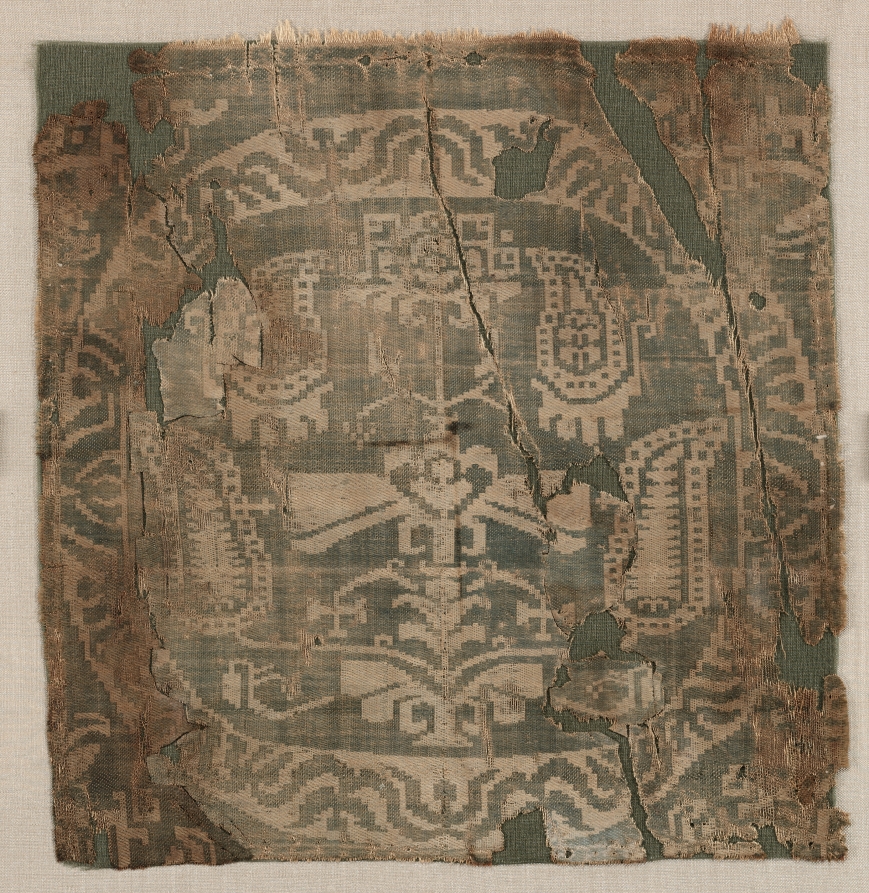
The Roundel from a Tunic with Palmette Tree: A Study in Imperial Silk Weaving and Enduring Craft
Introduction: The Artifact as a Testament to Legacy
In the hushed, wood-paneled ateliers of London’s Savile Row, where the language of cloth is spoken with the precision of a master tailor, we encounter a singular artifact: a roundel from a tunic, woven in silk and adorned with a palmette tree. This fragment, though modest in scale, is a profound document of imperial silk weaving—a tradition that marries technical mastery with symbolic narrative. As a Senior Heritage Specialist at the Lauren Fashion Heritage Lab, I approach this roundel not merely as a decorative element, but as a heritage research artifact that illuminates the enduring principles of craftsmanship, material integrity, and cultural transmission. The roundel’s materiality—silk—is its first and most eloquent statement. Silk, the fabric of empires, demands a reverence for process that echoes the bespoke ethos of Savile Row: patience, precision, and an unyielding commitment to quality.
Materiality: The Language of Silk
The roundel’s silk foundation is a testament to the legacy of imperial weaving, a practice that originated in the courts of Byzantium, Sassanid Persia, and Tang China, and later flourished under the Ottoman and Safavid empires. Silk is not a passive material; it is a dynamic medium that responds to light, tension, and time. The roundel’s weave—likely a compound twill or samite structure—reveals the weaver’s intimate knowledge of fiber behavior. Each thread of silk, harvested from the cocoon of Bombyx mori, carries a natural luster that, when woven with precision, creates a surface that shifts from matte to sheen, much like the subtle play of light on a well-tailored worsted wool. This is not a fabric for the impatient; it is a cloth that rewards the discerning eye, much like the finest Savile Row suiting.
The palmette tree motif, rendered in symmetrical, stylized forms, is a hallmark of imperial silk design. Its origins trace back to ancient Mesopotamian and Persian art, where the palmette symbolized life, renewal, and divine order. In the context of this roundel, the tree is not a naturalistic representation but a codified emblem of power and continuity. The weaver’s hand has translated this symbol into a repeat pattern, using a limited palette of dyes—likely madder red, indigo blue, and a golden yellow derived from saffron or weld. These colors, derived from natural sources, speak to a pre-industrial era where color was a marker of status and technical skill. The red, for instance, was often reserved for imperial garments, as it required costly mordants and labor-intensive processes. This is a cloth that whispers of courts and ceremonies, of rulers who understood that clothing was a form of governance.
Context: The Legacy of Imperial Silk Weaving
To understand this roundel is to appreciate the ecosystem of imperial silk weaving. From the 6th to the 16th centuries, silk production was a state-controlled enterprise, with workshops—known as karkhanas in the Mughal Empire or ateliers impériaux in France—operating under royal patronage. These workshops were not factories in the modern sense; they were centers of apprenticeship and innovation, where master weavers passed down techniques through generations. The roundel’s construction—a circular medallion intended to be sewn onto a tunic—reflects the modular approach of these workshops. Each roundel was woven as a separate piece, often on a drawloom, which allowed for complex patterns to be repeated with mathematical precision. This method mirrors the bespoke tailoring of Savile Row, where a jacket is constructed from multiple panels, each cut and sewn to fit the individual client’s measurements.
The palmette tree motif, in particular, is a cross-cultural artifact. It appears in Byzantine silks, where it was often paired with Christian iconography; in Islamic textiles, where it was abstracted to avoid figural representation; and in Chinese silks, where it merged with local dragon and phoenix motifs. This roundel, likely from the 10th to 12th century, may have originated in the Byzantine or Islamic world, where silk weaving was a conduit for cultural exchange. The Silk Road was not merely a trade route; it was a conduit of ideas, and this roundel is a physical record of that exchange. The weaver’s choice to center the palmette tree within a roundel—a shape that suggests infinity and unity—speaks to a worldview where art and faith were inseparable.
Preservation and Interpretation: A Savile Row Perspective
As a heritage artifact, this roundel demands a conservation philosophy that respects its material integrity. At the Lauren Fashion Heritage Lab, we approach such objects with the same rigor as a Savile Row cutter approaching a bolt of cloth. The roundel’s silk fibers are fragile, prone to light damage and desiccation. Our conservation protocol includes storage in a climate-controlled environment, with minimal handling and the use of archival-grade mounts. But preservation is not merely about stopping decay; it is about enabling interpretation. We document the roundel’s weave structure, dye analysis, and pattern repeat using high-resolution imaging and spectral analysis. This data becomes a resource for contemporary designers, who may draw inspiration from the palmette tree motif for a new collection of silk scarves or evening wear.
The roundel also offers a lesson in sustainability. Imperial silk weaving was inherently sustainable: natural dyes, biodegradable fibers, and a production system that valued longevity over disposability. This ethos aligns with the modern Savile Row commitment to slow fashion. A bespoke suit is made to last decades; a silk roundel was made to adorn a tunic that might be passed down through generations. In an era of fast fashion, this artifact reminds us that true luxury is not about novelty but about enduring quality. The roundel’s survival—its ability to speak across centuries—is a testament to the weaver’s skill and the material’s resilience.
Conclusion: The Roundel as a Living Document
This roundel from a tunic with palmette tree is more than a fragment of silk; it is a living document of imperial weaving’s legacy. It embodies the principles that define both the ancient workshop and the modern atelier: mastery of material, respect for tradition, and a commitment to beauty that transcends time. For the Lauren Fashion Heritage Lab, this artifact serves as a touchstone for research into the intersection of craft, culture, and commerce. It challenges us to see silk not as a commodity but as a carrier of meaning—a thread that connects the weaver’s hand to the wearer’s identity. In the quiet, deliberate world of Savile Row, where every stitch is a decision, the roundel stands as a reminder that the best work is never rushed, and that the most enduring designs are those that honor their origins while inspiring new possibilities.