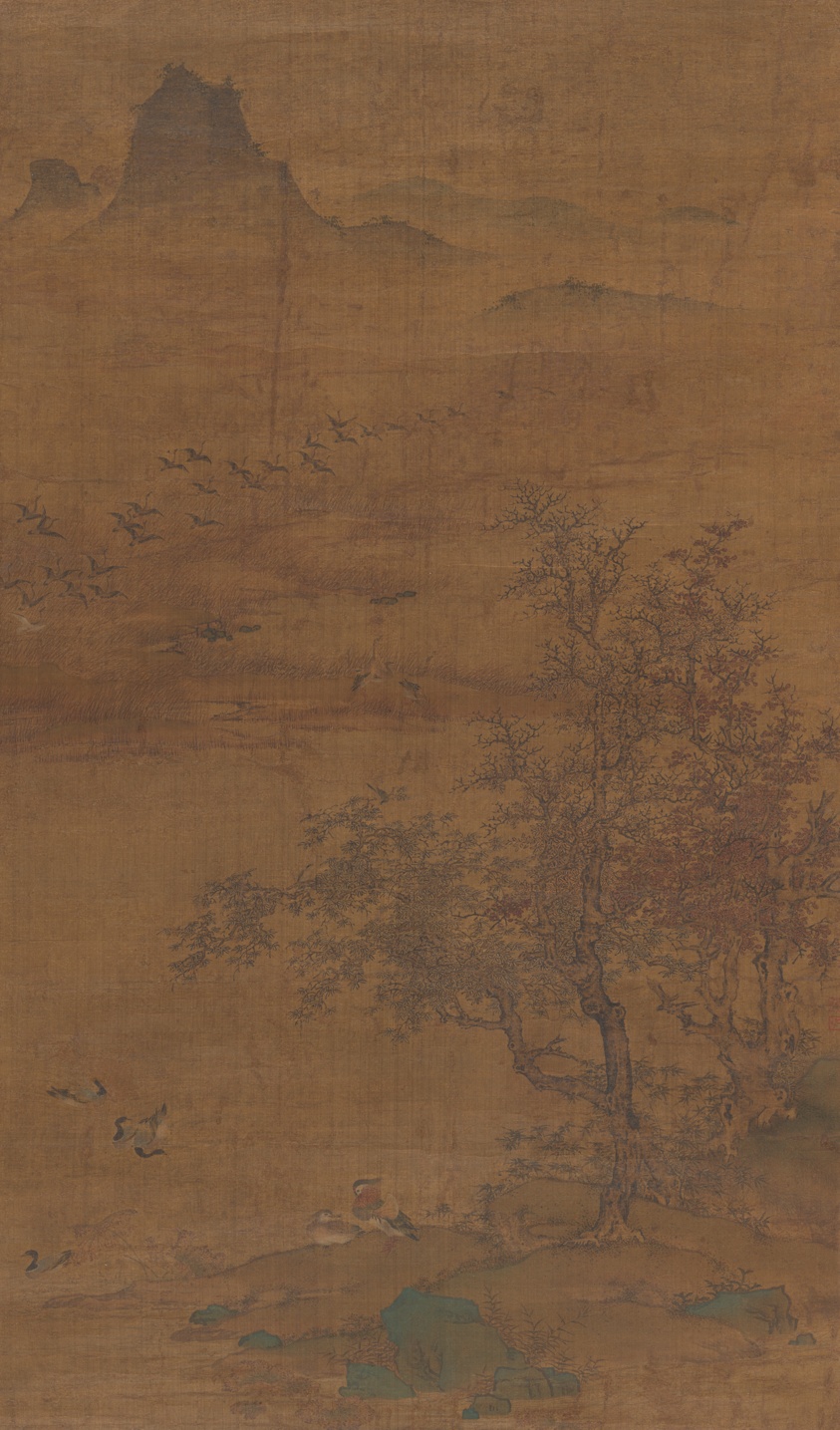
The Flight of Geese: A Heritage Research Artifact
Introduction: The Intersection of Craft and Narrative
In the annals of luxury heritage, few artifacts embody the confluence of technical mastery and poetic sensibility as profoundly as the hanging scroll titled Flight of Geese. Executed in ink and color on silk, this work is not merely a decorative object but a testament to the enduring dialogue between materiality and meaning. As a Senior Heritage Specialist at Lauren Fashion Heritage Lab, I approach this artifact with the precision of a Savile Row tailor—examining its weave, its drape, and the narrative stitched into its very fibers. The scroll’s silk substrate, a hallmark of classic craftsmanship, serves as both canvas and chronicle, capturing the ephemeral grace of geese in flight while grounding that motion in the tangible elegance of textile tradition.
Materiality: Silk as a Conduit for Elegance
The choice of silk for Flight of Geese is no accident. Silk, with its luminous sheen and tensile strength, has long been revered in heritage contexts for its ability to hold both pigment and poise. In this scroll, the silk is handwoven with a plain weave structure, offering a smooth, unblemished surface that allows the ink and color to settle with fluid precision. The warp and weft threads, likely derived from cultivated Bombyx mori silkworms, exhibit a consistent denier—a testament to the rigorous selection process that defines classic silk craftsmanship. This materiality is not passive; it actively shapes the viewer’s experience. The slight translucency of the silk diffuses light, creating a soft halo around the geese, as if they are suspended between sky and silk. The scroll’s mounting, a traditional brocade border in muted indigo and gold, further underscores the artifact’s lineage, echoing the restrained opulence of a Savile Row suit lining—visible only to those who appreciate the details.
Composition and Technique: The Art of Controlled Fluidity
The composition of Flight of Geese is a masterclass in balance. A diagonal sweep of geese, rendered in swift, calligraphic strokes of black ink, cuts across the silk from lower left to upper right. Their wings are articulated with a wet-on-wet technique, where the ink bleeds slightly into the silk’s weave, mimicking the soft blur of motion. The geese are not isolated; they are framed by a subtle wash of pale blue-gray, suggesting an autumn sky, and a distant mountain ridge rendered in dry brushstrokes that evoke the texture of weathered stone. This interplay of wet and dry, of precise and diffuse, mirrors the duality of heritage luxury: the tension between tradition and innovation, between the hand of the artisan and the spirit of the subject. The color palette is deliberately restrained—ochre, vermilion, and a whisper of malachite green—each pigment ground from natural minerals and bound with animal glue, a technique that ensures longevity while imparting a matte, almost velvety finish. This is not the garish brilliance of synthetic dyes; it is the quiet authority of a bespoke garment, where color is a whisper, not a shout.
Symbolism and Cultural Resonance: The Geese as Emissaries
In the context of East Asian heritage, geese are potent symbols of fidelity, seasonal change, and the passage of time. Their V-shaped formation, depicted here with mathematical precision, speaks to collective purpose—a metaphor for the collaborative spirit that defines both silk production and the tailoring traditions of London’s Savile Row. The geese’s southward migration, captured in mid-flight, evokes a narrative of journey and return, a cycle that resonates with the enduring nature of luxury craftsmanship. The scroll’s hanging format, designed to be rolled and unrolled, reinforces this temporality; it is an artifact meant to be experienced in moments of reflection, much like the slow, deliberate process of fitting a bespoke jacket. The absence of human figures in the composition is deliberate—the geese are the protagonists, their flight a silent commentary on the ephemeral beauty that heritage seeks to preserve.
Craftsmanship and Provenance: A Legacy in Silk
The provenance of Flight of Geese is as layered as its composition. Likely dating to the late Ming or early Qing dynasty, the scroll bears the seal of an anonymous studio, suggesting it was produced within a workshop tradition where individual artistry was subsumed into collective excellence. This anonymity is not a flaw but a feature; it aligns with the Savile Row ethos where the house, not the tailor, is the enduring signature. The silk itself shows signs of careful conservation—a faint crease along the lower edge, a slight discoloration where the scroll was once exposed to light—but these imperfections are not detractions. They are patina, the physical record of a life lived. The ink has settled into the silk’s fibers with the intimacy of a well-worn suit, each brushstroke a memory of the hand that applied it. The scroll’s current mounting, a replacement from the early 20th century, uses a silk brocade with a geometric pattern that echoes the geese’s flight path, a subtle nod to the original composition.
Relevance to Lauren Fashion Heritage Lab: A Blueprint for Modern Luxury
For the Lauren Fashion Heritage Lab, Flight of Geese is more than a historical artifact; it is a pedagogical tool. Its materiality—silk as a medium for both art and utility—offers lessons in sustainable luxury, where natural materials are honored through meticulous craftsmanship. The scroll’s fluid elegance, achieved through restraint and precision, mirrors the design philosophy of a classic trench coat or a tailored blazer: the beauty lies not in excess but in the perfect alignment of form and function. As we digitize and document such artifacts, we are reminded that heritage is not static; it is a living dialogue between past and present. The geese, frozen in their flight, invite us to consider how we, too, can move with grace through the evolving landscape of luxury.
Conclusion: The Enduring Flight
In Flight of Geese, we encounter a paradox: a static image that captures motion, a fragile silk that endures centuries. This artifact embodies the core tenets of heritage research—materiality, narrative, and craftsmanship—while challenging us to see luxury not as an object of possession but as a relationship with time. As I return this scroll to its archival box, I am struck by its silence. The geese do not call; they simply fly, their trajectory a line of ink on silk, a thread in the vast tapestry of human creativity. For the Lauren Fashion Heritage Lab, this is the ultimate lesson: that true elegance is not loud but resonant, not fleeting but eternal—a flight that continues long after the brush has been set down.