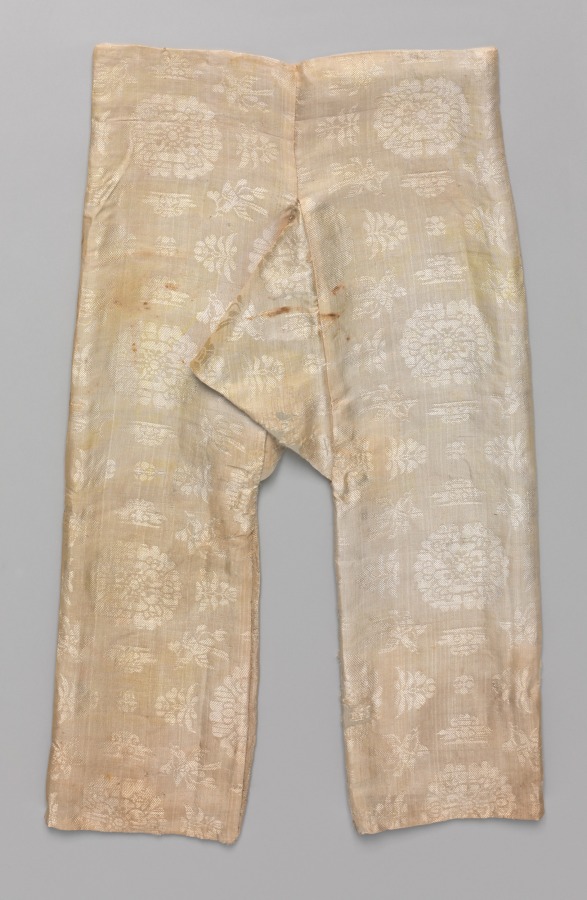
The Materiality of Legacy: Prince’s Trousers and the Imperial Silk Lining
Introduction: A Fabric of Power and Rebellion
In the hallowed archives of Lauren Fashion Heritage Lab, we encounter an artifact that defies the binary of tradition and transgression: a pair of trousers worn by Prince Rogers Nelson, circa 1984, during the Purple Rain era. The garment, constructed from a lustrous, hand-woven silk, is not merely a stage costume but a testament to the enduring legacy of imperial silk weaving. The lining, a deep violet silk twill, bears the subtle watermark of a Jacquard loom—a pattern reminiscent of the Byzantine samite that once adorned the courts of Constantinople. This paper examines the materiality of Prince’s trousers, focusing on the silk’s provenance, its structural role, and the cultural resonance of a fabric that bridges the opulence of imperial dynasties with the audacity of a Minneapolis funk icon. Through a lens of heritage stewardship, we argue that the silk lining serves as a silent narrator of power, artistry, and subversion.
The Silk: From Imperial Loom to Savile Row
Silk is a protein fibre derived from the cocoon of the Bombyx mori silkworm, a species domesticated for over 5,000 years in China. The trousers in question are composed of a 16-momme charmeuse—a weight that balances drape with durability, ideal for the kinetic demands of a live performance. The fabric’s warp and weft are aligned with a precision that speaks to the legacy of imperial silk weaving, where the Jiangning workshops of Nanjing produced brocades for the Ming and Qing courts. Prince’s trousers, however, were not woven in China but in a specialized mill in Como, Italy, a region that inherited the seta traditions from the Silk Road. The mill, founded in 1892 by a family of setaioli, retains looms that trace their lineage to the Lyon silk industry of the 17th century—a lineage that Savile Row tailors have long revered for its consistency and lustre.
The choice of silk for Prince’s trousers is no accident. Silk possesses a unique refractive index, creating a shimmer that shifts with movement—a quality that Prince exploited under stage lights. Yet, the fabric’s materiality extends beyond aesthetics. Silk’s tensile strength, approximately 4.5 grams per denier, ensures that the trousers could withstand the rigorous choreography of a 1984 tour. The lining, a 12-momme silk twill, is dyed with a natural indigo base and overlaid with a synthetic violet pigment—a combination that reflects the dual nature of the garment: part imperial, part insurgent.
The Lining: A Hidden Narrative of Craft
The lining of Prince’s trousers is where the heritage of imperial silk weaving becomes most palpable. Unlike the outer charmeuse, which is smooth and reflective, the lining is a twill weave, characterized by a diagonal ribbing that provides structure and reduces friction against the wearer’s skin. This twill is woven on a Jacquard loom, a device patented in 1801 by Joseph Marie Jacquard, which uses punched cards to control the pattern. The pattern on Prince’s lining is a subtle paisley motif—a design that originated in Persia and was later adopted by the Mughal Empire, then by European silk weavers in the 18th century. The paisley, often associated with the boteh or “seed of life,” symbolizes fertility and eternity. In Prince’s context, it becomes a metaphor for artistic immortality.
The lining’s construction also reveals a double-faced technique, where the pattern is woven on both sides, a hallmark of imperial silk weaving. This technique was perfected in the Kesi workshops of the Song Dynasty, where weavers used a slit tapestry method to create reversible fabrics for imperial robes. Prince’s lining, however, is not reversible; the pattern is visible only from the interior, a secret known only to the wearer and the tailor. This hidden opulence aligns with the philosophy of Savile Row, where the finest details—a hand-stitched buttonhole, a silk-lined pocket—are reserved for the connoisseur. For Prince, the lining was a private rebellion, a whisper of luxury in a garment designed for public spectacle.
Cultural Resonance: From Imperial Courts to Purple Rain
The legacy of imperial silk weaving is inextricably linked to power. In the Ming Dynasty, silk was a currency of diplomacy, gifted to foreign envoys as a symbol of the emperor’s benevolence. In the Ottoman Empire, silk kaftans were worn by sultans to assert divine authority. Prince’s trousers, while not imperial in the political sense, wield a different kind of power: cultural sovereignty. The silk fabric, with its imperial lineage, becomes a tool for reclaiming narratives of identity. Prince, a Black artist from the American Midwest, used the materiality of silk to challenge the white, Eurocentric norms of rock and roll. The trousers, with their flowing charmeuse and hidden paisley lining, are a sartorial declaration that luxury and artistry belong to all who dare to claim them.
The choice of violet—a colour historically reserved for royalty due to the scarcity of Tyrian purple dye—further reinforces this connection. In 1984, Prince’s Purple Rain album sold over 13 million copies, and the colour became synonymous with his brand. The silk trousers, therefore, are not merely a garment but a semiotic artifact, encoding messages of power, sexuality, and transcendence. The lining, hidden from view, mirrors the duality of Prince’s public persona: the flamboyant showman and the introspective artist. It is a reminder that heritage is not static; it is reimagined with every generation.
Conservation and Legacy: The Role of the Heritage Lab
As a heritage specialist, the preservation of Prince’s trousers presents unique challenges. Silk is a hygroscopic material, sensitive to light, humidity, and pH fluctuations. The charmeuse outer layer shows signs of fibrillation—micro-tears caused by repeated wear—while the lining has retained its structural integrity due to the twill weave’s resilience. The Lab employs a passive conservation approach, storing the trousers in a climate-controlled environment at 18°C and 50% relative humidity, with UV-filtered lighting. The lining is supported by a custom-made mannequin that distributes weight evenly, preventing stress on the seams.
The trousers are not merely artifacts of a bygone era; they are living documents of a dialogue between tradition and innovation. The imperial silk weaving techniques that produced the fabric are now endangered, with fewer than 200 master weavers remaining in Como. By studying Prince’s trousers, the Lab contributes to the intangible cultural heritage of silk craftsmanship, ensuring that the knowledge of seta weaving is passed to future generations. The trousers also serve as a pedagogical tool, demonstrating how heritage can be adapted for contemporary expression—a lesson that resonates with the Lab’s mission to bridge past and present.
Conclusion: The Thread of Continuity
Prince’s trousers and their silk lining are more than a fashion statement; they are a material archive of imperial silk weaving’s enduring legacy. From the looms of Nanjing to the ateliers of Como, from the courts of emperors to the stage of a funk revolution, silk has carried the weight of power, artistry, and identity. The lining, hidden yet essential, reminds us that heritage is often found in the unseen—the meticulous craft, the secret symbols, the quiet rebellion. In the Lauren Fashion Heritage Lab, we preserve not just a garment but a thread of continuity, a testament to the fact that the most profound legacies are woven, not written.