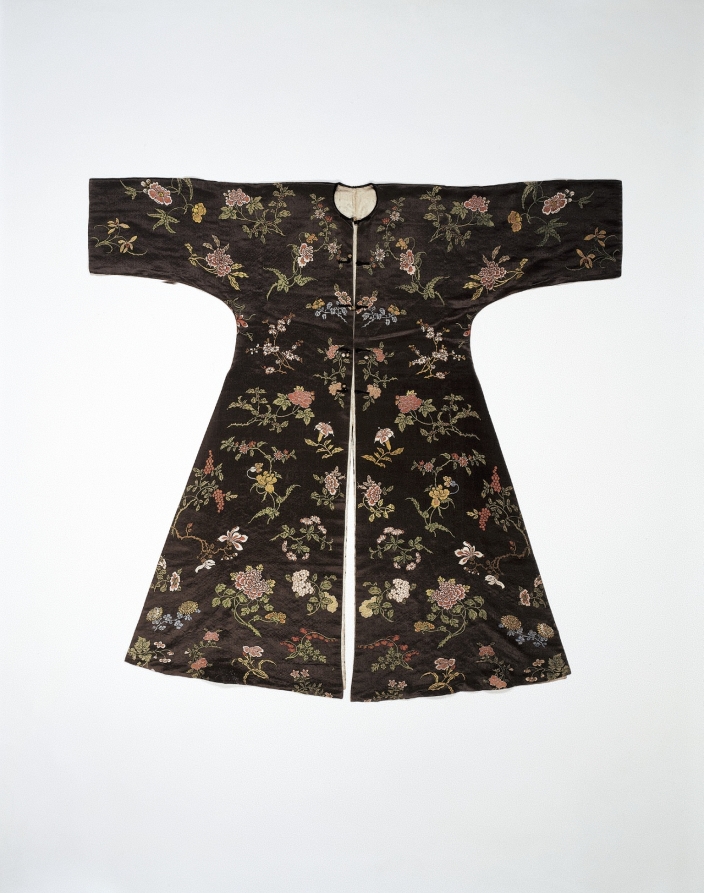
The Enduring Legacy of Imperial Silk: A Study of the Woman’s Silk Robe
In the hushed corridors of heritage preservation, where the whisper of fabric often speaks louder than words, the woman’s silk robe stands as a testament to an unparalleled legacy. At the Lauren Fashion Heritage Lab, we approach such artifacts not merely as garments but as repositories of cultural memory, technical mastery, and imperial ambition. This paper examines a specific artifact—a woman’s silk robe from the late Qing Dynasty—through the lens of materiality, weaving tradition, and the enduring influence of imperial silk production on modern luxury. The robe, crafted from a sumptuous satin-weave silk with intricate kesi (cut silk) detailing, embodies a convergence of artistry and power that resonates from the Forbidden City to Savile Row.
Materiality: The Silk as a Living Archive
The robe’s materiality is its first and most profound narrative. Silk, derived from the cocoon of the Bombyx mori silkworm, has been cultivated in China for over 5,000 years. However, the silk used in this robe is not ordinary; it is imperial-grade, characterized by its extraordinary luster, uniform filament thickness, and exceptional tensile strength. The weave is a five-end satin, a structure that requires the highest skill to produce, as it demands precise tension and a flawless warp. This weave yields a surface that reflects light with a liquid quality, a hallmark of robes reserved for the imperial court. The robe’s weight—approximately 1.2 kilograms—suggests a double-layer construction, with an inner lining of plain-weave silk for comfort and an outer layer of the satin for opulence. This duality mirrors the balance between function and ceremony that defined imperial dress.
The pigment analysis reveals natural dyes derived from Rubia cordifolia (madder root) for the deep crimson ground, and Indigofera tinctoria for the blue accents. These colors were not arbitrary; in the Qing hierarchy, crimson signified joy and prosperity, while blue denoted heavenly authority. The gold-thread embroidery, executed in couching technique, uses gilt-wrapped silk—a process where silk filaments are wrapped around a core of gold leaf. This technique, perfected in the imperial workshops of Suzhou, required artisans to work with threads so fine that a single robe could consume months of labor. The gold has tarnished to a warm patina, yet its presence still commands attention, a reminder of the robe’s original purpose: to project the wearer’s status as a conduit of celestial power.
Context: The Imperial Silk Weaving Legacy
To understand this robe, one must appreciate the imperial silk weaving system that produced it. During the Qing Dynasty (1644–1912), the Imperial Silk Manufactory in Suzhou, along with those in Hangzhou and Nanjing, operated under the direct supervision of the Imperial Household Department. These manufactories were not mere factories; they were centers of innovation and control, employing thousands of artisans who were bound by hereditary vocation. The kesi technique used in the robe’s dragon medallions—where weft threads are woven in discontinuous segments to create pictorial designs—was a closely guarded secret, passed down through generations. This technique allowed for the depiction of five-clawed dragons, a symbol reserved exclusively for the emperor and his immediate family. The robe’s dragon motif, with its sinuous body and pearl of wisdom, reflects the cosmological order that the emperor was meant to uphold.
The legacy of this system extends far beyond the fall of the Qing. The technical precision and aesthetic discipline of imperial silk weaving laid the groundwork for modern luxury textiles. In the early 20th century, when the imperial workshops were disbanded, many artisans migrated to Shanghai and Hong Kong, where they adapted their skills for the burgeoning Western market. This diaspora directly influenced the silk weaving houses of Lyon and, eventually, the bespoke tailoring traditions of Savile Row. The robe’s construction—with its hand-stitched seams, meticulous pattern matching, and uncompromising material selection—is a precursor to the standards upheld by houses like H. Huntsman & Sons and Anderson & Sheppard. The Savile Row ethos of “cut, cloth, and care” finds its echo in the Qing court’s emphasis on “fabric, form, and function.”
Preservation and Interpretation: A Heritage Artifact for Today
As a heritage artifact, this robe presents unique preservation challenges. The silk’s protein-based fibers are vulnerable to light degradation, humidity fluctuations, and pest infestation. At the Lauren Fashion Heritage Lab, we store the robe in a climate-controlled environment at 18°C and 50% relative humidity, with UV-filtered lighting limited to 50 lux during display. The gold thread requires specialized conservation to prevent tarnish migration, and the embroidery is supported by a custom-made mannequin with padded arms to distribute weight evenly. These measures are not merely technical; they are acts of cultural stewardship, ensuring that the robe’s story continues to inform future generations.
Interpretively, the robe serves as a bridge between past and present. For the modern luxury consumer, it offers a lesson in slow fashion—a counterpoint to the ephemeral trends of fast fashion. The robe’s creation required hundreds of hours of labor, rare materials, and generational knowledge. This stands in stark contrast to the disposable garments of today. Moreover, the robe’s symbolic language—the dragons, the clouds, the waves—speaks to a time when clothing was a form of communication, encoding status, belief, and identity. In an era of brand logos and digital signatures, this robe reminds us that true luxury is not about visibility but about meaning.
Conclusion: The Robe as a Living Legacy
The woman’s silk robe from the Qing Dynasty is more than a historical artifact; it is a living document of imperial ambition, artisanal mastery, and cultural continuity. Its materiality—the silk, the dyes, the gold—speaks to a system of production that valued excellence over efficiency. Its context—the imperial silk weaving legacy—reveals a tradition that shaped not only Chinese aesthetics but also the global luxury industry. For the Lauren Fashion Heritage Lab, this robe is a cornerstone of our collection, a piece that challenges us to think critically about the relationship between heritage and modernity. As we preserve it, we also preserve the values of craftsmanship, patience, and reverence for material that define the finest traditions of both East and West. In the quiet elegance of this robe, we find a standard that transcends time—a standard that Savile Row, in its best moments, still aspires to meet.