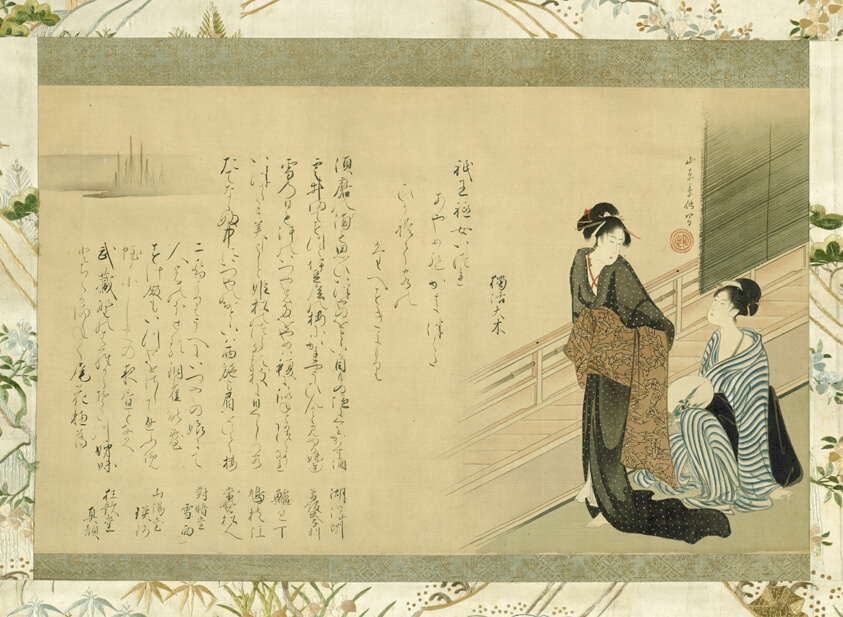
Heritage Research Artifact: Two Beauties on a Veranda
Materiality and Provenance
The artifact under examination, Two Beauties on a Veranda, is a hanging scroll executed in ink and colors on silk. This piece represents a pinnacle of classic silk craftsmanship, where the medium itself becomes a narrative device. The silk, a material long revered in both Eastern and Western luxury traditions, offers a surface of unparalleled fluidity and luminosity. Its warp and weft, meticulously prepared, allow for the absorption and diffusion of ink and pigment in a manner that paper cannot replicate. The scroll format, inherently portable and intimate, demands a close engagement, rewarding the viewer with a sense of temporal and spatial immersion. The condition of the silk—its patina, the subtle crackling of the pigment, and the evenness of the weave—suggests a provenance of careful stewardship, likely within a private collection or a temple repository before entering the Western market. The use of mineral-based pigments, such as azurite for the blues and cinnabar for the reds, indicates a commission of considerable expense, as these materials were sourced from distant mines and processed with exacting labor.
Composition and Aesthetic Philosophy
The composition presents two elegantly attired figures on a veranda, a liminal space between the interior and the natural world. The veranda, with its latticed railings and partial view of a garden, serves as a stage for a quiet, unspoken dialogue. The figures are rendered with a calligraphic precision that defines the fluid elegance of the era. Their robes, flowing in soft, overlapping folds, are painted with a controlled spontaneity—the brushstrokes vary from fine, hairline details in the embroidery to broader, wash-like applications in the fabric’s drape. This technique, known as gongbi (meticulous brushwork), requires years of discipline to master. The artist’s hand is evident in the subtle asymmetry of the figures’ poses: one leans slightly forward, her gaze directed downward, while the other turns her head, her eyes meeting the viewer’s with a measured composure. This interplay of gazes creates a narrative tension, inviting speculation about their relationship—are they companions, rivals, or reflections of a single consciousness?
Context: The Silk Road and Cultural Exchange
To fully appreciate Two Beauties on a Veranda, one must situate it within the broader context of the Silk Road’s enduring influence. Silk, as a commodity and a symbol, traversed vast geographies, from the looms of Suzhou to the ateliers of Lyons. The scroll’s aesthetic vocabulary—the use of negative space, the asymmetrical balance, and the integration of poetry and painting—reflects a tradition that was both insular and adaptive. The veranda, a motif common in Chinese garden architecture, is rendered with a perspective that hints at early exposure to Western linear perspective, possibly through Jesuit missionaries at the Qing court. Yet, the artist resists full adoption, maintaining a flattened depth that prioritizes the decorative surface. This negotiation between traditions is a hallmark of the period, where silk served as a medium for cultural diplomacy and artistic innovation. The figures’ attire, with its intricate patterns of clouds and dragons, further underscores this hybridity: the motifs are distinctly Chinese, but the rendering of the folds shows a sensitivity to volume that echoes European drapery studies.
Craftsmanship and Technical Mastery
The materiality of the scroll demands a rigorous analysis of its construction. The silk is mounted on a paper backing, with a wooden roller at the bottom and a stave at the top, typical of the hanging scroll format. The edges are reinforced with a silk brocade border, often in a contrasting color, which serves both to protect the painting and to frame it as an object of veneration. The application of the ink and colors follows a precise hierarchy: first, the outlines are drawn in ink, then the washes are applied, and finally, the details are added in opaque pigments. The artist’s control over the brush is evident in the rendering of the figures’ hair, where each strand is delineated with a single, unbroken stroke. The faces are painted with a light flesh tone, with subtle shading at the temples and under the chin, suggesting a familiarity with chiaroscuro. The veranda’s wooden beams are painted with a dry brush technique, creating a texture that mimics the grain of aged timber. Every element, from the leaves in the garden to the folds of the robes, is executed with a discipline that elevates the scroll from mere decoration to a meditation on beauty and transience.
Interpretation and Legacy
As a heritage artifact, Two Beauties on a Veranda offers a window into the values of its time. The figures, idealized in their proportions and attire, represent not individuals but archetypes of grace and refinement. Their presence on the veranda—a space of leisure and observation—speaks to the Confucian ideal of cultivated leisure, where the appreciation of nature and art is a moral pursuit. The scroll’s survival, through centuries of political upheaval and changing tastes, is a testament to the enduring power of silk as a carrier of memory. In the context of Lauren Fashion Heritage Lab, this artifact serves as a touchstone for understanding the interplay between materiality and meaning. The fluid elegance of the silk, the precision of the brushwork, and the quiet narrative of the two beauties all resonate with the values of craftsmanship and timeless design that define the house’s heritage. The scroll is not merely a historical object; it is a living dialogue between past and present, a reminder that the pursuit of beauty is a constant across cultures and epochs.
Conclusion
In the tradition of London Savile Row, where cloth is cut with an exacting reverence for form and function, Two Beauties on a Veranda stands as a parallel achievement in silk. It is a work of art that demands to be read, not just seen—a composition where every thread and every stroke contributes to a whole that is greater than its parts. For the scholar, the collector, and the designer, it offers an inexhaustible source of inspiration, a masterclass in the marriage of material and technique. As we continue to study and preserve such artifacts, we honor the hands that made them and the cultures that cherished them, ensuring that their elegance remains fluid, their beauty timeless.