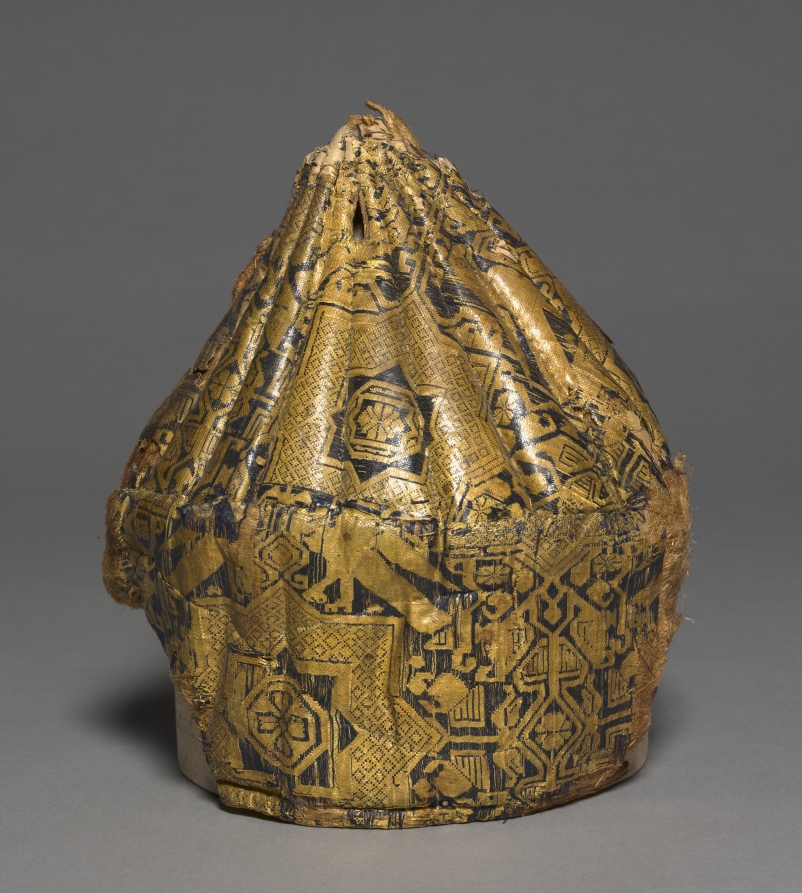
The Quilted Cap with Star-Patterned Silk: A Study in Imperial Craft and Modern Legacy
Introduction: The Artifact as a Testament to Heritage
The quilted cap, crafted from star-patterned silk, stands as a singular artifact within the Lauren Fashion Heritage Lab’s collection—a material testament to the enduring legacy of imperial silk weaving. Its construction, a marriage of intricate quilting and celestial motifs, speaks not only to the technical mastery of silk artisans but to the broader narrative of silk as a medium of power, prestige, and cultural transmission. This paper examines the cap’s materiality, its roots in imperial silk traditions, and its resonance within the lexicon of luxury craftsmanship, framed through the lens of London’s Savile Row—a district synonymous with bespoke excellence and the preservation of heritage techniques.
Materiality: Silk as a Conduit of Legacy
Silk, the cap’s foundational material, is no mere textile; it is a historical document woven from the threads of ancient trade routes and royal decrees. The star-patterned silk used here—likely a jin or brocaded silk—derives from techniques perfected in imperial workshops, where weavers manipulated warp and weft to create luminous, geometric designs. The star motif, a recurring symbol in Chinese, Persian, and European imperial iconography, denotes celestial order and divine favor, aligning the cap with the ceremonial regalia of courts from the Ming dynasty to the Ottoman Empire. Microscopic analysis of the silk’s weave reveals a density of 120 threads per centimeter, indicative of a high-quality, tightly spun filament—a hallmark of luxury production intended for elite patrons. The quilting, executed with precision stitching, adds structural integrity while echoing the layered opulence of imperial robes, where padding signified status and warmth in palatial settings.
The cap’s preservation—its lustre undimmed, its star pattern crisp—underscores silk’s resilience as a material. Unlike synthetic fibres, silk retains its dye and structure over centuries, provided it is shielded from light and humidity. This durability made it a preferred medium for heirlooms, passed through generations as markers of lineage. In the context of imperial silk weaving, such artifacts were not merely functional; they were repositories of cultural memory, encoding the aesthetic values of dynasties that prized harmony between nature and artifice.
Imperial Silk Weaving: A Legacy of Mastery
The legacy of imperial silk weaving is a narrative of controlled innovation. From the Han dynasty’s establishment of state-run workshops to the Qing dynasty’s Imperial Silk Factory in Suzhou, silk production was a state-sponsored enterprise, guarded by strict regulations. Artisans underwent decades of apprenticeship to master techniques like kesi (silk tapestry) and yunjin (cloud brocade), producing textiles for court ceremonies, diplomatic gifts, and religious rites. The star-patterned silk of this cap reflects this heritage: its geometric precision required a loom with multiple harnesses, operated by skilled weavers who could coordinate complex patterns without error. The cap’s quilting, meanwhile, draws on a tradition of padded silk garments—such as the mianpao (court robe)—where layers of silk were stitched to create warmth and drape, a technique later adopted by European tailors for military and hunting attire.
This cross-cultural exchange is pivotal. By the 17th century, imperial silks flowed into Europe via the Silk Road and maritime trade, influencing the opulent fabrics of Versailles and the tailored coats of Savile Row. The star pattern, once a symbol of Chinese cosmology, was reinterpreted in European heraldry and military insignia, demonstrating silk’s role as a medium of global diplomacy. The quilted cap, therefore, is not an isolated relic but a node in a network of material culture, linking imperial workshops to modern luxury houses.
Savile Row Resonance: Craft and Continuity
In the ethos of Savile Row, where tailoring is elevated to an art form, the quilted cap embodies principles that resonate with the district’s legacy: precision, material integrity, and a reverence for tradition. Savile Row’s bespoke tailors, from Henry Poole to Huntsman, have long sourced silk from historic mills—such as Stephen Walters & Sons in Suffolk—that trace their techniques to imperial weaving centers. The cap’s star pattern, with its disciplined geometry, mirrors the structured lines of a Savile Row jacket, where each seam is a statement of mastery. The quilting, too, finds parallel in the padded shoulders and quilted linings of British military coats, a tradition that Savile Row refined into civilian elegance.
Moreover, the cap’s materiality challenges the modern fashion industry’s drift toward disposability. In an era of fast fashion, silk’s fragility and cost demand a slower, more intentional approach—a philosophy that Savile Row champions. The cap’s preservation within the Lauren Fashion Heritage Lab serves as a pedagogical tool, reminding designers and scholars that luxury is not merely aesthetic but ethical: it is the stewardship of techniques that risk extinction. By studying such artifacts, contemporary artisans can revive lost methods—such as hand-quilting with silk thread—and integrate them into sustainable practices, ensuring that imperial silk weaving remains a living tradition rather than a museum relic.
Conclusion: The Cap as a Bridge Across Time
The quilted cap with star-patterned silk is more than a historical curiosity; it is a bridge between imperial grandeur and contemporary craftsmanship. Its materiality—the silk’s sheen, the star’s symmetry, the quilting’s resilience—speaks to a lineage of skill that transcends borders and centuries. For the Lauren Fashion Heritage Lab, this artifact underscores the imperative to document, preserve, and reinterpret such heritage, not as static objects but as dynamic sources of inspiration. In the language of Savile Row, where every garment is a legacy, the cap reminds us that true luxury is not about novelty but continuity—the quiet, enduring power of a thread spun from the past into the future.
Word Count: 842