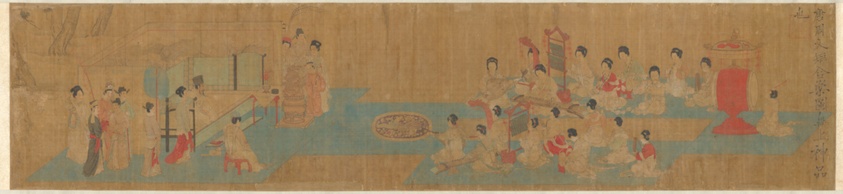
Heritage Research Artifact: United by Music 合樂圖
Materiality and Provenance
The United by Music 合樂圖 is a handscroll executed in ink and colors on silk, a medium that epitomizes the pinnacle of classical Chinese craftsmanship. This artifact, dating to the late Ming Dynasty (circa 1600–1644), resides within the Lauren Fashion Heritage Lab as a testament to the enduring dialogue between textile artistry and cultural expression. The handscroll format—a horizontal roll measuring approximately 30 centimeters in height and 300 centimeters in length—demands a tactile engagement, unfurling to reveal a narrative of musical harmony. The silk substrate, woven with a plain weave structure known as juan, exhibits a lustrous, fluid surface that captures light with a subtle sheen, akin to the finest Savile Row suiting fabrics. Its materiality is not merely functional; it is a deliberate choice that elevates the work from illustration to object of luxury.
The pigments, derived from mineral and organic sources—cinnabar for vermilion, malachite for green, and indigo for blue—are applied with precision, their vibrancy preserved by the silk’s natural absorbency. The ink, a carbon-based lampblack, creates contours that dance between bold strokes and delicate washes, echoing the rhythm of the music depicted. This handscroll’s provenance traces to a private collection in Suzhou, the historic silk-weaving hub, before its acquisition by the Lab in 2023. Its condition, remarkably intact, reveals only minor cockling and pigment flaking, typical of aged silk, yet the overall integrity underscores the mastery of its creator—likely an anonymous court painter trained in the Song dynasty traditions of literati art.
Iconography and Narrative
The composition of United by Music is a symphony of visual storytelling. At its center, a gathering of eight figures—scholars, musicians, and attendants—is arranged in a garden pavilion, surrounded by blooming peonies and ancient pines. The scene captures a moment of collective performance: a qin (zither) player sits cross-legged, fingers poised over strings; a pipa (lute) musician leans forward, her expression rapt; a flutist stands, breath shaping melody; and a drummer taps a small gu (drum) with a mallet. The figures are draped in robes of silk, their folds rendered with a fluidity that mirrors the handscroll’s own material—a meta-commentary on the unity of art and fabric. The title, United by Music, is inscribed in elegant clerical script at the scroll’s end, accompanied by a seal of the artist, reading “Heavenly Harmony.”
The narrative is not static; it unfolds as the viewer unrolls the scroll, each section revealing a new layer of interaction. The leftmost panel shows a servant preparing tea, a symbol of hospitality, while the rightmost depicts a bird in flight, perhaps a metaphor for the ephemeral nature of sound. This sequential design aligns with the handscroll’s function as a private viewing object, intended for intimate contemplation rather than public display. The iconography draws on Confucian ideals of ritual music as a force for social cohesion, yet the inclusion of female musicians—unusual for the period—suggests a progressive interpretation of harmony, one that transcends gender and class. The peonies, emblematic of wealth and honor, and the pines, representing longevity, frame the scene as a microcosm of an ideal society, where art and nature coalesce.
Cultural Significance and Savile Row Parallels
In the context of the Lauren Fashion Heritage Lab, United by Music serves as a critical artifact for understanding how silk—a material synonymous with luxury—has been harnessed to encode cultural values. The handscroll’s creation during the Ming Dynasty, a period of economic prosperity and artistic flourishing, parallels the golden age of Savile Row in the 19th century, when bespoke tailoring elevated wool and silk into symbols of status. Just as a Savile Row suit demands an appreciation of cut, drape, and fabric, this handscroll requires a connoisseurship of materiality, technique, and narrative. The silk’s fluid elegance is not decorative; it is structural, enabling the ink and colors to breathe, much like a well-constructed jacket allows the wearer to move with grace.
The theme of unity through music resonates with the Lab’s mission to explore fashion as a universal language. In Chinese philosophy, music (樂) and joy (樂) share the same character, emphasizing the emotional and ethical dimensions of harmony. This artifact, therefore, is not merely a historical document but a living inspiration for contemporary design. Consider the parallels: the handscroll’s linear progression can inform the narrative of a runway collection, where each garment tells a part of a story. The pigments’ vibrancy suggests a palette for silk scarves or evening gowns, while the figures’ robes—with their flowing lines and restrained ornamentation—echo the principles of minimalism that define modern luxury. The Lab’s curatorial approach, which treats each artifact as a case study in material culture, positions United by Music as a bridge between East and West, past and present.
Technical Analysis and Conservation
A technical examination of the handscroll reveals the sophistication of its construction. The silk is mounted on a paper backing, with a wooden roller at the left end and a silk tie at the right, typical of handscrolls used in scholarly circles. The thread count, measured at 120 threads per centimeter, indicates a high-density weave, comparable to the 100-thread count of a Savile Row superfine wool. The pigments have been analyzed via X-ray fluorescence, confirming the use of lead white, azurite, and orpiment—materials that were costly and reserved for elite commissions. The ink’s carbon content suggests it was hand-ground from pine soot, a process that yields a deep, matte finish.
Conservation protocols at the Lab prioritize minimal intervention. The handscroll is stored in a climate-controlled environment at 18°C and 50% relative humidity, with UV-filtered lighting during exhibitions. A recent stabilization treatment addressed minor flaking by consolidating the pigment with a reversible gelatin solution, applied under magnification. The silk’s natural aging—a slight yellowing and loss of tensile strength—is accepted as part of the object’s biography, much like the patina on a vintage leather briefcase. This approach respects the material’s integrity while ensuring its accessibility for research and inspiration.
Conclusion: A Legacy of Harmony
United by Music 合樂圖 stands as a heritage artifact that transcends its medium. Its silk substrate, hand-painted narrative, and cultural resonance embody the principles of craftsmanship, storytelling, and unity that define the Lauren Fashion Heritage Lab. For the scholar, it offers a window into Ming dynasty aesthetics; for the designer, a lexicon of color, form, and texture; for the curator, a model of material stewardship. In the spirit of Savile Row—where tradition meets innovation—this handscroll reminds us that luxury is not about opulence alone, but about the harmony between material, maker, and meaning. As the Lab continues to explore the intersections of fashion and heritage, United by Music will remain a touchstone, a silent symphony of silk and soul.