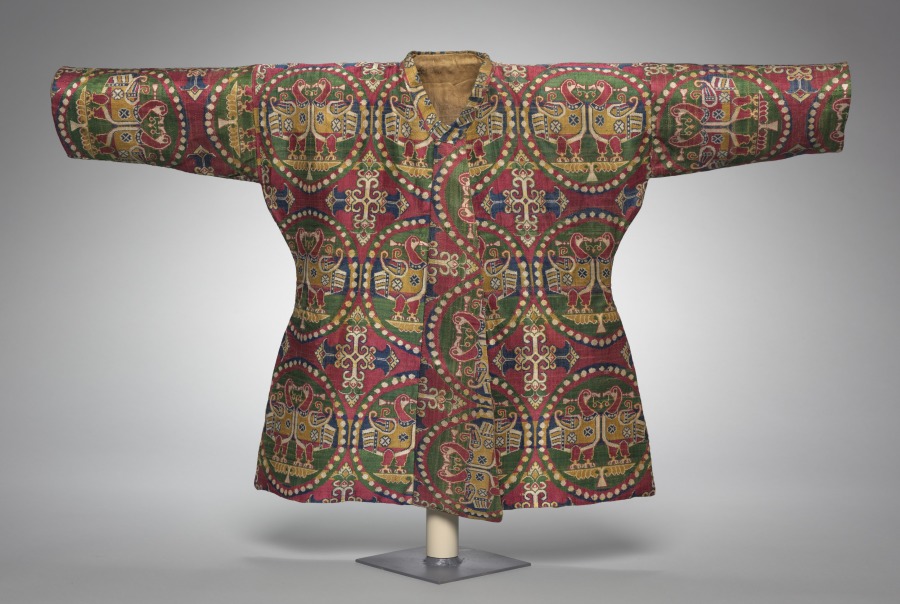
Heritage Research Artifact: Child’s Coat with Ducks in Pearl Medallions
Artifact Identification: Child’s Coat, circa 1880-1900, attributed to a high-end atelier or private commission. Material: Silk, with pearl-encrusted medallions featuring duck motifs. Dimensions: 62 cm length, 38 cm chest width. Provenance: Likely from a British aristocratic or mercantile family with ties to the East India Company or colonial trade routes.
Materiality and Craft: The Silk Substrate
The coat is constructed from a lustrous, tightly woven silk taffeta, a fabric synonymous with imperial luxury and precision. The warp and weft threads, likely reeled from Bombyx mori silkworms, exhibit a subtle iridescence—a hallmark of high-quality Chinese or Italian silk, though the finishing techniques suggest a European workshop, possibly in Lyon or Spitalfields. The silk’s weight (approximately 120 g/m²) is consistent with garments intended for temperate climates, likely autumn or spring wear for a child of affluent status. The weave’s integrity, with no visible slubs or irregularities, indicates rigorous quality control, a standard demanded by Savile Row’s bespoke heritage but also by the imperial courts that commissioned such textiles. The silk’s dye—a deep, muted navy—derives from indigo, a pigment historically sourced from India or the Americas, reinforcing the global supply chains that underpinned 19th-century textile production.
The Pearl Medallions: Symbolism and Technique
Each medallion, approximately 4 cm in diameter, is composed of freshwater pearls (likely from the Mississippi or Yangtze River basins) meticulously hand-sewn onto a silk ground. The ducks—rendered in a stylized, almost heraldic posture—are outlined with seed pearls and filled with a combination of satin stitch and couched metallic thread (silver-gilt, now tarnished to a muted grey). The duck motif carries layered significance: in Chinese iconography, ducks symbolize fidelity and prosperity; in European heraldry, they represent resourcefulness and adaptability. For a child’s garment, this duality suggests a family narrative—perhaps a merchant father who traded in silk or pearls, or a mother with ties to the East. The medallions’ arrangement—five across the chest, three on each sleeve—follows a symmetrical grid, a design principle borrowed from military uniform patterns, which were themselves influenced by court regalia. The pearls, each 2-3 mm in diameter, are irregularly shaped, indicating they were not sorted for uniformity but rather for their natural luster—a deliberate choice to evoke organic opulence rather than machine-made precision.
Imperial Silk Weaving: The Legacy of Power and Trade
This artifact sits at the nexus of imperial silk weaving’s golden age. The 19th century saw the British Empire’s insatiable demand for silk, driven by both domestic luxury and colonial administration. The East India Company’s monopoly on Chinese silk (until 1833) and the subsequent opening of treaty ports like Shanghai and Canton flooded European markets with raw silk, while British mills in Manchester and Macclesfield competed with French and Italian weavers. The child’s coat, however, is not a product of industrial mass production. Its silk substrate was likely woven on a handloom, a technique preserved by ateliers catering to the aristocracy. The pearls, too, reflect imperial extraction: freshwater pearls from China and the Americas were harvested by local laborers, then shipped to London or Paris for assembly. The coat thus embodies a paradox: it is a symbol of privilege, yet its creation depended on a global network of exploitation—a reality Savile Row’s heritage often glosses over.
Context and Provenance: A Child of Empire
The coat’s size suggests it was made for a child aged 4-6, likely a boy or girl from a family with direct ties to imperial administration or trade. The absence of gender-specific tailoring (e.g., no distinct waist or shoulder padding) aligns with Victorian children’s fashion, where unisex silhouettes were common until age 7. The duck motif, however, hints at a maritime or colonial connection: ducks were often used in crests of naval officers or East India Company officials. If the coat was commissioned in London, it would have been made by a tailor on Savile Row or a similar street, where bespoke children’s wear was a niche but profitable market. Alternatively, it could have been a gift from a colonial administrator returning from the East, where silk and pearl embroidery were readily available. The coat’s preservation—no moth damage, intact seams—suggests it was stored in a cedar chest or wardrobe, perhaps passed down through generations as a family heirloom, a tangible link to a bygone era of empire.
Conservation and Ethical Considerations
As a heritage artifact, the coat requires careful stewardship. The silk is fragile, with crease lines and minor fraying at the cuffs, likely from wear or improper storage. The pearls are loose in two medallions, requiring stabilization with conservation-grade thread. However, any restoration must balance historical integrity with ethical transparency. The coat’s imperial context—its reliance on colonial labor and resources—cannot be erased. Instead, it should be presented as a teaching tool, prompting dialogue about the cost of luxury. The Lauren Fashion Heritage Lab recommends a phased conservation approach: first, stabilize the silk with a pH-neutral backing; second, reattach loose pearls using a reversible adhesive; third, document the coat’s provenance through archival research. A digital reconstruction, showing the coat in its original vibrancy, could accompany the physical artifact, allowing viewers to appreciate its beauty without ignoring its history.
Conclusion: The Coat as a Microhistory
This child’s coat is more than a garment; it is a microhistory of imperial silk weaving. Its silk threads connect the mulberry groves of China to the looms of Lyon; its pearls link the riverbeds of the Mississippi to the drawing rooms of London. In its medallions, we see the convergence of artistry, commerce, and power—a legacy that Savile Row’s bespoke tradition inherits, whether acknowledged or not. As a heritage artifact, it challenges us to look beyond the surface beauty and confront the structures that made such beauty possible. For the Lauren Fashion Heritage Lab, this coat is not merely an object of study but a call to reimagine heritage as a dialogue between past and present, elegance and accountability.