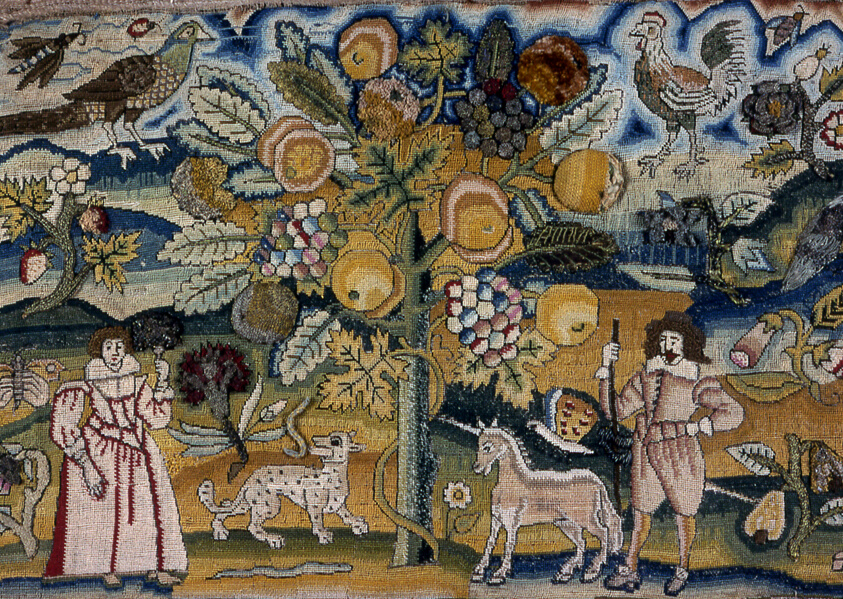
The Materiality of Eden: A Technical and Cultural Analysis of the Adam and Eve Needlework Picture
Introduction: The Convergence of Craft and Narrative
Within the hallowed tradition of British decorative arts, few artifacts capture the intersection of technical virtuosity and theological narrative as compellingly as the needlework picture depicting Adam and Eve. This piece, executed on a ground of plain-weave linen and enriched with an extraordinary palette of silk, metal-wrapped threads, and glass beads, represents the apogee of 17th-century English domestic craftsmanship. As a Senior Heritage Specialist at Lauren Fashion Heritage Lab, I approach this artifact not merely as a decorative object but as a material document—a testament to the cultural, economic, and aesthetic values of its era. The work’s foundation in silk, a fiber synonymous with luxury and refinement, establishes its place within a lineage of elite production that resonates with the exacting standards of London’s Savile Row.
Materiality: The Language of Silk and Metal
The primary support of this needlework picture is linen, plain weave, chosen for its durability and neutral ground, which allows the embroidered elements to command attention. Yet it is the embroidery materials that define the piece’s status. The use of silk and creped silk yarns introduces a fluid, luminous quality, with the creped variant offering a subtle texture that catches light differently than its smooth counterpart. This interplay of sheen and matte surfaces is a hallmark of sophisticated silk craftsmanship, akin to the way a Savile Row tailor selects worsted wool for its drape or silk lining for its whisper against the skin.
The inclusion of gilt-metal purl and wire, gilt-metal-wire-wrapped silk, and gilt-metal-strip-wrapped silk elevates the piece from mere needlework to a form of textile jewelry. The metal threads, meticulously applied through techniques such as couching and raised and couched buttonhole, create a three-dimensional effect that mimics the gilded halos and divine light of religious iconography. The buttonhole filling, plaited braid, square chain, and tent stitches demonstrate a mastery of surface ornamentation, each stitch chosen for its structural integrity and visual impact. The knotted pile adds a tactile dimension, inviting touch while reinforcing the narrative’s sensory richness.
Technical Execution: Stitch as Sculpture
The technical repertoire employed in this piece reflects a deep understanding of textile engineering. The tent stitch, a staple of canvas work, provides a dense, uniform background that anchors the composition. In contrast, the raised and couched buttonhole creates a bas-relief effect, particularly evident in the rendering of Adam’s musculature and Eve’s flowing hair. This technique, which involves building up layers of thread before covering them with buttonhole stitches, transforms flat linen into a sculptural surface. The plaited braid and square chain stitches delineate the Tree of Knowledge, its branches twisting with a sinuous energy that echoes the serpent’s temptation.
The glass beads, interspersed throughout the foliage and figures, introduce a reflective quality that shifts with the viewer’s perspective. This use of beadwork, while decorative, also serves a symbolic function: the beads catch light as the forbidden fruit catches desire, a subtle nod to the narrative’s moral complexity. The gilt-metal purl, a fine coil of metal wire, is couched in parallel lines to simulate the texture of bark and the serpent’s scales, demonstrating a meticulous attention to naturalistic detail.
Cultural Context: Silk and the Domestic Sphere
In 17th-century England, silk was a marker of status and piety. The production of needlework pictures, often by women of the gentry and merchant classes, was both a leisure activity and a demonstration of moral virtue. This Adam and Eve piece, with its biblical subject and luxurious materials, would have been displayed in a prominent domestic space—perhaps a parlor or withdrawing room—as a testament to the household’s refinement and religious devotion. The choice of silk, imported at great expense from Italy and the Far East, underscores the economic networks that connected English homes to global trade routes.
The fluid elegance of the silk threads, combined with the rigid structure of the metal wires, mirrors the tension between human frailty and divine order inherent in the Genesis story. The creped silk yarns, with their irregular surface, evoke the texture of leaves and the softness of skin, while the gilt-metal-strip-wrapped silk suggests the unattainable brilliance of paradise. This duality is central to the piece’s aesthetic power: it is at once intimate and grandiose, personal and universal.
Savile Row Parallels: Craftsmanship as Heritage
The ethos of this needlework picture aligns closely with the principles of London’s Savile Row, where bespoke tailoring is defined by an uncompromising commitment to material quality and technical precision. Just as a Savile Row cutter selects a length of Harris Tweed or Holland & Sherry cloth for its weight, drape, and longevity, the embroiderer of this piece chose linen for its stability and silk for its luster. The buttonhole filling and plaited braid stitches are analogous to the hand-sewn buttonholes and pick-stitching that distinguish a bespoke suit from its ready-made counterpart. Both traditions celebrate the invisible labor of the hand, the hours of stitching that transform raw materials into objects of enduring value.
Moreover, the piece’s narrative function—its role in communicating status, faith, and cultural literacy—mirrors the semiotics of Savile Row attire. A well-tailored suit speaks of discipline, taste, and heritage; this needlework picture speaks of piety, skill, and domestic prosperity. Both are artifacts of a system in which craftsmanship is not merely a means of production but a language of identity.
Conclusion: A Legacy in Thread
The Adam and Eve needlework picture, with its foundation in linen and its elevation through silk, metal, and beadwork, stands as a masterwork of textile art. Its technical complexity—from the raised and couched buttonhole to the knotted pile—reflects a deep engagement with materiality that transcends mere decoration. As a heritage artifact, it offers insight into the cultural values of 17th-century England, where silk was both a commodity and a symbol, and where the act of embroidery was a meditation on faith, femininity, and the domestic sphere. For the modern observer, particularly those attuned to the traditions of Savile Row, this piece serves as a reminder that true craftsmanship is timeless—a thread that connects the needleworker’s hand to the tailor’s, the past to the present, and the material to the divine.