← BACK TO ARCHIVES
Silk
Heritage Synthesis: Portrait of Kobo Daishi (Kukai)
Curated on May 13, 2026 // Node: LDN-01
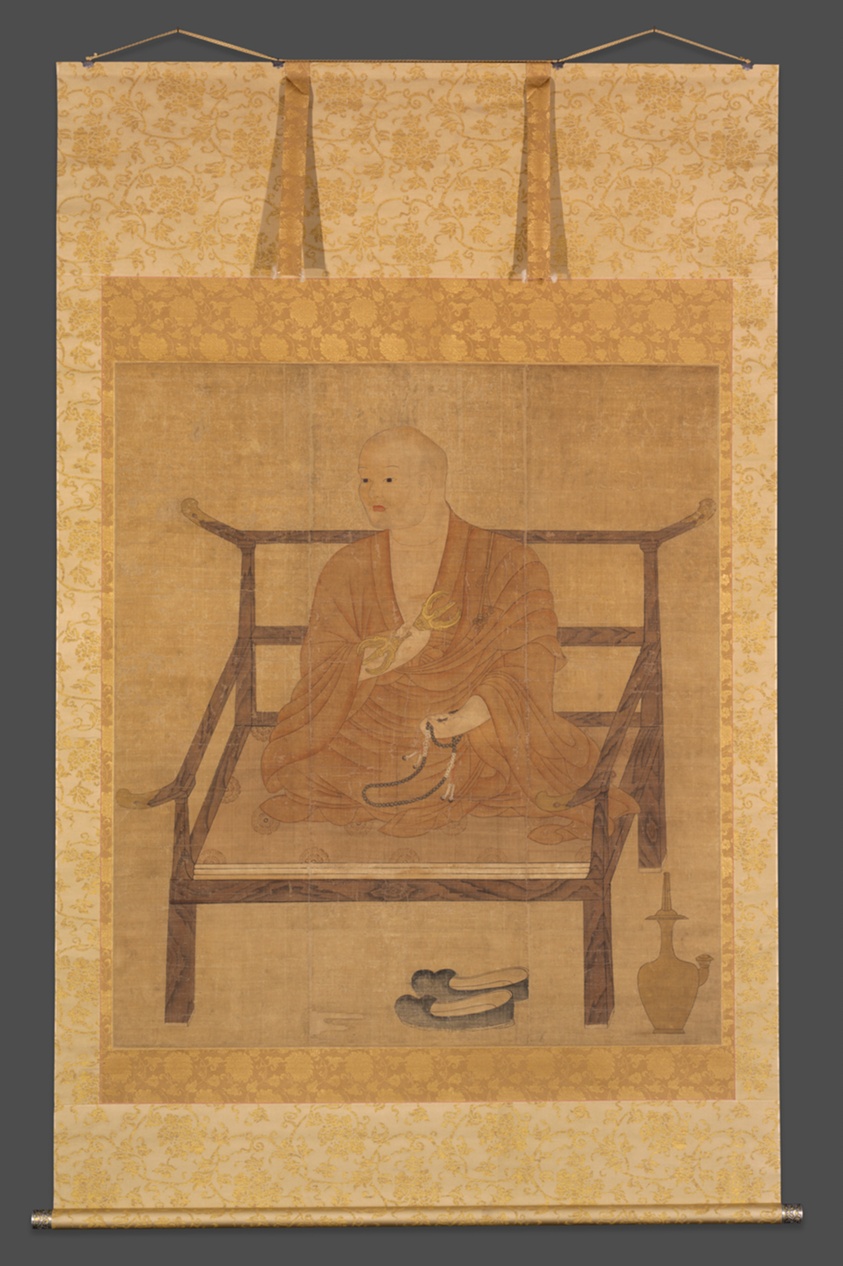
The Materiality of the Divine: Kobo Daishi as a Testament to Silk Craftsmanship
In the hallowed ateliers of London’s Savile Row, where the drape of a cloth is a language spoken in whispers of thread and weave, we understand that materiality is not merely a substrate—it is the first and final statement of intent. The *Portrait of Kobo Daishi (Kukai)*, a hanging scroll executed in ink, colors, and gold on silk, is a masterclass in this principle. It is not a painting that happens to be on silk; it is a dialogue between the divine and the tactile, where the silk itself becomes a medium of transcendence. As a Senior Heritage Specialist at the Lauren Fashion Heritage Lab, I approach this artifact not as a static relic, but as a living document of craftsmanship, one that speaks to the enduring tension between the ephemeral and the eternal—a tension that defines both haute couture and sacred art.
The Silk as Canvas: A Foundation of Fluid Elegance
Silk, in its raw form, is a paradox: it is both delicate and resilient, luminous and opaque. The artisans who prepared the silk for this scroll understood that its surface was not a passive ground but an active participant. The weave—likely a plain or tabby structure, given the period’s preference for smooth, untextured grounds—was chosen for its ability to absorb pigments and gold leaf while retaining a subtle, almost liquid sheen. This is not the stiff, starched silk of later European tapestries; it is a supple, flowing fabric that mirrors the calligraphic lines of Kukai’s robes. The fluid elegance of the silk is not incidental—it is intentional. It allows the brushstrokes to breathe, to move as if animated by the very breath of the monk depicted.
Consider the gold. Applied as leaf or powdered pigment, it does not sit flat on the silk; it catches the light in a manner that shifts with the viewer’s angle, creating a halo effect around Kukai’s head and shoulders. This is not mere decoration. In the context of Esoteric Buddhism, gold signifies the eternal, the immutable. Yet on silk, it becomes something more: a reminder that the divine is always in motion, always refracting through the material world. The gold is not static; it is a living element, much like the silk itself.
Ink and Color: The Discipline of Restraint
The palette of this scroll is restrained—ochre, vermilion, indigo, and black—but each hue is applied with the precision of a Savile Row tailor cutting a bespoke suit. The ink lines, which define Kukai’s facial features and the folds of his robes, are executed with a controlled fluidity that speaks to years of discipline. There is no hesitation in these strokes; they are the result of a hand trained to see the line before it touches the silk. This is the same ethos that drives a master cutter on Row: the understanding that every mark, every seam, must serve the whole.
The colors, too, are layered with intention. The vermilion of Kukai’s inner robe is not a flat red; it is built from multiple washes, each one allowing the silk to show through, creating a depth that mimics the translucency of actual fabric. The indigo of his outer garment is similarly nuanced, shifting from deep navy to a lighter, almost ethereal blue near the edges. This is not accident; it is the result of a technique known as *tsukuri-e*, or “built-up painting,” where pigments are applied in successive layers to achieve a luminous, almost three-dimensional effect. The silk, in this process, is not a barrier but a collaborator, its natural sheen amplifying the colors from within.
The Craftsmanship of the Scroll: A Study in Tension
A hanging scroll is not a static object; it is designed to be unrolled, viewed, and re-rolled. This act of handling places immense stress on the silk, which must remain flexible yet durable. The artisans who constructed this scroll understood this tension intimately. The silk was mounted on a paper backing, then attached to a wooden roller, with a protective silk border—often in a contrasting color—to guard against wear. This is the same principle that governs the construction of a bespoke garment: the unseen elements are as important as the visible ones. The stitching, the interfacing, the lining—these are the silent heroes of longevity.
In the *Portrait of Kobo Daishi*, the silk border is a deep, muted gold, echoing the gold leaf of the central image. This is not merely decorative; it frames the composition, drawing the eye inward while protecting the edges from fraying. The roller, too, is a study in craftsmanship. Made from wood, often lacquered or wrapped in silk, it must balance the weight of the scroll while allowing for smooth rotation. This is engineering as art, a lesson that Savile Row tailors know well: a jacket must hang, move, and rest with equal grace.
Heritage and the Living Fabric
What does this artifact teach us about heritage? That materiality is not a fixed state but a continuum. The silk of this scroll was once a living thread, spun from the cocoon of a silkworm, dyed with plant and mineral pigments, and woven by hands that have long since turned to dust. Yet it remains, not as a fossil, but as a vibrant surface that continues to interact with light, air, and touch. This is the essence of heritage: not preservation for its own sake, but a dialogue between past and present.
At the Lauren Fashion Heritage Lab, we often speak of “the hand”—the trace of the maker left in every stitch, every brushstroke. In this scroll, the hand is everywhere and nowhere. It is in the precise placement of gold leaf, in the delicate wash of indigo, in the way the silk yields to the brush. It is a reminder that craftsmanship is not about perfection; it is about intention. And intention, when executed with discipline, becomes timeless.
Conclusion: The Eternal Thread
The *Portrait of Kobo Daishi* is more than a religious icon; it is a testament to the power of materiality. The silk, the ink, the gold—they are not separate elements but a unified whole, each one enhancing the other. This is the lesson for those of us who work in heritage and fashion: that the medium is not a vehicle for the message; it *is* the message. As Kukai himself wrote, “The body is the temple of the mind.” In this scroll, the silk is the temple of the divine. And in its fluid elegance, we find a reflection of our own craft—a craft that, at its best, transcends time.
Heritage Lab Insight
Lab Insight: AIC Silk Archive Node #11548.