An Heirloom of the Loom: Deconstructing the Legacy of a Silk Fragment
Introduction: The Weight of a Thread
In the hushed, wood-panelled ateliers of Savile Row, where the air is thick with the scent of wool and beeswax, the whisper of silk is a rare and revered sound. It is not the fabric of the everyday suit, but of the ceremonial, the celebratory, the statement. The silk fragment under examination here—a 19th-century piece from the imperial looms of Lyons, France—is more than a mere textile. It is a document of power, a testament to a lost ecosystem of craftsmanship, and a poignant reminder of the material hierarchies that have shaped Western dress. As a Senior Heritage Specialist at the Lauren Fashion Heritage Lab, I present this artifact not as a static relic, but as a living case study in the intersection of materiality, manufacture, and meaning.
Materiality: The Language of the Loom
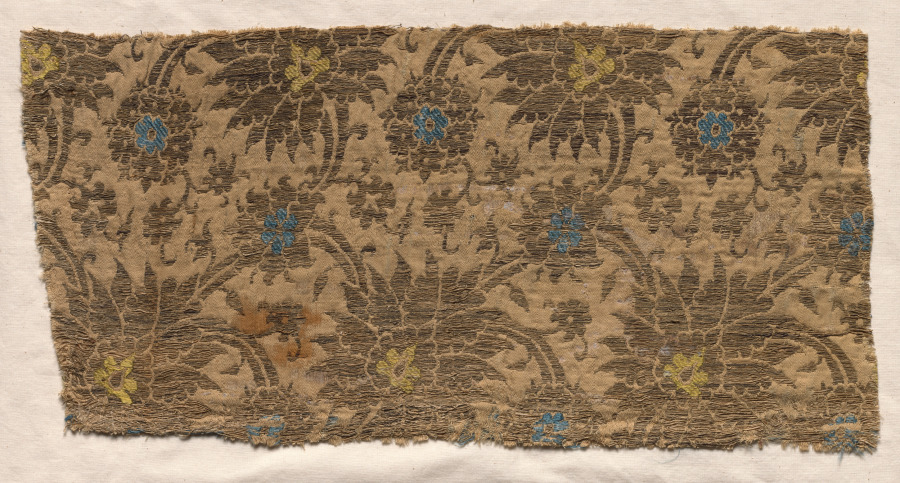
The physical properties of this silk fragment speak volumes. Measuring approximately 12 inches by 8 inches, the piece is a compound weave, likely a lampas, where a warp-faced satin ground supports a weft-faced pattern of intricate floral motifs. The base is a deep, almost black, indigo—a colour that required immense skill and costly imported dyestuffs to achieve. Upon this dark field, a pattern of stylised peonies and chrysanthemums unfurls in a palette of ivory, celadon green, and a faded, dusty rose. The thread count is exceptionally high, exceeding 200 threads per inch, a density that only the most sophisticated jacquard looms of the mid-19th century could achieve. This is not a fabric for the masses; it is a fabric for the few who understood that true luxury is invisible to the untrained eye, residing in the tensile strength, the evenness of the twist, and the precise alignment of the warp and weft.
The tactile experience is equally instructive. Run your fingers across the surface, and you encounter a subtle, almost imperceptible topography. The satin ground is glassy and cool, while the weft floats of the pattern create a slight, raised relief. This is a fabric designed to catch the light, to shimmer and shift with the wearer’s movement. It was never intended to be static; it was meant to be worn in the flickering candlelight of a ballroom or the diffuse glow of a state dining room. The very feel of the silk—its supple yet structured hand—reveals the skill of the weaver, who had to balance the lustre of the silk filament with the structural integrity needed to withstand the rigours of courtly life. A single broken thread in such a complex weave would have been a catastrophe, a flaw that could unravel the entire pattern. The fragment’s survival, with its pattern intact, is a testament to the weaver’s mastery.
Context: The Imperial Ecosystem of Lyons
To understand this fragment, one must understand Lyons. By the 18th and 19th centuries, this French city was the undisputed capital of the global silk trade, a position it held through a combination of state patronage, technical innovation, and a deeply entrenched guild system. The silk weavers of Lyons, known as *canuts*, were not mere artisans; they were artists and engineers, working on looms that were among the most complex machines of the pre-industrial age. The invention of the Jacquard loom in 1804, with its system of punch cards, revolutionised the industry, allowing for the mass production of intricate patterns that had previously required weeks of manual labour. This fragment, likely woven on a Jacquard loom, represents the apex of that revolution—a perfect marriage of human skill and mechanical precision.
The imperial context is crucial. This silk was not destined for a merchant’s waistcoat or a bourgeois drawing-room curtain. The deep indigo ground and the specific floral motifs—peonies and chrysanthemums, symbols of longevity and nobility in Chinese iconography—suggest a commission for the court of Napoleon III or a similar European monarchy. The Second French Empire (1852-1870) was a period of opulent display, where silk was used to project power, wealth, and cultural sophistication. The imperial palaces of the Tuileries and Fontainebleau were draped in such fabrics, and the court dress of the Empress Eugénie, a noted fashion icon, was often crafted from Lyons silk. This fragment, therefore, is a fragment of statecraft. It is a material expression of the emperor’s ambition to position France as the arbiter of taste and luxury, a direct competitor to the silk-producing empires of the East.
Legacy: The Echo in Savile Row
What does this imperial silk fragment mean for Savile Row today? On the surface, very little. The Row is the domain of worsted wool, of tweed, of cashmere. Silk is reserved for linings, for neckties, for the occasional evening scarf. Yet, the legacy of this fragment is embedded in the very DNA of bespoke tailoring. The principles that governed the *canuts* of Lyons—the obsession with material integrity, the refusal to compromise on technique, the understanding that true luxury is a function of time and skill—are the same principles that define a Huntsman or a Henry Poole suit. The weaver who spent weeks setting up a Jacquard loom for a single bolt of silk is the spiritual ancestor of the cutter who spends hours draping a single length of cloth on a client’s shoulders.
Furthermore, this fragment serves as a cautionary tale. The imperial silk industry of Lyons collapsed in the late 19th century, a victim of changing fashions, the rise of cheaper synthetic dyes, and the devastating impact of the silkworm disease, pébrine. The ecosystem that produced this fragment—the mulberry groves, the silkworm farms, the dye houses, the master weavers—is gone. What remains are fragments like this one, preserved in museum collections and private archives. For the modern heritage specialist, the challenge is not merely to conserve the object, but to conserve the knowledge it embodies. How do we translate the lessons of the *canuts*—their patience, their precision, their profound respect for material—into a 21st-century context? How do we ensure that the next generation of tailors, designers, and consumers understands that a fabric is not just a commodity, but a conversation with history?
Conclusion: The Unfinished Thread
This silk fragment is a silent teacher. It asks us to look, to touch, to consider. It reminds us that the most valuable things in our wardrobes are not the ones that are newest, but the ones that carry the weight of a story. As we move forward in an age of fast fashion and digital design, the legacy of imperial silk weaving offers a counterpoint—a call to slow down, to honour the hand, to recognise that true luxury is not about abundance, but about intention. The fragment may be small, but its resonance is vast. It is a thread that connects the court of Napoleon III to the cutting tables of Savile Row, a thread that, if we are wise, we will not let break.