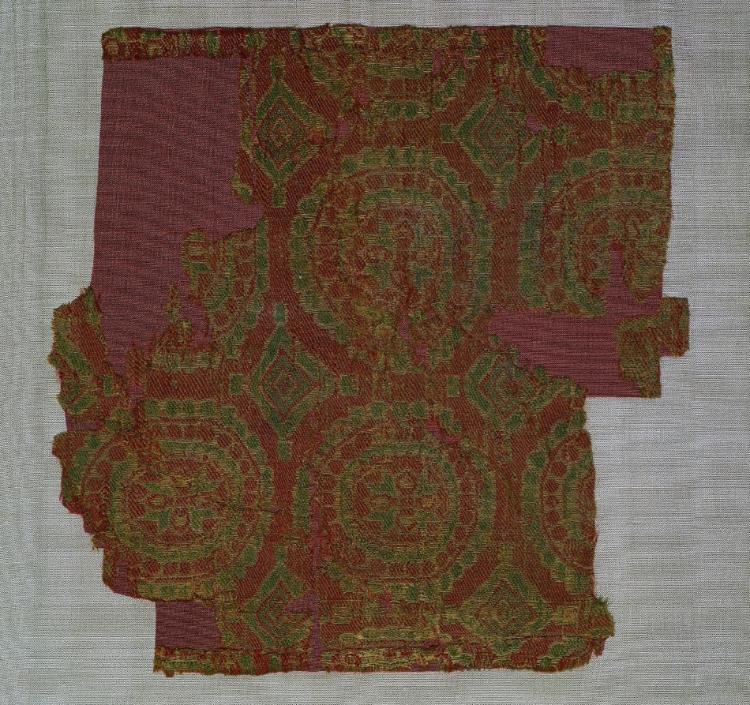
An Examination of Imperial Authority Woven in Thread: The Samite with Rosette Roundels
To comprehend the samite fragment under consideration—a specimen of silk bearing the distinct, repetitive motif of rosettes enclosed within rounded borders—is to engage with a narrative far exceeding mere decorative appeal. One must approach it not as a simple textile, but as a consummate expression of systemic power, technological mastery, and a deliberately cultivated aesthetic language designed for imperial consumption. The very materiality of silk establishes the foundational premise: this is a commodity of such profound value and controlled provenance that its possession and display were, for centuries, a privilege legally and logistically reserved for the uppermost echelons of Byzantine, and later, European society. The fabric itself is a testament to a protected industrial secret, the sericulture and complex loom technology of which represented a state monopoly of the highest order.
The Grammar of Power: Roundels as Heraldic Precedent
The motif, at first glance, may appear purely botanical—a stylised floral rosette. However, to the discerning eye, its presentation within a series of perfectly executed roundels (orbiculi) reveals a deeper purpose. This structural device is not arbitrary. It imposes order, containment, and rhythmic authority upon the field of the cloth. The rounded functions as a frame, a medallion of significance, isolating and elevating the central emblem. In this, one perceives the direct precursor to the heraldic devices that would later adorn the tabards of European nobility and the liveries of great houses. The rosette within is thus not a mere flower; it is an insignia of office or affiliation, likely indicative of a specific workshop within the imperial *gynaeceum* or destined for a particular faction or ceremonial purpose within the court hierarchy. The repetition across the fabric’s surface is a deliberate statement of boundless, replicable power—an empire’s identity woven into an endless, portable procession.
Technical Mastery and the Economics of Astonishment
The production of such a textile was an enterprise of formidable complexity, representing a significant capital investment in both human and mechanical terms. The samite weave—a weft-faced compound twill—allowed for the creation of these detailed, polychrome patterns without compromising the drape and substance of the cloth. This technical achievement facilitated the “economics of astonishment” central to imperial diplomacy. Such silks were not merely garments; they were instruments of statecraft. Presented as diplomatic *largesse* to barbarian kings or gifted to secure the allegiance of a distant bishop, their value was multifaceted. They conveyed the technological and cultural superiority of the donor, embedded the recipient within a network of patronage defined by Byzantine taste, and created a dependency on a source of prestige that could be, if necessary, withheld. The samite, therefore, operated as a soft-power currency of the highest denomination.
From Sacred Vestment to Secular Heirloom: A Legacy in Continuum
The journey of this aesthetic and technical legacy, following the eventual dissemination of silk knowledge beyond Byzantium, is a study in adaptive reinvention. The rounded motif, once an explicit symbol of a single emperor’s divine mandate, evolved. In the medieval West, it found a new sanctity within ecclesiastical vestments, wrapping saints and bishops in a cloth whose imperial lineage lent authority to the Church. The contained, emblematic nature of the design translated seamlessly into the world of secular heraldry, providing a formal language for familial identity. Crucially, the underlying principle—that a specific, repeatable pattern woven into luxury cloth conveys status, affiliation, and authority—never dissipated.
It is this very principle that finds its most refined, sartorial expression in the bespoke tailoring of Savile Row. While the medium has shifted from Byzantine silk to Scottish tweed or English worsted, the conceptual through-line remains palpable. The bespoke garment is an exercise in contained, personal insignia. The meticulously cut silhouette, the exclusive cloth pattern, the discreet ticket pocket or distinctive lapel roll—each is a modern rounded, a subtle, repeatable emblem of belonging to a particular tradition of excellence. The client’s monogram woven into the lining is the direct descendant of the imperial rosette. Both function as a proprietary mark, signalling initiation into a rarefied realm of consumption where quality is mandated and history is worn upon the person.
Conclusion: The Cloth of Empire and Its Enduring Thread
In final analysis, the samite with rosette roundels stands as a definitive artefact of imperial ambition. It is a confluence of biological mastery (the silkworm), mechanical innovation (the draw-loom), and sophisticated iconography. Its value was simultaneously intrinsic, symbolic, and political. To drape oneself in such a fabric was to be enveloped by the ideology of the state, to become a mobile testament to its reach and refinement. The legacy of this imperial silk weaving is not confined to museums; it is woven into the very fabric of how civilisations construct and project identity through material culture. It established a paradigm—that the most exclusive cloth serves as a canvas for power—a paradigm that, though softened and secularised, continues to inform the apex of the sartorial arts to this very day. The rosette may have faded, but the rounded, in spirit, endures.