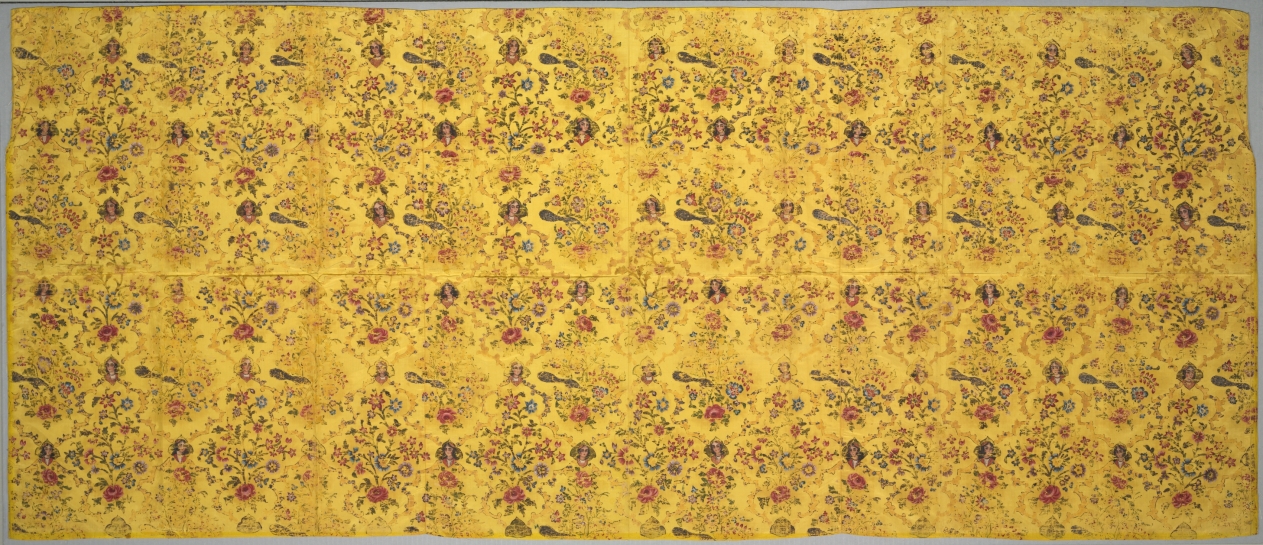
The Peacock and the Portrait: A Silk Wall Covering as Imperial Legacy
In the hushed, wood-paneled ateliers of London’s Savile Row, where the measure of a man is taken in cloth and the whisper of shears is a sacred sound, we understand that true luxury is not merely seen—it is felt. It is the weight of a worsted wool, the give of a cashmere, the luminous, almost liquid, hand of a silk that has been woven with the precision of a master craftsman. The artifact before us—a wall covering of silk, embellished with flora, peacocks, and portrait medallions—is not a textile. It is a document. It is a testament to the enduring legacy of imperial silk weaving, a legacy that, like the finest bespoke suit, is built upon an unbroken chain of technique, taste, and power.
Materiality: The Unspoken Language of Silk
Silk is not a fabric; it is a declaration. In the context of imperial weaving, it was the medium of statecraft, the material of diplomacy, and the ultimate signifier of status. The very act of producing this wall covering would have begun in the sericulture of the East, where the Bombyx mori silkworm spun its cocoon in a process so secret that its revelation was once punishable by death. The resulting filament—a continuous, lustrous protein fiber—was then shipped, often via the Silk Road, to the great weaving centers of Europe: Lyon, Venice, and, most critically for this artifact, the imperial manufactories of France and Italy.
The materiality of this piece is its first and most profound statement. The silk is not a simple tabby or twill; it is a compound weave, likely a lampas or a damask, where the ground and the pattern are woven in two distinct sets of warps and wefts. This allows for a complex interplay of light and shadow, of matte and sheen. The ground is a deep, resonant indigo—a color so difficult to achieve in natural dyes that it was reserved for the highest echelons of society. The pattern, woven in a contrasting cream and gold thread, is not printed or painted; it is integral to the structure of the cloth. This is the hallmark of imperial weaving: the pattern is not an addition; it is the cloth itself.
Iconography: The Peacock, the Flora, and the Portrait
The design of this wall covering is a carefully curated narrative, a visual language that would have been immediately legible to its intended audience. The peacock, with its iridescent tail feathers, is a universal symbol of immortality, resurrection, and, most importantly, royalty. In the context of imperial silk, the peacock is not merely decorative; it is a heraldic device. It speaks to the divine right of the monarch, the eternal nature of the dynasty. The peacock’s eye, woven into the fabric, is a constant, watchful presence, a reminder of the sovereign’s omnipresence.
The flora is equally deliberate. The intertwining vines, the stylized leaves, and the blossoms—likely pomegranates, lotus, or chrysanthemums—are not random botanical studies. They are symbols of fertility, prosperity, and the cyclical nature of life. The pomegranate, with its multitude of seeds, represents abundance and unity. The lotus, rising from the mud, signifies purity and spiritual awakening. These motifs, woven into the silk, create a microcosm of the ideal imperial garden: ordered, abundant, and eternal.
The portrait medallions are the most telling element. These are not generic faces; they are likely representations of the reigning monarch, his consort, or a dynastic ancestor. The medallion format, often framed by a laurel wreath or a ribbon, is a direct reference to Roman imperial portraiture, a classical language of power that was revived in the Renaissance and Baroque periods. The inclusion of these portraits transforms the wall covering from a decorative object into a political statement. It is a woven portrait gallery, a constant reminder of the sovereign’s lineage and authority. In a palace or a state apartment, this silk would have served as a backdrop to court life, a silent witness to every audience, every negotiation, every act of governance.
Legacy: The Unbroken Thread of Imperial Weaving
The legacy of imperial silk weaving is not a relic of the past; it is a living tradition that informs the very fabric of luxury today. The techniques developed in the imperial manufactories—the complex drawlooms, the precise registration of multiple warps, the use of gold and silver threads—are the direct ancestors of the jacquard looms that produce the finest bespoke fabrics for Savile Row. The weavers who created this wall covering were not artisans; they were artists, trained in a discipline that demanded years of apprenticeship and a deep understanding of mathematics, chemistry, and design.
This wall covering, now a heritage artifact, was once a functional object. It was hung in a room that was designed to impress, to intimidate, and to inspire. It was a tool of soft power, a visual representation of the wealth and sophistication of its owner. Today, it serves a different purpose. It is a research artifact, a primary source that allows us to understand the material culture of empire. It tells us about trade routes, about dyeing techniques, about the movement of motifs across continents. It tells us about the relationship between art and power, between craft and commerce.
For the modern connoisseur, this silk wall covering is a reminder that true luxury is not about trend or novelty. It is about provenance, about craftsmanship, about the story that a material can tell. On Savile Row, we do not simply cut cloth; we cut a narrative. We understand that a suit is not just a garment; it is a legacy. And this silk, with its peacocks and its portraits, is the ultimate expression of that principle. It is a woven history, a fabric of power, and a testament to the enduring, unbroken thread of imperial silk weaving.