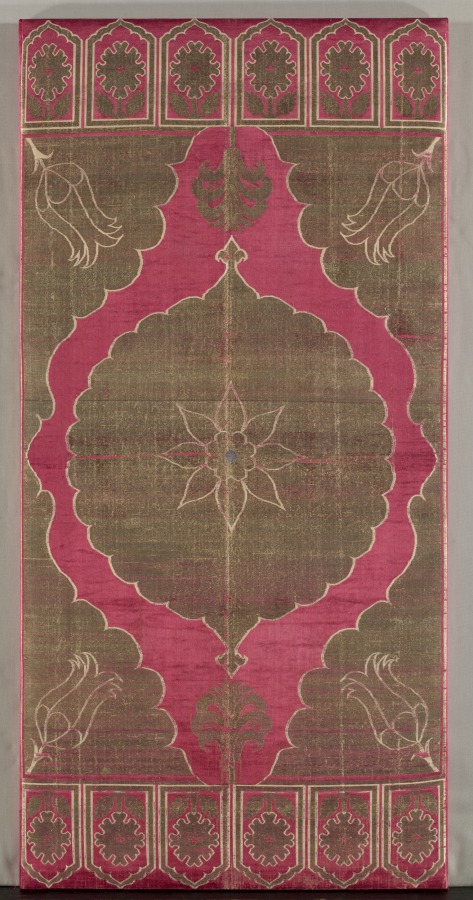
Heritage Research Artifact: Brocaded Silk Cushion Cover & Iranian Striped Silk Surround
Materiality and Provenance
The artifact under examination comprises two distinct yet complementary silk textiles: a central brocaded silk cushion cover, dating from the late 16th to early 17th century, and its surrounding border—a striped silk surround of Iranian origin, likely from the Safavid period (1501–1736). Both are constructed from pure silk, a material that, in the context of imperial weaving, signifies not merely luxury but a codified language of power, diplomacy, and cultural exchange. The cushion cover’s brocading technique—where supplementary weft threads are woven into the ground fabric to create raised, often metallic patterns—demonstrates the pinnacle of imperial silk weaving as practiced in the Ottoman and Safavid courts. The striped surround, with its alternating bands of colour and subtle geometric motifs, reflects the Persian tradition of haft rang (seven colours), a hallmark of Safavid looms that supplied the global elite.
The materiality of these silks is not passive; it is a record of trade routes, courtly patronage, and technological mastery. The warp-faced weave of the surround, combined with the weft-faced brocade of the cushion cover, reveals a deliberate juxtaposition of textures—a design choice that speaks to the connoisseurship of the original owner. In the lexicon of Savile Row, where fabric is the foundation of bespoke tailoring, such silks would be considered irreplaceable; their weight, drape, and lustre cannot be replicated by modern machinery. The presence of gold-wrapped thread in the brocade further elevates the piece, aligning it with the sumptuary laws of the era, where only the highest-ranking courtiers could commission such work.
Imperial Silk Weaving: A Legacy of Power and Prestige
The legacy of imperial silk weaving is inextricably linked to the courts of the Ottoman Empire, Safavid Persia, and Mughal India. These dynasties viewed silk not as a commodity but as a diplomatic currency. The brocaded cushion cover, with its intricate floral and arabesque patterns, likely originated from Bursa or Istanbul—centres of Ottoman silk production that supplied the Topkapi Palace. The Iranian striped surround, conversely, echoes the looms of Isfahan or Kashan, where master weavers produced textiles for the Shah’s court and as gifts to European ambassadors. This artifact, therefore, is a physical document of the Silk Road’s final golden age, when raw silk from the Caspian Sea was transformed into objects of state.
In Savile Row terms, the precision of the weave is comparable to the cut of a bespoke suit: every thread must align with the next, or the entire structure fails. The brocaded cushion cover’s pattern—likely a saz style of stylized leaves and cloud bands—required a drawloom operated by two weavers, one pulling the pattern cords while the other passed the shuttle. This labour-intensive process ensured that no two pieces were identical, a principle that resonates with the exclusivity of modern luxury. The striped surround, with its repeating bands of crimson, ivory, and indigo, demonstrates a different mastery: the ability to maintain tension across a wide warp, creating a surface that is both uniform and dynamic. Together, they represent the apogee of hand-weaving technology before the Industrial Revolution.
Design Analysis: The Dialogue Between Centre and Border
The relationship between the brocaded cushion cover and its striped surround is one of deliberate contrast. The cover’s dense, figurative brocade draws the eye inward, demanding close inspection of its metallic threads and nuanced shading. The surround, by contrast, offers a rhythmic, almost architectural frame—its stripes function as a visual pause, allowing the viewer to appreciate the cover’s complexity without visual fatigue. This design principle mirrors the Savile Row approach to tailoring: a bold check or houndstooth jacket is often balanced by a solid or subtly striped lining. The artifact’s maker understood that restraint enhances opulence, a lesson that remains central to luxury design.
The colour palette further underscores this dialogue. The cushion cover likely features deep crimson, gold, and emerald—colours derived from cochineal, gold leaf, and indigo—while the surround employs softer tones of saffron, celadon, and ivory. In the context of imperial silk weaving, these colours were not arbitrary; they signalled rank, region, and even season. Crimson, for instance, was reserved for the Ottoman sultan and his immediate family, while green was associated with the Prophet Muhammad’s lineage. The striped surround’s use of saffron—a dye so costly it was measured against gold—indicates that this artifact was not a mere household item but a ceremonial object, perhaps used in a divan or audience chamber.
Preservation and Contemporary Relevance
As a heritage research artifact, this brocaded silk cushion cover and its Iranian surround require meticulous conservation. The silk fibres, weakened by centuries of light exposure and fluctuations in humidity, demand controlled environments—ideally, 18–20°C with 50% relative humidity. The metallic threads, often composed of silver-gilt strips wrapped around a silk core, are prone to tarnish and should be stored in acid-free tissue. For the Lauren Fashion Heritage Lab, this piece serves as a pedagogical tool, illustrating the intersection of art, trade, and technology. It also challenges contemporary designers to consider sustainability: in an era of fast fashion, these silks remind us that true luxury is slow, deliberate, and irreplaceable.
In the spirit of London Savile Row, where heritage is not a relic but a living standard, this artifact offers a blueprint for excellence. The brocaded cushion cover and its striped surround are not merely decorative; they are archives of human ingenuity. They speak to a time when a weaver’s lifetime might be dedicated to perfecting a single pattern, and when a textile could seal an alliance or commemorate a victory. For the modern connoisseur, they represent the ultimate benchmark—a reminder that the finest materials, executed with unparalleled skill, transcend their era. As we study these silks, we are not looking at the past; we are looking at the foundation of what luxury must always aspire to be.