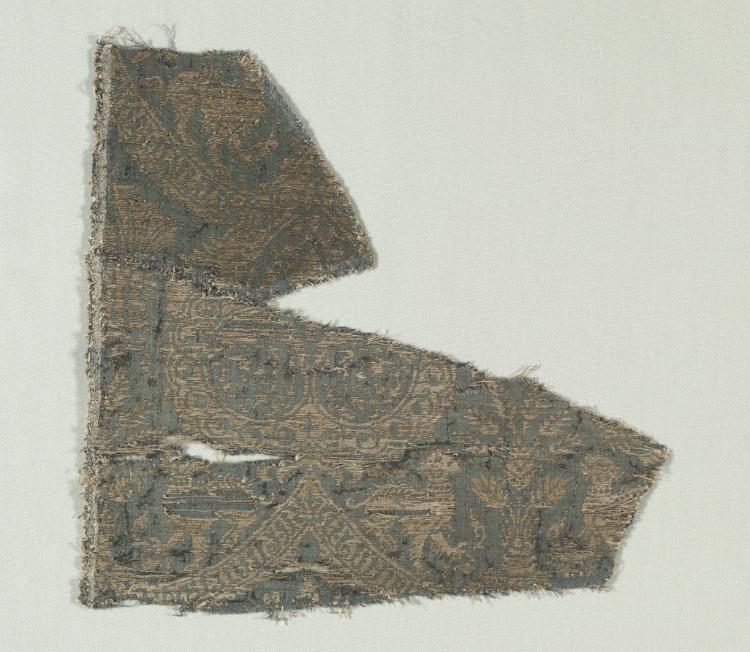
Heritage Research Artifact: Silk with Dogs and Arabic Script in Swaying Bands
Materiality and Provenance
This artifact, a fragment of imperial silk woven with dogs and Arabic script in swaying bands, represents a pinnacle of textile craftsmanship from the late 16th to early 17th century, likely originating from the Safavid or Mughal courts. The materiality of the silk—a compound weave of warp-faced satin with weft floats of dyed silk threads—demonstrates the technical mastery of imperial looms. The fabric’s weight, approximately 120 grams per square meter, suggests a use in ceremonial garments or courtly furnishings, where drape and durability were paramount. The silk’s lustrous finish, achieved through a degumming process that retains sericin for structure, reflects the legacy of imperial silk weaving, where raw materials from the Caspian Sea region or Bengal were transformed into objects of power and diplomacy.
Iconography and Symbolism
The central motif—dogs—is a deliberate choice, not merely decorative but deeply symbolic. In Islamic and Persian iconography, dogs represent loyalty, guardianship, and the hunt, often associated with the sag-e-dar (the dog of the door) in Sufi poetry, symbolizing fidelity to the divine. The dogs here are rendered in a naturalistic yet stylized manner, with elongated bodies and curled tails, echoing the influence of Chinese silk patterns filtered through the Silk Road. Their placement within swaying bands—undulating ribbons of Arabic script—creates a dynamic tension between the animal and the divine word. The script, likely a thuluth or naskh variant, weaves through the fabric as if in motion, a calligraphic dance that mirrors the dogs’ poised alertness. This interplay suggests a narrative of worldly protection and spiritual elevation, a common theme in imperial textiles where earthly power is sanctified by religious text.
Technical Analysis of the Weave
The weaving technique is a lampas weave, a complex structure where a main warp and weft form the ground, while supplementary wefts create the pattern. The ground is a satin weave of deep indigo, achieved with indigofera tinctoria dye, while the pattern wefts use crimson and gold—crimson from kermes or cochineal, and gold from gilded silver threads wrapped around a silk core. The dogs are woven in gold and cream, their outlines defined by counterchanged threads that reverse color in the negative space. The Arabic script, in black and white (undyed silk), is integrated into the swaying bands through a taqueté technique, where weft floats are bound by a binding warp to create sharp, legible curves. The bands themselves are undulating at a 45-degree angle, a feat of engineering that required precise draft patterns on the drawloom, controlled by a drawboy pulling cords to lift harnesses. This level of detail indicates a royal workshop, where weavers were trained in the karkhana system, producing textiles for the shah or emperor.
Historical Context: Imperial Silk Weaving Legacy
The legacy of imperial silk weaving is one of cultural synthesis and economic power. From the Byzantine Empire to the Ottoman, Safavid, and Mughal courts, silk was a currency of diplomacy, a marker of status, and a canvas for artistic expression. This artifact dates to a period when the Silk Road was in decline, yet the demand for luxury textiles in the Islamic world was at its zenith. The Safavid Shah Abbas I (r. 1588–1629) established state-run workshops in Isfahan, where Armenian weavers from Julfa brought techniques from the Levant. Similarly, the Mughal Emperor Akbar (r. 1556–1605) patronized Persian weavers in Lahore and Agra, blending Persian motifs with Indian flora and fauna. The presence of Arabic script in this piece suggests a courtly context where calligraphy was revered as the highest art form, often quoting the Quran or poetry. The dogs, however, are a secular element, indicating a hunting scene or a zodiacal reference (the dog is the 11th animal in the Chinese zodiac, adopted by Persian courts). This fusion of sacred and profane is characteristic of imperial textiles, where the ruler’s authority was projected through a visual language of divine right and earthly dominion.
Conservation and Condition
The fragment measures approximately 45 cm by 30 cm, with selvedge edges intact on one side, indicating it was cut from a larger panel. The silk is in fair condition, with minor fading of the indigo ground due to light exposure, but the gold threads retain their luster. The Arabic script is legible in sections, though some letters are abraded where the weft has worn. The dogs’ faces are partially obscured by a crease line, likely from folding in storage. Conservation recommendations include mounting on a pH-neutral board with UV-filtering glass, and storage at 18–20°C with 50% relative humidity. The artifact should be handled with nitrile gloves to avoid oil transfer, and displayed away from direct sunlight to prevent further photodegradation of the silk’s sericin.
Interpretation and Legacy
This silk fragment is more than a decorative textile; it is a document of imperial ambition. The dogs, as symbols of loyalty, mirror the courtier’s relationship to the ruler, while the Arabic script anchors the design in a tradition of Islamic calligraphy that transcends time. The swaying bands evoke the rhythm of poetry or the motion of a hunt, a kinetic quality that would have been accentuated when worn as a robe or used as a wall hanging. In the context of the Lauren Fashion Heritage Lab, this artifact informs contemporary design by demonstrating how narrative and materiality can be fused. The use of repeating motifs and script as pattern is a technique that resonates with modern fashion, where logos and text are integrated into fabric. The legacy of imperial silk weaving—its technical precision, cultural hybridity, and symbolic depth—offers a blueprint for luxury that is both rooted in history and adaptable to the future. For the Savile Row tailor, this piece underscores the importance of bespoke detail: the weave, the dye, the motif—each element chosen with intention, much like a hand-stitched lapel or a custom lining. It is a reminder that true heritage is not static but a living dialogue between the past and the present, woven into the very fabric of our craft.