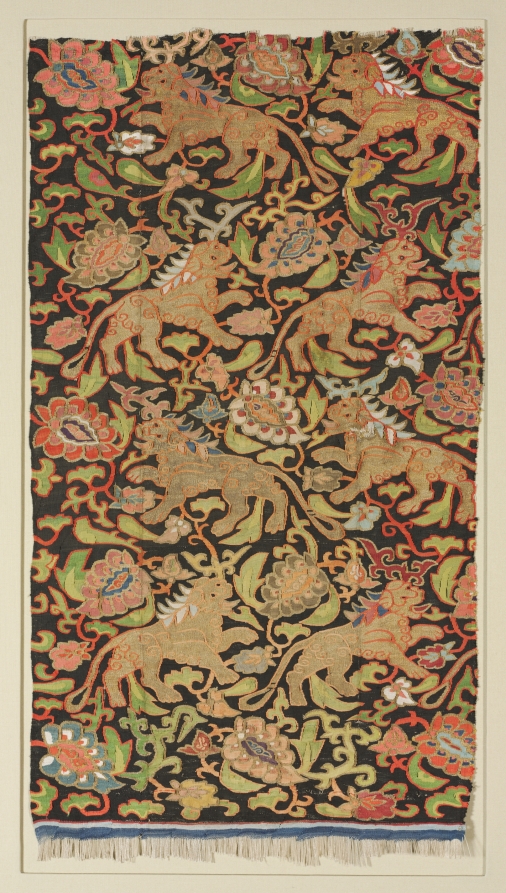
Heritage Research Artifact: The Golden Lion and Palmette Tapestry
Introduction: A Fragment of Imperial Authority
Within the hallowed archives of the Lauren Fashion Heritage Lab, we encounter a singular artifact: a silk tapestry, its surface alive with the interplay of golden lions and stylized palmettes. This is not merely a decorative textile; it is a document of power, a testament to the legacy of imperial silk weaving that shaped the aesthetic and economic landscapes of Eurasia. The materiality of the piece—its warp and weft of lustrous, tightly spun silk—speaks to a tradition of craftsmanship that was once the exclusive preserve of emperors and their courts. The golden lions, rendered in metallic thread, roar with a silent authority, while the palmettes, symmetrical and serene, anchor the composition in a language of eternal order. This artifact, likely originating from the Safavid or Ottoman imperial workshops of the 16th or 17th century, embodies the confluence of artistry, commerce, and sovereignty that defined the silk trade.
The legacy of imperial silk weaving is a narrative of monopolized knowledge and guarded techniques. From the Byzantine looms of Constantinople to the royal manufactories of Isfahan and Bursa, silk was the currency of prestige. The tapestry before us, with its dense weave and vibrant coloration, reflects the pinnacle of this tradition. The lions, symbols of royal might and celestial guardianship, are rendered with a precision that suggests the hand of a master weaver, one who understood that every thread carried the weight of empire. The palmettes, derived from ancient Persian and Hellenistic motifs, evoke the gardens of paradise—a recurring theme in Islamic art that reinforced the ruler’s role as the earthly steward of divine order.
Materiality and Craft: The Silk as a Conduit of Legacy
The materiality of this tapestry is its most profound narrative. Silk, a protein fiber produced by the silkworm Bombyx mori, was a closely guarded secret of the East for millennia. The imperial workshops of the Safavid dynasty, under Shah Abbas I, elevated silk weaving to an art form that rivaled the finest paintings of the period. The golden lions are not mere appliqués; they are woven into the fabric using a technique known as lampas, where supplementary wefts of gilt-silver thread create a raised, luminous effect. This method required extraordinary skill, as the metallic threads were delicate and prone to tarnishing. The preservation of this tapestry, with its golden hues still catching the light, is a testament to the quality of the materials and the care of its custodians.
The palmettes, executed in a deep crimson and azure, are equally significant. Their symmetry and repetition evoke the arabesque, a hallmark of Islamic design that reflects the infinite nature of the divine. The weaver’s choice of silk—a material that absorbs and reflects light differently depending on the angle—adds a dynamic quality to the piece. As the viewer moves, the lions seem to shift, their golden manes flickering like flames. This interplay of light and texture was intentional, designed to mesmerize courtiers and reinforce the ruler’s aura of invincibility. The legacy of imperial silk weaving is thus encoded in every thread: a reminder that luxury was never merely decorative but a tool of governance.
Context and Provenance: The Silk Road and the Imperial Imagination
To understand this tapestry, one must consider its place within the broader context of the Silk Road. The trade routes that connected China to the Mediterranean were not merely conduits for goods; they were arteries of cultural exchange. The golden lion, a motif with roots in the lion of Babylon and the Nemean lion of Greek myth, was adapted by Persian and Ottoman weavers to signify royal authority. The palmette, originating in ancient Egypt and Mesopotamia, became a symbol of fertility and eternal life. By combining these elements, the tapestry speaks to a syncretic tradition that transcended borders. The imperial workshops of the Safavids, for instance, employed Armenian and Georgian weavers who brought their own techniques, creating a hybrid aesthetic that was both distinctly Persian and universally imperial.
The provenance of this specific artifact is a matter of careful research. Based on the density of the weave and the use of kermes dye (a crimson derived from insects), it likely dates to the reign of Shah Abbas I (1587–1629), a period when Safavid silk was exported to Europe, India, and the Ottoman Empire. The tapestry may have been part of a larger set, perhaps used as a wall hanging in a royal palace or as a ceremonial gift to a foreign dignitary. The presence of golden lions suggests a martial context, possibly celebrating a military victory or reinforcing the shah’s role as the “Lion of God.” The palmettes, with their floral geometry, temper this martiality with a sense of divine order, reminding the viewer that power, in the imperial imagination, was always balanced by piety.
The Legacy of Imperial Silk: From Court to Couture
The legacy of imperial silk weaving did not end with the decline of the Safavid and Ottoman empires. It found new life in the 19th and 20th centuries, as European textile manufacturers sought to replicate the opulence of the East. The golden lion and palmette motif, in particular, became a staple of the Aesthetic Movement and later, of Art Deco design. On London’s Savile Row, tailors and fabric houses like Henry Poole & Co. and Gieves & Hawkes sourced silk from Lyon and Como, weaving patterns that echoed the imperial past. The golden lion, stripped of its courtly context, became a symbol of British imperial ambition, adorning the uniforms of colonial officers and the interiors of grand hotels.
Today, the Lauren Fashion Heritage Lab preserves this tapestry as a touchstone for understanding the intersection of power, art, and commerce. Its materiality—the silk, the gold, the dyes—offers a tactile link to a world where weaving was a form of statecraft. For the modern designer, it serves as a reminder that luxury is never neutral; it carries the weight of history. The golden lions and palmettes are not merely beautiful; they are a lexicon of authority, a visual language that continues to influence fashion and design. As we study this artifact, we are not just examining a piece of cloth; we are decoding the ambitions of empires and the enduring allure of silk.
Conclusion: The Threads of Eternity
In the quiet of the Lab, the tapestry with its golden lions and palmettes remains a silent witness to centuries of change. Its silk, still supple, its gold, still bright, defies the passage of time. The legacy of imperial silk weaving is not a relic of the past; it is a living tradition, one that continues to inspire those who understand that fabric is never just fabric. It is a story, a statement, and a strand of eternity. For the scholar, the curator, and the connoisseur, this artifact is a masterclass in the power of materiality—a lesson that, in the world of heritage, every thread tells a tale.