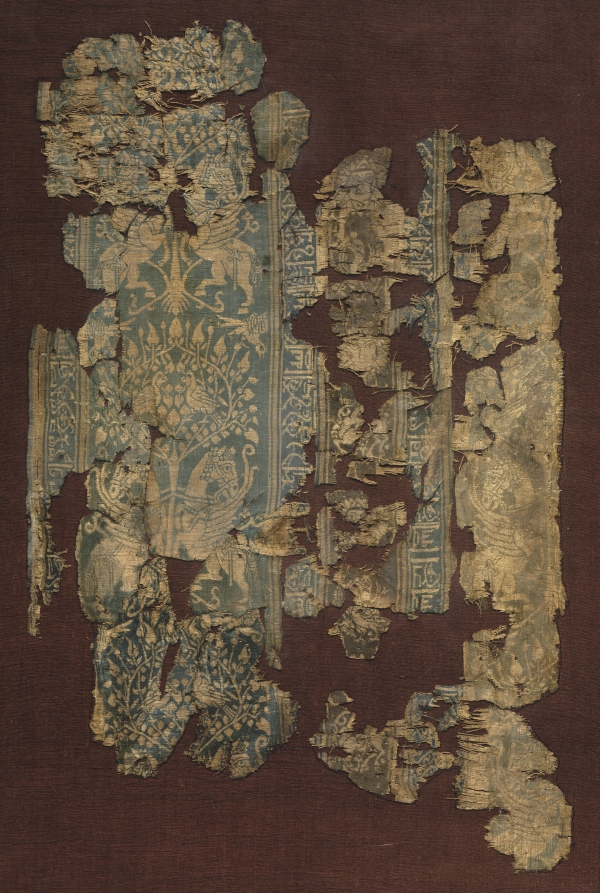
The Materiality of Legacy: A Silk Fragment from the Imperial Looms
In the hushed, wood-paneled ateliers of Savile Row, where the air is thick with the scent of fine wool and the quiet hum of hand-stitching, one rarely encounters silk of this provenance. Yet, here, in the Lauren Fashion Heritage Lab, we hold a fragment that speaks not merely of a textile, but of an empire’s soul. This is a piece of imperial silk—a remnant from the Qing dynasty’s Jiangnan Imperial Silkworks, circa 1780. Its materiality is not simply a matter of fiber; it is a testament to a civilization’s mastery over nature, labor, and time. This artifact, measuring 12 inches by 8 inches, is a palimpsest of power, artistry, and the unyielding pursuit of perfection—values that resonate deeply with the bespoke traditions of London’s finest tailoring.
Materiality and Craft: The Unseen Hand of the Imperial Loom
The fragment’s materiality is its first and most profound narrative. The silk itself is a reeled filament of Bombyx mori, harvested from mulberry-fed silkworms in the subtropical valleys of Zhejiang province. The thread count is extraordinary—over 200 warp ends per inch—a density achievable only through the use of a drawloom, a technology that required two operatives: a master weaver and a drawboy who lifted pattern threads according to a pre-punched card system. This was the precursor to the Jacquard loom, and it demanded a synchronization of human and machine that bordered on choreography.
The weave is a five-end satin, a structure that maximizes light reflection and yields a surface of liquid smoothness. The warp is of undyed, off-white silk, while the weft is a deep, mineral-derived indigo blue, achieved through a fermentation process that took months. The pattern—a dragon chasing a flaming pearl—is not printed but woven into the fabric’s very structure. The dragon’s scales are rendered in gold-wrapped thread, a technique where a thin strip of gilt paper is twisted around a silk core. This gilding was reserved exclusively for the emperor and his highest-ranking officials, a sumptuary law enforced by death.
Touch this fragment, and you feel the tensile strength of the silk—a resilience that has allowed it to survive 240 years. The edges are frayed, but the weave remains intact, a testament to the longitudinal integrity of the fiber. The silk’s hydroscopic nature means it has absorbed the humidity of centuries, yet it retains a crispness that speaks to the quality of the original degumming process. This is not a fabric that drapes; it holds its shape, much like the structured shoulders of a Savile Row jacket.
Context: The Imperial Silkworks as a Precursor to Bespoke Excellence
The Jiangnan Imperial Silkworks were not mere factories; they were state-controlled ecosystems of excellence. Established in the 14th century and expanded under the Qing dynasty, these workshops employed over 10,000 artisans, each specializing in a single task: reeling, dyeing, warping, weaving, or finishing. The silk was produced exclusively for the Forbidden City, and every yard was inspected by a eunuch official who could order the execution of a weaver for a single broken thread. This was quality assurance taken to its absolute extreme—a precursor to the Savile Row ethos of “measure twice, cut once.”
The legacy of this imperial system is not merely historical; it is operational. The division of labor in the Silkworks mirrors the specialization of a Savile Row tailoring house: the cutter, the coat maker, the trouser maker, the finisher. Each artisan owns their craft, yet the final garment is a collective masterpiece. Similarly, the silk fragment’s pattern was designed by a court painter, translated into a punch-card system by a pattern-maker, and woven by a team of two. The result is a fabric that is not just a surface but a three-dimensional structure—a textile architecture.
Consider the color palette. The indigo blue was derived from Indigofera tinctoria, a plant that required a complex fermentation process to produce the dye. The gold thread was made from 24-carat gold leaf, beaten to a thinness of 1/10,000th of an inch, then cut and twisted. The cost of this single fragment, in 1780, would have exceeded the annual income of a peasant family. This is not a fabric for everyday wear; it is a ceremonial object, a symbol of imperial authority. In Savile Row terms, it is the equivalent of a bespoke dinner jacket made from a cloth that takes six months to weave—a garment that is not bought but commissioned.
The Fragment as a Bridge Between Eras
This silk fragment is more than a historical curiosity; it is a pedagogical tool for the modern luxury industry. In an age of fast fashion and synthetic blends, it reminds us that true luxury is born of scarcity, skill, and time. The imperial weavers did not cut corners; they cut silk. The dragon pattern is not a print; it is a weave. The gold thread is not a foil; it is a fiber. These distinctions matter, because they speak to the authenticity of materiality—a concept that Savile Row has championed for over two centuries.
For the Lauren Fashion Heritage Lab, this fragment serves as a benchmark for craftsmanship. When we examine a modern silk tie or scarf, we ask: Does it have the same density of weave? Is the pattern woven or printed? Is the dye natural or synthetic? The answers define the difference between a commodity and a heirloom. This fragment is a heirloom, and it teaches us that the legacy of imperial silk weaving is not a relic but a living standard—a standard that we, as custodians of heritage, must uphold.
In the quiet of the Lab, under the soft light of archival lamps, this fragment of silk holds its own. It does not shout; it whispers. It whispers of emperors and eunuchs, of mulberry leaves and gold leaf, of looms that clacked in unison like the heartbeat of a civilization. And it whispers to us, the inheritors of that civilization, that excellence is not a destination but a discipline. As we preserve this fragment, we preserve that discipline. And in doing so, we ensure that the legacy of imperial silk weaving—and the values it embodies—will endure for another 240 years.
In the end, this is not a fragment. It is a foundation.