← BACK TO ARCHIVES
Silk
Heritage Synthesis: One Hundred Cranes 百鶴圖
Curated on May 15, 2026 // Node: LDN-01
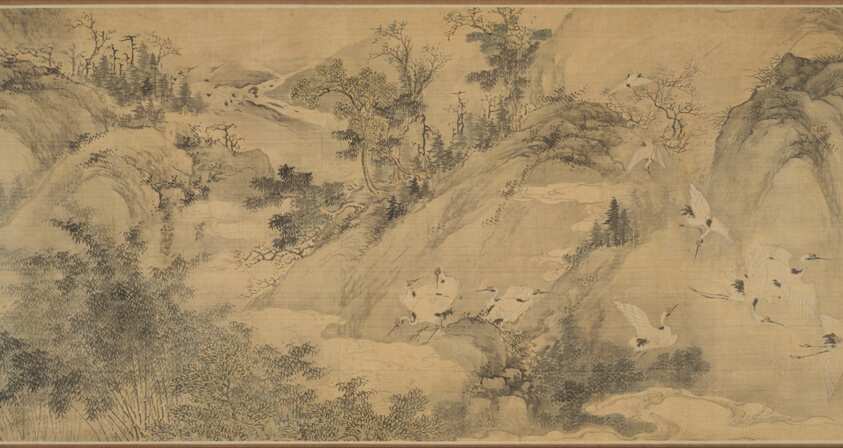
One Hundred Cranes 百鶴圖: A Study in Materiality and Craft
In the rarefied echelons of heritage textiles, where the whisper of silk against skin is a language of its own, the *One Hundred Cranes* handscroll emerges as a masterclass in materiality. As a Senior Heritage Specialist at the Lauren Fashion Heritage Lab, I approach this artifact not merely as a painting, but as a testament to the symbiotic relationship between medium and message. The handscroll, executed in ink and light color on silk, embodies a philosophy of restraint and precision—qualities that resonate deeply with the ethos of London’s Savile Row, where craftsmanship is measured in generations, not seasons.
The Silk Substrate: A Foundation of Fluidity
Silk is the protagonist here. Unlike paper, which absorbs ink with a certain rigidity, silk offers a diaphanous, almost breathing surface. The warp and weft of this textile create a natural grid that guides the brush, demanding a lightness of touch. In the *One Hundred Cranes*, the silk’s luminosity is not incidental; it is integral. The light color washes—subtle ochres, pale greens, and faint vermilions—are applied with a transparency that allows the silk’s inherent sheen to glow through. This is not a surface to be conquered, but a partner to be courted. The handscroll format, unrolled horizontally, mirrors the silk’s own linearity, inviting the viewer to traverse the composition as one might walk a bespoke tailoring room, observing each stitch, each seam.
The materiality of silk here speaks to a broader heritage of luxury. In Savile Row, a length of silk from a historic mill is chosen for its drape, its weight, its ability to hold a crease or fall in fluid folds. Similarly, the artist of *One Hundred Cranes* selected a silk of exceptional quality—likely a fine, plain-weave *sha* or *luo*—to ensure that the ink would not bleed but settle, creating crisp edges and soft gradations. The result is a surface that feels both fragile and enduring, much like the finest tailored garments that are handled with reverence.
Craftsmanship and the Handscroll Tradition
The handscroll is a format that demands a specific kind of engagement. Unlike a framed painting, which is static, a handscroll is unrolled section by section, revealing its narrative in a controlled, temporal sequence. This act of unrolling is itself a ritual of craftsmanship. The silk must be mounted with precision, using a backing that supports without stiffening. The *One Hundred Cranes* likely employs a traditional Chinese mounting technique, where the silk is adhered to a paper lining with a starch paste, allowing for flexibility and preservation. This is akin to the interlining in a bespoke jacket—invisible, yet critical to the garment’s structure.
The ink and light color application further elevates the craft. The artist’s brushwork is a study in controlled spontaneity. Each crane, rendered in fluid strokes of black ink, is a gesture of economy—no line is extraneous. The light color washes, applied in thin layers, suggest the subtle hues of dawn or dusk, evoking a sense of timelessness. This technique requires a deep understanding of the silk’s absorbency; too much moisture, and the color spreads uncontrollably; too little, and it appears chalky. The mastery here is palpable, a dialogue between hand and material that mirrors the tailor’s interplay with cloth.
Symbolism and the Savile Row Aesthetic
The crane, in East Asian culture, is a symbol of longevity, fidelity, and grace. One hundred cranes amplify this symbolism, representing a collective wish for enduring prosperity. Yet, in the context of this handscroll, the cranes are not merely symbolic; they are a study in movement and stillness. The birds are depicted in various poses—some in flight, others alighting, a few preening. This diversity of form within a unified theme echoes the Savile Row principle of individual expression within a disciplined silhouette. A bespoke suit is not a uniform; it is a canvas for personal distinction, much like each crane in the scroll has its own character.
The composition itself is a lesson in balance. The cranes are arranged across the silk in a flowing rhythm, with empty spaces that allow the eye to rest. This negative space is not absence but presence—a breathing room that enhances the overall harmony. In tailoring, this is the *soupçon* of ease in a jacket’s drape, the slight give that makes a garment feel alive. The *One Hundred Cranes* achieves this through the silk’s natural luminosity, which fills the voids with a soft, ambient light.
Preservation and Legacy
As a heritage artifact, the *One Hundred Cranes* handscroll presents unique conservation challenges. Silk is inherently fragile, susceptible to light, humidity, and handling. The ink and color layers are vulnerable to flaking. Preservation requires a controlled environment—stable temperatures, low light, and minimal physical contact. This is not unlike the care given to a vintage Savile Row suit, which is stored in acid-free garment bags and handled with white gloves. The handscroll’s mounting must be periodically inspected, and if necessary, remounted by a specialist conservator. This is a labor of love, a commitment to ensuring that future generations can experience the work’s materiality firsthand.
The legacy of *One Hundred Cranes* extends beyond its aesthetic value. It is a document of silk craftsmanship, a record of a technique that has been refined over centuries. In the Lauren Fashion Heritage Lab, we study such artifacts to understand the interplay of material and meaning. The handscroll teaches us that luxury is not about opulence but about precision—the exact weight of silk, the perfect viscosity of ink, the deliberate pace of unrolling. These are lessons that resonate on Savile Row, where a master tailor might spend hours adjusting a shoulder seam, knowing that the difference between good and exceptional is measured in millimeters.
Conclusion: The Enduring Dialogue
The *One Hundred Cranes* handscroll is more than a painting; it is a conversation between artist and silk, between tradition and innovation. Its materiality—the luminous silk, the controlled ink, the subtle color—speaks to a heritage of craftsmanship that transcends cultural boundaries. For the Lauren Fashion Heritage Lab, it serves as a touchstone for understanding how materials shape narrative. And for those of us who appreciate the art of making, it is a reminder that true elegance is never loud; it is a whisper, a gesture, a crane in flight across a silk sky.
Heritage Lab Insight
Lab Insight: AIC Silk Archive Node #75091.