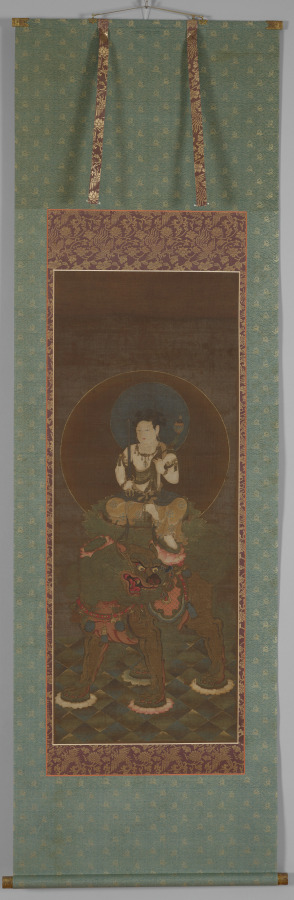
An Examination of the Monju with Five Hair Knots: A Specimen of Imperial Weaving
To the discerning eye, accustomed to the precise drape of a Super 150s wool or the subtle sheen of a rare Sea Island cotton, the subject of this analysis presents a rather more formidable proposition. It is not a garment, but an artifact; a statement not of sartorial intent, but of spiritual and temporal authority rendered in thread. The Monju Bosatsu (Mañjuśrī) with Five Hair Knots, executed in silk tapestry (kesi), stands as a definitive document from the apex of imperial silk weaving. One does not merely look upon it; one reads its weave, deciphers its code, and comprehends the formidable infrastructure of power and piety required for its creation.
The Substrate of Sovereignty: Imperial Silk
Before addressing the iconography, one must first appreciate the foundation. Imperial silk, particularly during the zenith of Chinese production under the Song and Ming dynasties, was not a mere textile. It was a controlled substance. The cultivation of the mulberry, the rearing of the silkworms, the meticulous reeling of the filaments—these were processes shrouded in protocol and often protected by severe decree. The resulting yarn was the period’s equivalent of a proprietary technical fabric, its quality so consistently superior that it became the non-negotiable standard for articulating the highest forms of cultural expression. To commission an image in silk was to immediately elevate it above the realms of paint on paper or ink on scroll. It implied permanence, immense cost, and access to a rarefied cadre of artisans whose skills were, effectively, state secrets.
The Technique: Kesi Tapestry Weaving
The method employed here, kesi or ‘cut silk’, is the pinnacle of this woven arts tradition. It is not embroidery, an additive process, but a form of discontinuous weft tapestry. Imagine, if you will, a loom threaded with the finest plain silk warp. The artisan, working from a detailed cartoon, introduces small shuttles of coloured weft threads only where that specific hue is required. These threads are woven back and forth within their designated area, building up the image pixel by pixel, then cut and tucked at the colour boundary. This results in a sharp, painterly delineation of form and, critically, a textile that is visually identical on both faces.
The discipline required is extraordinary. It is the textile equivalent of bespoke tailoring’s most rigorous canvassing: a hidden structure that creates a flawless, enduring surface. The density of the weave confers a substantial, almost architectural hand-feel, while the play of light across the myriad tiny silk facets gives the image a luminous depth unattainable by pigment alone. This was slow, deliberate, and prohibitively expensive work. The time invested in a single panel of this quality would eclipse that of a Savile Row cutter crafting a full wardrobe for a distinguished client.
Decoding the Figure: Iconography as Imperial Narrative
The subject, Monju Bosatsu (the Bodhisattva of Wisdom), is depicted in a classic formulation, identified by the five hair knots (gosho) symbolising the peaks of wisdom. He is often shown seated on a lion, representing the taming of the mind’s ferocity through wisdom. In an imperial context, however, this iconography transcends mere religious devotion. It becomes a statement of state ideology.
The emperor, as the Son of Heaven, was the supreme patron of all faiths, the mediator between the celestial and the terrestrial. Commissioning such an image in the most technically demanding and costly medium available was a dual proclamation. First, it demonstrated profound piety and cultural refinement, aligning the throne with the ultimate wisdom of the Bodhisattva. Second, and perhaps more crucially, it was a breathtaking display of logistical and economic mastery. The ability to marshal the entire supply chain—from silkworm to sublime icon—was a metaphor for the ability to govern the realm itself. The flawless execution of the kesi technique mirrored the desired flawless administration of the empire.
A Legacy in Thread
Today, this artifact exists as a peerless benchmark. In the same manner that a vintage Anderson & Sheppard drape or a Huntsman silhouette informs contemporary cutting, the Monju with Five Hair Knots establishes the canonical standards for heritage textile craftsmanship. Its value lies not in nostalgia, but in its enduring testimony to a total philosophy of making: where material integrity, technical virtuosity, and profound symbolic intent are inseparable.
For the modern custodian of heritage, whether in fashion or beyond, the lessons are clear. True luxury is not defined by ostentation, but by this trinity of principles. The imperial silk weavers understood that the medium was an intrinsic part of the message. The silk, the kesi, and the iconography of Monju were fused into a single, indivisible statement of power and perfection. It remains, therefore, the ultimate bespoke creation—a one-of-a-kind garment for the soul, cut from the cloth of heaven and stitched with the threads of empire.