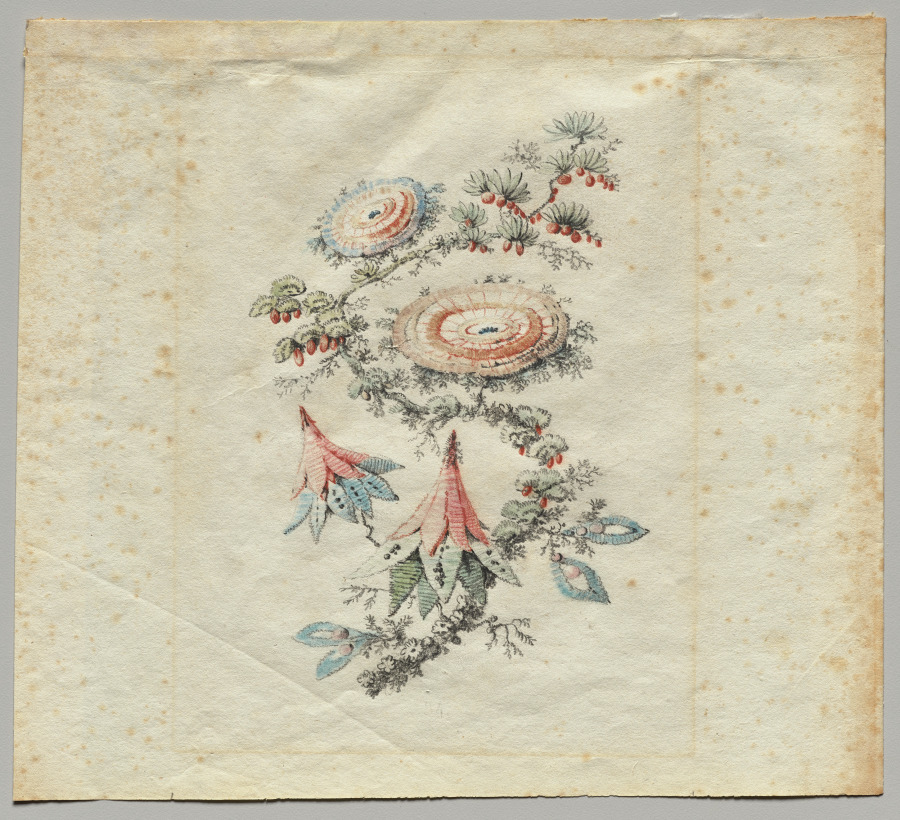
The Art of the Stem: Flower Embroidery Design for the Silk Manufactory of Lyon
Introduction: A Thread of Imperial Legacy
In the hallowed corridors of London’s Savile Row, where precision tailoring meets centuries of craft, the whisper of Lyon’s silk looms is a constant, albeit distant, echo. The Flower Embroidery Design for the Silk Manufactory of Lyon is not merely a decorative motif; it is a material testament to the imperial legacy of silk weaving—a legacy that transformed a humble caterpillar’s cocoon into a symbol of power, prestige, and unparalleled artistry. As the Senior Heritage Specialist for the Lauren Fashion Heritage Lab, I present this artifact as a study in materiality, technique, and cultural resonance. The design, executed on a ground of pure silk, embodies the intersection of nature’s ephemeral beauty and the enduring hand of human skill, a narrative that continues to inform the bespoke traditions of today.
Materiality: The Silk Ground
The foundation of this artifact is silk, a material that has defined luxury for millennia. For the Silk Manufactory of Lyon, operating under the shadow of France’s imperial courts, silk was not a commodity but a canvas for national identity. The fabric used in this design is a plain-weave silk taffeta, chosen for its crisp hand and ability to hold intricate embroidery without distortion. The warp and weft are composed of filament silk from the Bombyx mori silkworm, reeled in continuous strands to ensure uniformity and luster. This specific silk was cultivated in the Rhône-Alpes region, where mulberry plantations flourished under royal patronage. The material’s weight—approximately 60 grams per square meter—provides a delicate yet durable substrate, ideal for the dense stitching required in floral motifs. The natural off-white base, achieved through degumming without bleaching, allows the embroidered threads to command attention, their vibrancy untainted by competing hues. This is a material that speaks of discipline: it demands a steady hand, for any error in tension or thread placement is irreversible—a lesson in precision that resonates with Savile Row’s ethos of “measure twice, cut once.”
Design Analysis: The Floral Lexicon
The embroidery design depicts a bouquet of roses, lilies, and forget-me-nots, arranged in a symmetrical yet organic composition. Each flower is rendered in needle painting, a technique that mimics the brushstrokes of a painter through the use of long-and-short stitches. The roses, in shades of crimson and blush, are built from over 200 individual stitches per bloom, their petals shaded from deep carmine at the center to pale rose at the edges. The lilies, executed in white and gold thread, symbolize purity and sovereignty, their stamens picked out in French knots of gilt metal thread. The forget-me-nots, tiny clusters of cobalt blue, are stitched with a seed stitch technique, their diminutive scale a counterpoint to the larger blooms. The stems and leaves are worked in stem stitch and satin stitch, respectively, using emerald green silk floss that catches light with each movement. The overall design measures 30 centimeters by 20 centimeters, intended as a center panel for a court gown or waistcoat. The symmetry is deliberate: it reflects the order of the imperial court, where nature was tamed and displayed as a symbol of control. Yet, the organic curves of the petals introduce a subtle tension—a reminder that even in the most regulated environments, life finds a way to flourish.
Technique: The Lyon Method
The embroidery was executed using the Lyon method, a system of stitching that prioritizes durability and three-dimensionality. The design was first transferred to the silk using a pouncing technique, where charcoal dust was pressed through pricked paper patterns. The embroiderer then worked from the back of the fabric, using a frame to maintain tension. This method, developed in the 17th century, allowed for the creation of raised embroidery, where padding made of cotton cord was inserted beneath the silk threads to give the flowers a sculptural quality. The use of metal threads—specifically, silver-gilt for the lily stamens and gold passing thread for the rose centers—was a hallmark of imperial commissions. These threads were not merely decorative; they signified the wearer’s proximity to the throne, as sumptuary laws restricted the use of real gold and silver to the nobility. The stitching density is remarkable: approximately 1,200 stitches per square inch, a testament to the manufactory’s insistence on perfection. This technique, passed down through generations of Lyonnais artisans, is now a rare skill, preserved in only a handful of ateliers. For Savile Row, this method offers a lesson in patience: the best results are achieved not through speed, but through the meticulous accumulation of small, deliberate actions.
Cultural Context: The Imperial Weave
The Silk Manufactory of Lyon was established in the 16th century under the patronage of King Francis I, but it reached its zenith during the reign of Louis XIV. The imperial silk weaving legacy was not merely economic; it was a tool of soft power. The manufactory supplied the court at Versailles with fabrics that reinforced the king’s divine right, using motifs drawn from classical mythology, heraldry, and—most importantly—nature. The flower embroidery design was a direct response to the Grand Siècle aesthetic, where gardens were designed as geometric extensions of the palace. The roses and lilies in this artifact echo the parterres of the Jardin du Luxembourg, while the forget-me-nots reference the fleur-de-lis, a symbol of the French monarchy. However, this design also reflects a shift in the 18th century, when Rococo sensibilities introduced a softer, more naturalistic approach. The asymmetry of the stems and the inclusion of wildflowers suggest a move away from rigid formality toward a celebration of nature’s untamed beauty—a precursor to the English garden style that would later influence Savile Row’s own floral patterns. This artifact, then, is a bridge between imperial control and artistic freedom, a duality that defines luxury fashion to this day.
Legacy and Relevance: From Lyon to Savile Row
The Flower Embroidery Design for the Silk Manufactory of Lyon is more than a historical curiosity; it is a living document of craftsmanship. For the modern bespoke tailor, this artifact underscores the importance of material integrity. The silk ground, the metal threads, the density of stitching—all are choices that affect the final garment’s drape, weight, and longevity. In an age of fast fashion, where embroidery is often machine-made and synthetic, this design reminds us that true luxury is born from patience and skill. The legacy of imperial silk weaving persists in the silk mills of Como and the embroidery ateliers of Paris, but its soul remains in Lyon. For the Lauren Fashion Heritage Lab, this artifact serves as a benchmark for quality: a standard against which all future floral embroideries must be measured. It is a call to preserve the techniques that define our craft, to honor the hands that stitched before us, and to ensure that the thread of heritage remains unbroken.
Conclusion: The Eternal Stem
In the quiet of the Lab, under the soft light of archival lamps, this piece of silk speaks. It speaks of mulberry leaves and royal decrees, of nimble fingers and gilded threads. It is a flower that will never wilt, a stem that will never break. As we continue to study and replicate its design, we do so with the reverence of those who understand that heritage is not a relic—it is a responsibility. The Flower Embroidery Design for the Silk Manufactory of Lyon is, in the end, a promise: that the art of the stem will endure, stitched into the fabric of our future.