An Artefact of Diplomacy: Interpreting the Material Protocol of the Tribute Handscroll
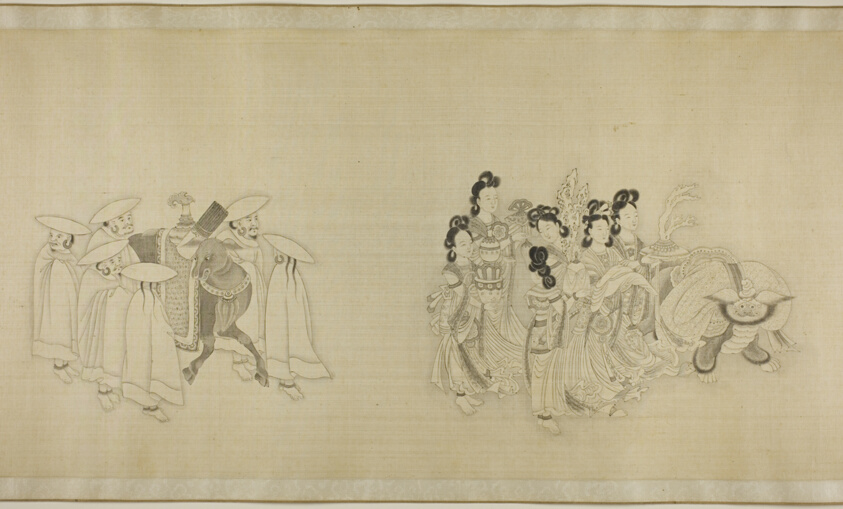
To engage with this handscroll, Envoys Presenting Tribute, is to handle not merely an artistic representation but the very fabric of statecraft itself. The medium is the first and most profound statement. Silk is not a passive substrate here; it is the premier diplomatic material, a commodity so intrinsically linked to Chinese civilisation that its name defined the trade routes of the ancient world. To commit such a scene to silk, with ink, is to employ a language of prestige understood across continents. The choice echoes the foundational principles of our own craft on Savile Row: the selection of a cloth is the first and most critical decision, setting the parameters for all that follows. This silk is a silent envoy in its own right, communicating wealth, technological mastery, and cultural refinement before a single brushstroke is considered.
The Grammar of Line and the Tailoring of Space
The rendering of the scene exhibits a fluid elegance that belies its immense political gravity. Observe the line work. The drapery of the envoys' robes—likely depicting textiles from various tributary states—is articulated with ink washes and brushlines of consummate control. This is not mere description; it is sartorial analysis. The folds fall with a weighted, natural grace, each ripple and cascade carefully composed to suggest the quality and weave of the fabric, the movement of the body beneath, and the posture of deference or authority. The artists responsible were, in effect, master tailors with a brush, understanding that the hang of a garment reveals the stature of the wearer.
Furthermore, the composition employs a continuous narrative, unfurling like a meticulously paced procession. The handscroll format demands a temporal engagement; the viewer controls the revelation, section by section, much as one would assess a bespoke garment detail by detail. The spatial arrangement is hierarchical and deliberate. The receiving court, the central focus of the tribute, is positioned with an unshakeable balance, its architecture and figures forming a stable axis. The approaching envoys navigate a landscape that is both physical and symbolic, their journey through the pictorial space mirroring the diplomatic journey itself. This is composition as protocol, a visual embodiment of the careful choreography that governed imperial audiences.
Materiality as Message: The Silk Standard
We must return, invariably, to the material fact. The silk ground of this scroll represents the apex of a centuries-old craft ecosystem. Its production—from sericulture to weaving—was a state-controlled secret, a protected knowledge that maintained a formidable economic and cultural advantage. The surface accepts the ink with a particular luminosity and depth; the finest silks provide a slight tooth and an impeccable, consistent plane, allowing for the most nuanced gradations of ink—from the palest, almost vaporous washes to the richest, most definitive black. This technical perfection is non-negotiable. It is the equivalent of the pristine, flawlessly rolled lapel or the imperceptible hand-stitched seam: a standard so high it becomes invisible, the absolute foundation of credibility.
The act of painting on silk requires a supreme, confident discipline. There is no room for hesitation or correction; the ink is absorbed immediately, committing each decision to permanence. This technical constraint elevates the artistry into a performance of mastery, much as the cutting of a precious cloth admits no error. The resulting imagery, therefore, carries the authority of flawless execution. Every figure, every gesture, every offering rendered upon this silk is stamped with the imprimatur of technical and artistic certainty, reinforcing the central message of the scene: an empire in full command of its materials, its aesthetics, and its geopolitical narrative.
Legacy and Parallels: A Continuous Thread
The heritage encapsulated within this scroll resonates beyond its historical moment. It establishes a paradigm where material excellence and artistic expression are fused in the service of presenting an ideal—whether of imperial harmony or, in a contemporary context, of personal authority. The classic silk craftsmanship it exemplifies is a testament to the enduring power of investing in foundational quality. In the ateliers of Savile Row, the parallel is clear. The canvas may be a length of Scottish tweed or a swathe of Italian silk, but the principle is congruent: the material is chosen not for fashion alone, but for its inherent virtues, its history, and its capacity to be transformed by expert hands into a statement of enduring value.
Envoys Presenting Tribute is, in its essence, a masterclass in composed presentation. It understands that diplomacy, like bespoke tailoring, is a theatre of perception built upon unassailable standards. The envoys offer their treasures; the empire receives them, its superiority articulated not through aggression but through the overwhelming, silent authority of its context—the majestic court, the ordered ceremony, and, most fundamentally, the sublime surface upon which this entire world is recorded. The scroll itself becomes the ultimate tribute to the civilisation that produced it, a sovereign object that continues to command respect across the centuries. It reminds us that true heritage is not preserved behind glass; it is encoded in the continuing pursuit of material integrity and elegant execution, a standard that remains forever current.