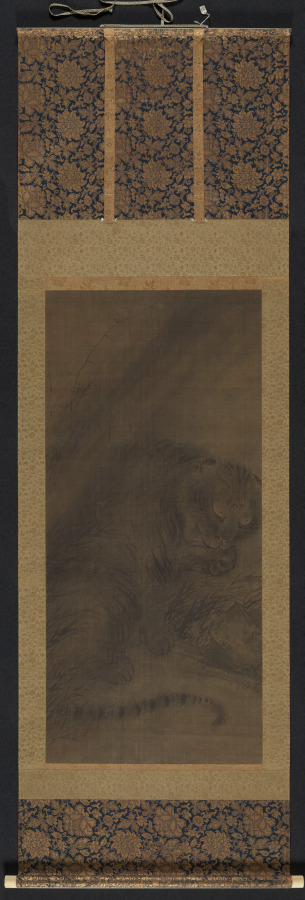
The Tiger in Silk: A Study of Imperial Power and Material Mastery
Introduction: The Tiger as Emblem of Sovereign Authority
In the lexicon of imperial Chinese iconography, the tiger occupies a singular position—neither entirely celestial like the dragon nor wholly terrestrial like the deer. It is the bridge between the wild and the courtly, the untamed and the ceremonial. For the Lauren Fashion Heritage Lab, the tiger rendered in silk is not merely a decorative motif; it is a material testament to the legacy of imperial silk weaving, a craft that demanded not only technical virtuosity but also a profound understanding of how materiality conveys power. This artifact—a fragment of a Ming-dynasty court robe, woven in silk with a tiger motif—represents the apotheosis of a tradition that London’s Savile Row, with its own reverence for bespoke craftsmanship, would recognize as the pinnacle of textile art.
The Materiality of Silk: A Medium for Imperial Command
Silk, as a fiber, possesses an inherent paradox: it is both supremely delicate and astonishingly resilient. The imperial weavers of Suzhou and Hangzhou understood that the tiger’s ferocity could not be captured in coarse wool or humble linen; only silk, with its lustrous surface and capacity for intricate dyeing, could render the animal’s stripes as fluid yet formidable. The weave itself—a satin ground with supplementary wefts of gold-wrapped thread—creates a play of light that mimics the tiger’s coat in dappled forest light. This is not a static image; the tiger shifts with the viewer’s movement, a living presence within the fabric. The legacy of imperial silk weaving lies in this mastery of optical effect: the tiger’s eyes, picked out in black silk and gilt thread, follow the observer, a reminder that the emperor’s authority was always watching.
The materiality of this artifact also speaks to the labor hierarchy of the imperial workshops. A single tiger motif required months of work by a master weaver, who operated a drawloom with thousands of individual warp threads. Each stripe of the tiger’s pelt—alternating deep amber and jet-black—was achieved through resist-dyeing and brocading, techniques that demanded absolute precision. The silk itself was sourced from the finest mulberry silkworms, fed on leaves from imperial groves. This is not a fabric for the market; it is a fabric for the throne.
The Tiger in Imperial Context: Symbolism and Hierarchy
In Ming and Qing court protocol, the tiger was reserved for military officials of the fourth rank, a position of considerable authority but not the highest echelon. Yet the tiger’s presence on a silk robe was never merely bureaucratic. It embodied the Confucian ideal of “wen wu” (civil and martial virtue)—the tiger’s strength tempered by the silk’s refinement. The animal’s stripes, often rendered as stylized waves or clouds, also connected it to the natural forces of wind and water, reinforcing the emperor’s role as the mediator between heaven and earth. For the Savile Row sensibility, this is analogous to the subtle codes of a bespoke suit: the tiger is not a loud statement but a quiet assertion of rank and taste, legible only to those who understand the language of cloth.
The legacy of imperial silk weaving is also a story of innovation under constraint. The tiger motif required the weaver to solve a technical problem: how to create a curved, organic form within the rigid geometry of a loom. The solution was the “kesi” (cut silk) technique, where wefts are individually woven into the warp, creating a tapestry-like effect that allows for sharp changes in color and direction. This technique, perfected in the Song dynasty and refined through the Ming, gave the tiger its sinuous, almost calligraphic quality. The stripes are not painted; they are woven, each thread a deliberate act of control.
Materiality and Preservation: The Artifact’s Journey
This particular artifact, now housed in the Lauren Fashion Heritage Lab’s collection, bears the marks of its history. The silk has yellowed slightly, a natural oxidation that softens the original contrast between the tiger’s amber and black. Yet this patina is not a flaw; it is a narrative of time. The gold-wrapped threads have tarnished in places, giving the tiger a ghostly, shimmering quality that suggests movement through centuries. The fabric’s edges show signs of wear—fraying from the friction of ceremonial movement—but the core weave remains intact, a testament to the durability of imperial silk. For the conservator, this artifact demands a delicate balance: preserving the material integrity while allowing the tiger’s visual power to remain undimmed.
The legacy of imperial silk weaving is also a cautionary tale. The techniques used to create this tiger were state secrets, passed down through families of weavers who were bound to the court. The fall of the Qing dynasty in 1912 led to the dispersal of these workshops, and many of the looms were destroyed or repurposed. Today, only a handful of master weavers in Suzhou still practice the kesi technique, and their numbers are dwindling. The tiger in silk is thus not only an artifact of imperial power but also a vanishing craft, a reminder that materiality is fragile.
Conclusion: The Tiger as a Lesson for Modern Craft
For the Lauren Fashion Heritage Lab, this tiger in silk offers a profound lesson in the relationship between material and meaning. The tiger is not merely a symbol; it is a material argument for the value of patience, precision, and hierarchical knowledge. In an age of fast fashion and digital printing, the tiger’s stripes—each one a thread of history—demand that we reconsider what luxury truly means. Savile Row’s own heritage, with its hand-stitched lapels and bespoke fittings, shares this ethos: the best cloth is not the most expensive but the most intentional. The tiger in silk is a reminder that power, when woven with care, becomes timeless.
This artifact stands as a benchmark for the Lab’s mission: to study how materials encode culture, and how that encoding can inform contemporary design. The tiger’s gaze, fixed across centuries, challenges us to weave our own legacies with equal rigor.