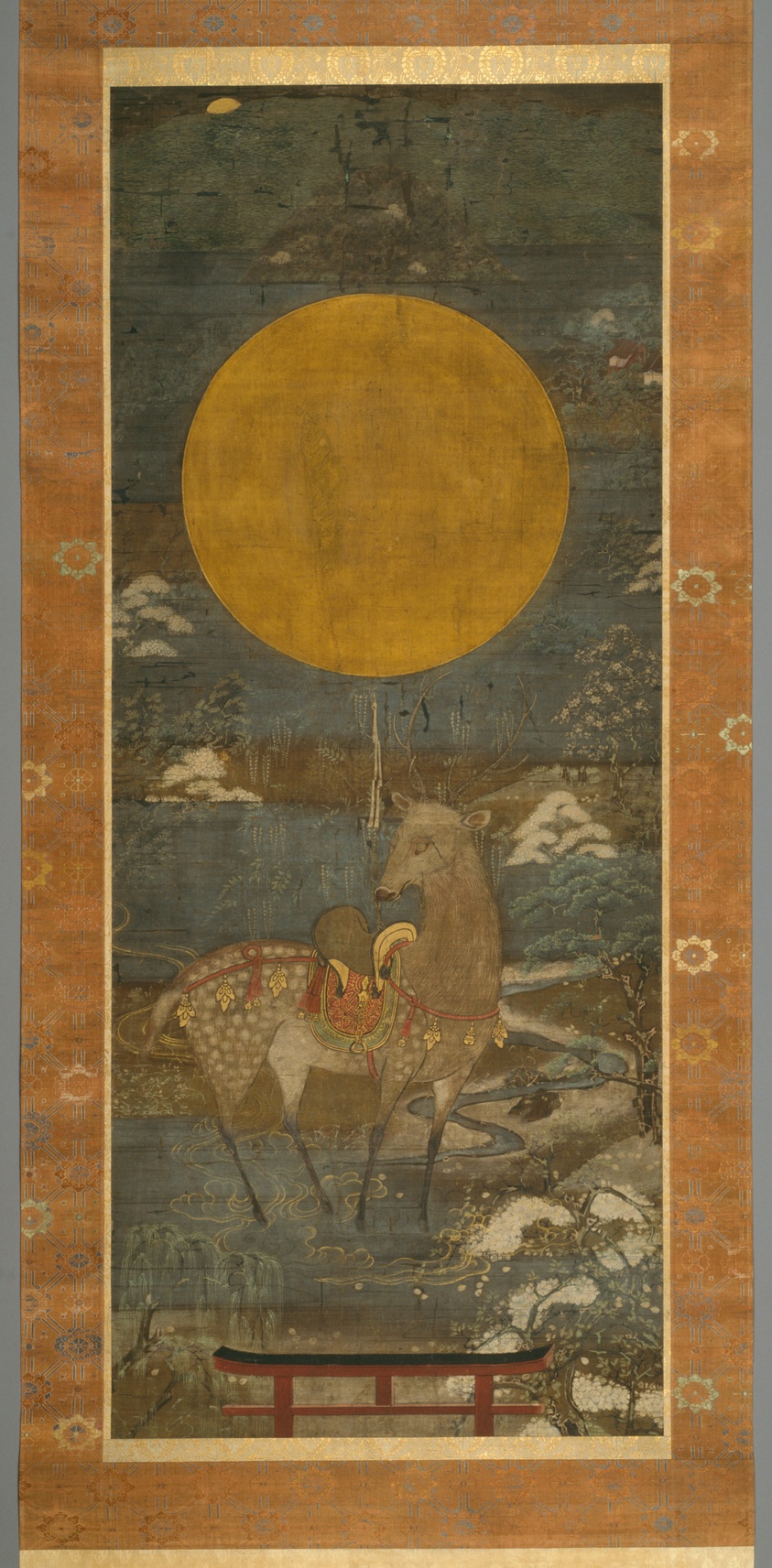
The Kasuga Deer Mandala: A Study in Silk, Sovereignty, and Sacred Symbology
Introduction: The Fabric of the Divine
In the hushed corridors of heritage, where the tangible meets the transcendent, the Kasuga Deer Mandala stands as an artifact of profound significance. Executed in ink, colors, and gold on silk, this 14th-century Japanese masterpiece is not merely a painting; it is a testament to the confluence of material mastery and spiritual narrative. As a Senior Heritage Specialist at the Lauren Fashion Heritage Lab, I approach this work with the discerning eye of a Savile Row tailor—where every thread, every hue, and every gesture speaks to a legacy of precision and elegance. The silk substrate, a foundation of unparalleled fluidity, transforms this mandala into a living document of faith, power, and artistry.
Materiality: The Silk Canvas as a Medium of Meaning
The choice of silk is no accident. In classical Japanese craftsmanship, silk was the preferred surface for sacred imagery, revered for its luminosity and tensile strength. The Kasuga Deer Mandala employs a finely woven silk ground, its warp and weft creating a subtle grid that anchors the composition. The application of ink and colors—mineral pigments like azurite for blues, cinnabar for reds, and orpiment for yellows—is layered with precision, while gold leaf is meticulously applied to highlight the deer’s antlers and the shrine’s architectural details. This technique, known as kinpaku, requires a steady hand and an understanding of light reflection, akin to the way a Savile Row tailor selects a worsted wool for its drape and sheen. The gold does not merely decorate; it sanctifies, drawing the eye to the deer as a conduit between the earthly and the divine.
The fluid elegance of silk allows the mandala to retain a supple, almost breathing quality. Unlike paper or wood, silk absorbs pigment and gold with a softness that resists rigidity, echoing the deer’s graceful posture. This materiality is critical: it ensures the artifact’s survival across centuries, yet it also demands reverence in handling. At the Lab, we consider such textiles as archives of touch—each fold, each crease tells a story of ritual use, perhaps hung in a shrine or carried in procession. The silk’s patina, a gentle yellowing from age, adds a layer of historical depth, much like the worn leather of a bespoke shoe that has walked through time.
Context: The Kasuga Shrine and the Deer as Divine Messengers
To understand the mandala, one must first understand its provenance. The Kasuga Taisha shrine in Nara, Japan, is a UNESCO World Heritage site, dedicated to the Fujiwara clan’s tutelary deities. Deer have long been considered sacred messengers of the gods in Shinto tradition, believed to carry divine will between realms. The mandala depicts a white deer—a rare and auspicious creature—standing before the Kasuga shrine’s iconic vermilion-lacquered architecture, its antlers adorned with a golden sun disc and crescent moon. This imagery is not decorative; it is theological. The deer’s posture, poised yet alert, symbolizes vigilance and purity, while the shrine’s torii gate and lanterns anchor the scene in a specific geography of worship.
The mandala’s composition is a masterclass in spatial hierarchy. The deer occupies the foreground, its body rendered in delicate ink outlines and soft washes of white pigment, creating a sense of ethereal weight. Behind it, the shrine recedes into a mist of gold and blue, suggesting a liminal space where the sacred and the mundane intersect. This technique, borrowed from Chinese landscape painting but refined in Japanese yamato-e style, emphasizes the deer’s role as a mediator. For the Fujiwara clan, who commissioned such works to legitimize their political authority, the mandala was both a devotional object and a statement of lineage—a reminder that their power was divinely sanctioned.
Symbolism and the Art of Narrative
The Kasuga Deer Mandala operates on multiple symbolic levels. The deer itself is a kami—a Shinto spirit—yet its depiction with gold antlers and a celestial motif also echoes Buddhist iconography, reflecting the syncretic nature of Japanese religious practice. The mandala’s circular form, though not explicit, is implied through the arrangement of elements: the deer’s body curves inward, the shrine’s roof arcs, and the gold clouds swirl in a cyclical pattern. This geometry invites contemplation, much like the cut of a Savile Row jacket that guides the eye along a seamless line from shoulder to hem.
The use of gold is particularly telling. In Japanese aesthetics, gold represents the immutable—the eternal light of the Buddha—while silk embodies the transient, the fleeting beauty of the natural world. Together, they create a tension that mirrors the human condition: the desire for permanence in a world of change. The deer, standing at the threshold of the shrine, embodies this paradox. It is both a creature of the forest and a herald of the divine, a reminder that heritage is not static but a living dialogue between past and present.
Preservation and the Role of the Heritage Specialist
As a specialist, my role is to ensure that artifacts like the Kasuga Deer Mandala are not merely preserved but interpreted. The silk’s fragility demands controlled environments—low light, stable humidity, and minimal handling—yet its story must be told. At the Lauren Fashion Heritage Lab, we employ advanced imaging techniques to document the mandala’s pigment layers and weave structure, creating a digital twin that allows scholars worldwide to study its intricacies without physical risk. This is not a betrayal of the object’s materiality but an extension of its legacy. Just as a Savile Row tailor might preserve a pattern for future generations, we safeguard the mandala’s knowledge.
The fluid elegance of the silk, the precision of the gold application, and the narrative depth of the deer all converge in this artifact. It is a reminder that heritage is not about static preservation but about dynamic engagement—a conversation between the maker’s hand, the viewer’s eye, and the scholar’s mind. In the Kasuga Deer Mandala, we find a mirror of our own quest for meaning: a deer poised on silk, carrying the weight of centuries, yet light as a whisper.
Conclusion: A Legacy Woven in Gold and Silk
The Kasuga Deer Mandala is more than a religious icon; it is a testament to the power of materiality to convey the ineffable. Its silk ground, gold highlights, and fluid composition speak to a tradition of craftsmanship that values both precision and poetry. For the heritage specialist, it offers a case study in how objects can bridge the sacred and the secular, the political and the personal. As we continue to study and preserve such artifacts, we honor not only the hands that created them but the cultures that sustain them. In the deer’s quiet gaze, we see the eternal—a moment captured in silk, waiting to be understood anew.