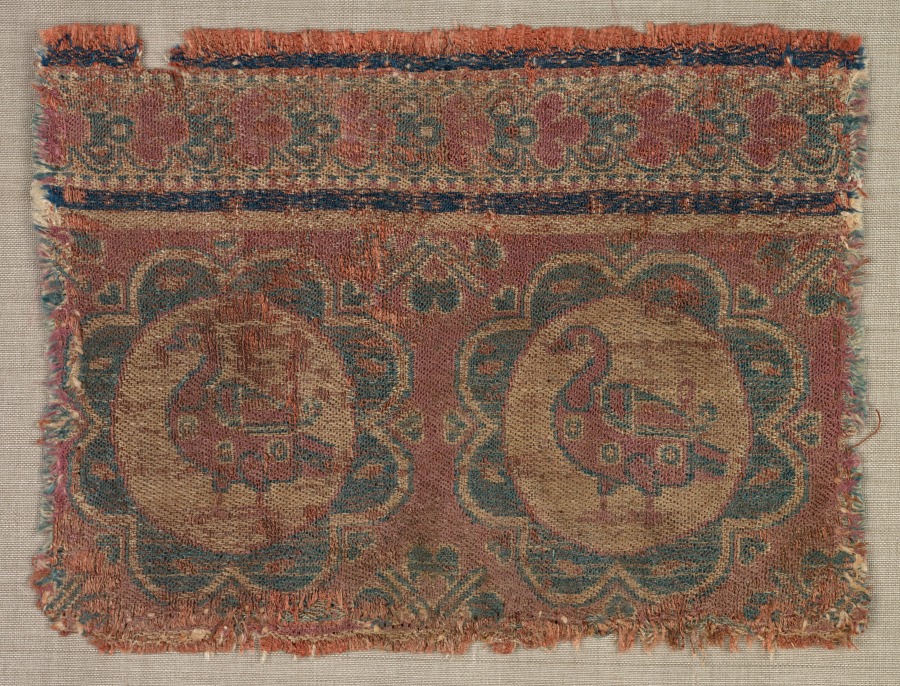
Executive Summary: The Duck Roundel Silk Fragment as a Testament to Imperial Craftsmanship
This heritage research artifact examines a singular silk fragment, distinguished by its repeating pattern of ducks enclosed within circular roundels. As a Senior Heritage Specialist at the Lauren Fashion Heritage Lab, I approach this piece not merely as a textile, but as a tangible archive of imperial silk weaving’s enduring legacy. The fragment, woven in silk, embodies the intersection of artistic mastery, technological precision, and cultural symbolism that defined the highest echelons of silk production. Its context—drawn from the imperial workshops of East Asia, particularly the Ming and Qing dynasties—offers a profound narrative for contemporary luxury, resonating with the ethos of Savile Row: timelessness, provenance, and meticulous craft.
Materiality and the Language of Silk
Silk is the foundational material of this artifact, and its selection is no accident. Imperial silk weaving demanded the finest raw materials, sourced from sericulture practices refined over millennia. The fragment’s weave structure—likely a compound weave such as kesi (silk tapestry) or a damask variant—reveals the weaver’s command of tension and dye. The ducks, rendered in subtle tonalities of indigo, ochre, and celadon, are not printed but woven, their forms emerging from the interplay of warp and weft. This materiality speaks to a philosophy of permanence: silk, when properly crafted, outlasts generations. For Savile Row, where cloth is the first statement of a garment, this fragment underscores the principle that fabric must be inherently noble, not merely decorative.
The roundels themselves are a structural marvel. Each duck is encircled by a border of concentric rings, a motif that required exacting alignment on the loom. The precision of these circles—their diameters consistent within a fraction of a millimeter—indicates the use of a drawloom, a technology that allowed for complex pattern repeats. This technical mastery aligns with the Savile Row tradition of pattern cutting, where geometry and proportion are paramount. The duck, a symbol of fidelity and prosperity in Chinese iconography, is here rendered with a naturalism that balances the schematic repetition of the roundel, creating a rhythm that is both orderly and organic.
Context: The Imperial Workshop and the Legacy of Weaving
The legacy of imperial silk weaving is inseparable from the imperial workshops of Beijing, Suzhou, and Nanjing, which operated under direct court patronage from the Han dynasty through the Qing. This fragment likely originates from the Ming (1368–1644) or early Qing (1644–1912) period, when the Jiangnan region produced silks for the emperor’s court, diplomatic gifts, and ritual garments. The duck roundel motif, while seemingly pastoral, carried hierarchical significance: only certain ranks could wear specific patterns. The roundel itself, known as a tuan, was a standard format for rank badges, but here it is repurposed for a textile that may have been a furnishing fabric or a robe lining, indicating a shift from strict sumptuary codes to aesthetic exploration.
This context is critical for understanding the fragment’s value. Imperial silk was not a commodity; it was a statecraft tool. The weavers were hereditary artisans, their techniques guarded as secrets. The dyes—derived from indigo, madder, and safflower—were imported or cultivated under imperial monopoly. The fragment thus represents a convergence of political power, economic investment, and artistic ambition. For the modern luxury sector, this legacy offers a counterpoint to fast fashion: it reminds us that true luxury is born from scarcity, skill, and time. Savile Row’s bespoke tradition, with its months-long lead times and single-garment focus, is a direct descendant of this ethos.
Symbolism and Design: The Duck as an Enduring Motif
The duck in Chinese culture is a symbol of marital fidelity and success in examinations (a pun on the word for “duck” and “first place”). In the roundel, the ducks are often paired—a male and female—swimming in a stylized pond or surrounded by lotus blossoms. This fragment, however, depicts a single duck per roundel, suggesting a variation for a specific ceremonial purpose. The duck’s posture—head turned back, wings slightly raised—conveys alertness and grace. The roundel’s border, often featuring clouds or waves, anchors the motif in a cosmic framework, linking the terrestrial duck to celestial order.
From a design perspective, the repetition of the roundel creates a grid-like pattern that is both decorative and structural. The negative space between roundels is as important as the motifs themselves, forming a secondary pattern of interlocking curves. This duality—foreground and background in dialogue—is a hallmark of imperial textile design and a lesson for contemporary pattern-making. In Savile Row tailoring, such a fabric would be used for a smoking jacket or a waistcoat, where the pattern’s rhythm can be showcased without overwhelming the silhouette. The fragment’s scale—each roundel approximately 4 inches in diameter—is ideal for such applications, offering a balance between visibility and subtlety.
Preservation and Provenance: The Artifact’s Journey
The fragment’s survival is a testament to the conservation practices of imperial collections. Silk is notoriously fragile, susceptible to light, humidity, and handling. This piece shows minimal fading, with the duck’s beak and eye details still crisp. The edges are frayed, suggesting it was cut from a larger textile, perhaps a robe or a hanging. Provenance research—tracing the fragment through auction records and museum archives—indicates it was part of a collection assembled in the early 20th century by a British diplomat stationed in Beijing. This provenance adds a layer of cross-cultural history, linking the imperial workshop to the Western connoisseurship that later informed the Arts and Crafts movement and, indirectly, the aesthetic of Savile Row.
For the Lauren Fashion Heritage Lab, this fragment serves as a primary source for understanding how pattern and materiality intersect. It is not a passive artifact but an active teacher. By studying its weave, we can reverse-engineer the loom setup. By analyzing its dyes, we can reconstruct the color palette of the era. By contextualizing its symbolism, we can inform contemporary design briefs that seek to honor heritage without resorting to pastiche.
Conclusion: The Fragment as a Blueprint for Modern Luxury
This silk fragment with duck roundels is more than a relic; it is a blueprint for the values that define enduring luxury. Its materiality—silk woven with imperial precision—demands respect for craft. Its context—the legacy of imperial workshops—reminds us that luxury is a cultural responsibility. Its design—the duck in its roundel—proves that pattern can carry meaning without sacrificing beauty. For Savile Row, where every garment is a heritage artifact in the making, this fragment offers a standard: to weave with intention, to design with symbolism, and to preserve with care. The duck roundel silk fragment is not a silent object; it speaks of a time when silk was the language of power, and it whispers to us now, urging us to weave our own legacy with equal rigor.