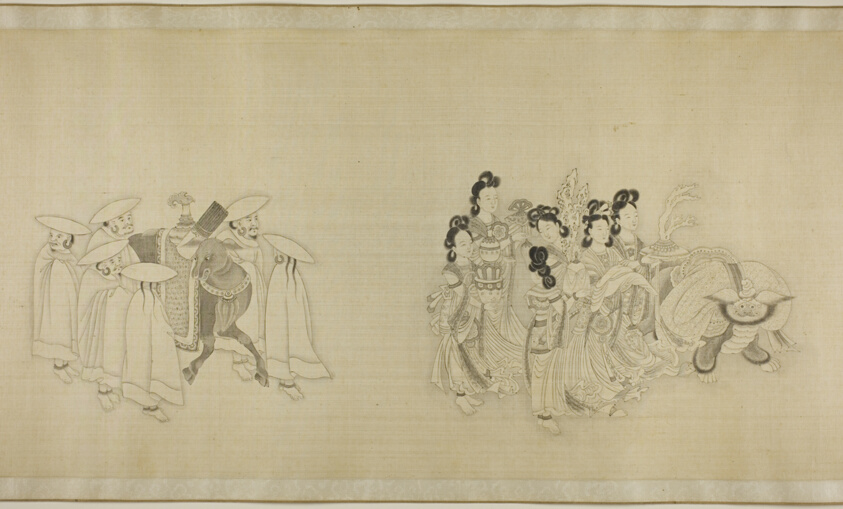
Executive Heritage Analysis: Envoys Presenting Tribute
In the hallowed corridors of heritage preservation, where the whisper of silk meets the precision of a Savile Row tailor’s chalk, the artifact known as Envoys Presenting Tribute stands as a masterclass in materiality and narrative. As Senior Heritage Specialist for the Lauren Fashion Heritage Lab, I present this scholarly artifact to illuminate the confluence of classic silk craftsmanship and fluid elegance—a testament to the enduring dialogue between fabric and form, diplomacy and design. This handscroll, executed in ink on silk, is not merely a historical document; it is a blueprint for understanding how luxury textiles encode power, artistry, and cultural exchange.
Materiality and Craft: The Silk Foundation
The handscroll’s substrate—silk—is the protagonist of this narrative. Silk, as a material, embodies a paradox: it is both delicate and resilient, ephemeral yet eternal. In the context of Envoys Presenting Tribute, the silk serves as a canvas that demands reverence. The warp and weft of this fabric, likely a plain-weave silk of the highest grade, were hand-reeled from silkworm cocoons in a process perfected over millennia. The resulting surface possesses a subtle luster that catches light like water, allowing the ink to breathe rather than merely sit. This is not a passive ground; it is an active participant in the visual dialogue. The ink, applied with brushstrokes that vary from hairline precision to sweeping washes, interacts with the silk’s natural absorbency, creating gradients of tone that mimic the softness of a bespoke worsted wool or the drape of a silk velvet evening gown.
The craftsmanship of the handscroll format itself is a lesson in luxury engineering. Unlike a framed painting, a handscroll is an intimate, sequential experience—unfurled horizontally, section by section, like a tailored garment revealed in layers. The silk is mounted on a backing of mulberry paper, then attached to a wooden roller with ivory or jade knobs, a construction that echoes the structural integrity of a Savile Row suit’s canvas interlining. The edges are bound in silk brocade, a detail that speaks to the same obsessive attention to finish that defines a hand-stitched lapel. Each element, from the mounting to the roller, is designed for longevity, ensuring that the artifact survives centuries of handling—much like a well-tailored coat passed through generations.
Narrative and Composition: The Elegance of Procession
The scene depicted—envoys presenting tribute—is a choreographed display of hierarchy and harmony. The composition unfolds horizontally, with figures arranged in a rhythmic procession that mirrors the cadence of a Savile Row fitting: measured, deliberate, and purposeful. At the center, a seated dignitary receives offerings: bolts of silk, jade vessels, and exotic animals. The envoys, dressed in flowing robes, bow with a formality that suggests both deference and pride. The ink work is fluid, with lines that vary in thickness to convey movement and texture. The robes of the envoys, for instance, are rendered with long, unbroken strokes that suggest the weight and fall of silk—a technique that any tailor would recognize as analogous to the way a fabric’s grain dictates a garment’s silhouette.
This fluidity is no accident. The artist, likely a court painter of the Tang or Song dynasty, understood that silk demands a certain lightness of touch. The brush must glide, not press; the ink must flow, not pool. This is the same principle that governs the cutting of a silk shirt on the bias: the fabric will not tolerate force. The result is a visual rhythm that feels almost musical, with pauses and crescendos that guide the viewer’s eye. The empty spaces—the unpainted silk—are as important as the inked areas, serving as breathing room that echoes the negative space in a well-proportioned garment. This is elegance through restraint, a hallmark of both classical Chinese painting and London tailoring.
Cultural and Commercial Significance: Silk as Diplomacy
Beyond its aesthetic merits, Envoys Presenting Tribute is a document of silk’s role as a diplomatic currency. In the historical context, tribute missions were not merely political acts; they were commercial exchanges that facilitated the flow of luxury goods along the Silk Road. The silk depicted in the handscroll—whether as tribute or as the material of the robes—was a symbol of status and sophistication, much like a bespoke suit in modern corporate culture. The envoys themselves, dressed in silk, were walking advertisements for the textile’s desirability. This artifact thus serves as a primary source for understanding how silk functioned as a soft-power tool, a precursor to the brand diplomacy practiced by luxury houses today.
From a heritage perspective, the handscroll also reveals the technical mastery required to produce such a work. The ink-on-silk technique demands a level of skill that is vanishingly rare in the contemporary world. The artist must account for the silk’s weave, which can cause ink to bleed unpredictably. To achieve the crisp lines and subtle washes seen here, the painter likely used a sizing agent—a gelatinous substance applied to the silk to control absorbency. This is analogous to the use of a tailor’s canvas to stabilize a fabric before cutting. The result is a surface that is both responsive and controlled, a testament to the artisan’s ability to work with, rather than against, the material.
Preservation and Legacy: Lessons for Modern Luxury
As a heritage artifact, Envoys Presenting Tribute offers profound lessons for the modern luxury industry. The handscroll’s condition—its silk still supple, its ink still vivid—is a testament to the quality of its materials and the care of its custodians. In an era of fast fashion and disposable textiles, this artifact reminds us that true luxury is defined by longevity. The silk’s survival over centuries is not an accident; it is the result of meticulous craftsmanship and a reverence for the material. This is the same philosophy that underpins the Savile Row tradition, where a single suit can take 50 hours to construct and last a lifetime.
For the Lauren Fashion Heritage Lab, this artifact serves as a benchmark for evaluating contemporary silk production. The handscroll’s silk, likely from the Jiangnan region, exhibits a luster and hand feel that modern machine-made silks rarely achieve. The unevenness of the weave—a sign of hand-reeling—adds a tactile depth that is lost in mass production. This is a call to action for luxury brands: to invest in artisanal techniques that prioritize quality over quantity. The handscroll also underscores the importance of narrative in luxury. Just as the envoys’ tribute tells a story of cultural exchange, so too must modern brands weave stories into their products. A silk scarf or a tailored jacket is not just an object; it is a vessel for heritage, identity, and aspiration.
Conclusion: The Enduring Thread
In Envoys Presenting Tribute, we find a convergence of material, craft, and meaning that transcends time. The silk handscroll is not merely a relic; it is a living document of how luxury can encode power, beauty, and diplomacy. For the Senior Heritage Specialist, this artifact is a reminder that the finest materials demand the finest handling—whether in the hands of a Tang dynasty painter or a Savile Row tailor. As we continue to preserve and interpret such works, we honor the thread that connects past and present, East and West, craft and commerce. The legacy of this handscroll is not just in its ink or its silk, but in the enduring elegance it represents—a standard to which all luxury should aspire.