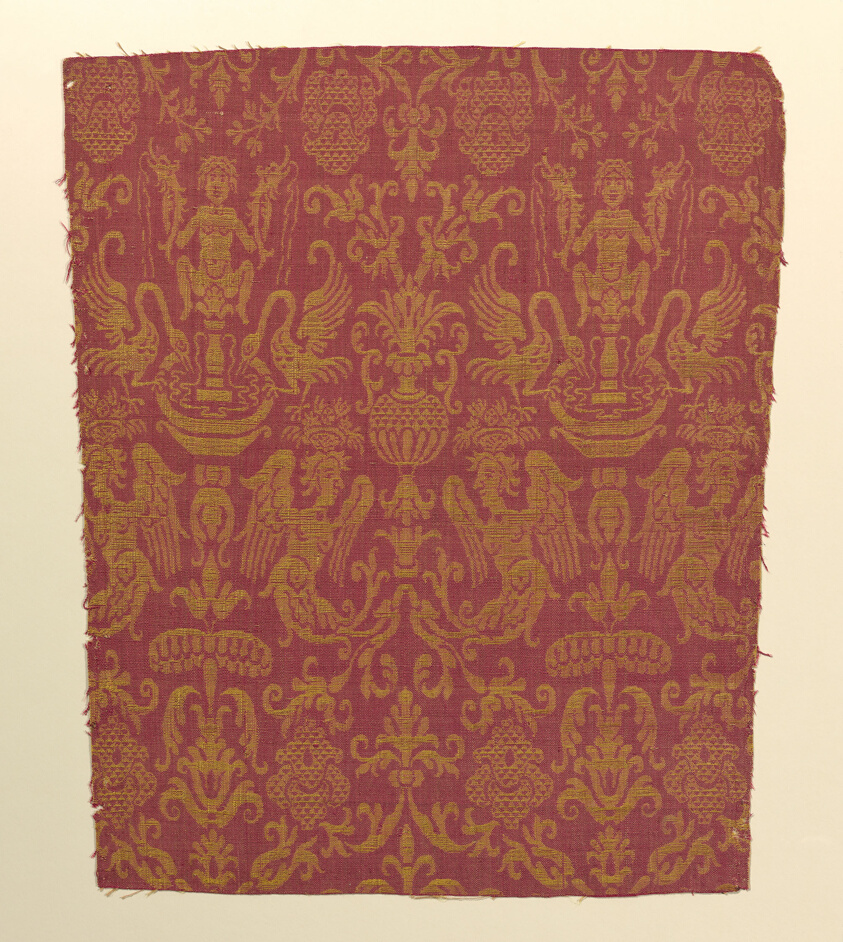
The Fragment as Testament: Deconstructing Materiality and Craft in a Silk and Linen Plain Weave
Introduction: The Silent Narrative of a Textile Fragment
In the hallowed corridors of heritage preservation, the fragment often speaks with greater eloquence than the whole. At the Lauren Fashion Heritage Lab, we are entrusted with the stewardship of such silent narratives—textile remnants that, though physically incomplete, offer a profound lexicon of craftsmanship, materiality, and cultural memory. The subject of this research artifact is a fragment of exquisite provenance: a plain weave composed of silk and linen, enriched by supplementary patterning wefts bound by secondary binding warps in plain interlacings. This is not merely a scrap of fabric; it is a microcosm of classic silk craftsmanship and fluid elegance, a testament to the artisanal rigor that defines the lineage of luxury textiles. Drawing upon the disciplined precision of London’s Savile Row—where tailoring is a philosophy, not a trade—this paper deconstructs the fragment’s materiality, structural ingenuity, and historical resonance, arguing that its fragmented state enhances, rather than diminishes, its scholarly value.
Materiality: The Dialogue Between Silk and Linen
The fragment’s foundational weave—a plain weave of silk and linen—immediately commands attention for its strategic juxtaposition of two distinct fibers. Silk, the quintessential emblem of opulence, contributes a luminous sheen, a supple drape, and a tensile strength that has captivated civilizations from the Han Dynasty to the courts of Renaissance Europe. Linen, conversely, embodies a more austere elegance: its natural irregularities, crisp hand, and breathable structure ground the textile in a tactile honesty that resists ostentation. In this fragment, the union is not one of compromise but of orchestrated contrast. The silk warps provide a lustrous, fluid ground, while the linen wefts introduce a subtle texture and dimensional stability, preventing the fabric from succumbing to excessive limpness. This interplay mirrors the Savile Row ethos of balancing structure with flow—a jacket’s canvas interfacing, for instance, must be both supportive and yielding. The fragment’s materiality thus speaks to a sophisticated understanding of fiber behavior, where each component is selected not for its isolated properties but for its contribution to a cohesive whole.
Structural Complexity: Supplementary Patterning and Secondary Binding Warps
Beyond the plain weave foundation, the fragment’s true intellectual intrigue lies in its supplementary patterning wefts, bound by secondary binding warps in plain interlacings. This is a technique of considerable technical finesse, one that elevates the textile from utilitarian cloth to a canvas for ornamental expression. The supplementary wefts—likely composed of finer silk threads—float across the surface, creating raised motifs that catch light and shadow, while the secondary binding warps anchor these floats at precise intervals, preventing distortion and ensuring structural integrity. The plain interlacings of these binding warps—a simple over-one, under-one rhythm—are deceptively sophisticated; they allow the supplementary wefts to emerge and recede without compromising the fabric’s overall flexibility. This method is reminiscent of the compound weaves used in historic brocades and damasks, yet here it is executed with a restraint that aligns with the understated luxury of classic Savile Row tailoring. The fragment’s pattern, though partially obscured by wear, suggests a rhythmic, geometric motif—perhaps a stylized vine or a repeating lozenge—that would have shimmered against the matte linen ground. Such patterning was not merely decorative; it signified status, craftsmanship, and a deliberate investment in time and skill.
Context: Classic Silk Craftsmanship and Fluid Elegance
To contextualize this fragment is to place it within the lineage of classic silk craftsmanship—a tradition that prizes fluid elegance as its highest aesthetic achievement. In the ateliers of Lyon, the workshops of Como, and the bespoke houses of Savile Row, silk has long been the medium through which tailors and weavers articulate grace. The fluidity of this fragment—its ability to drape, to fold, to move with the body—is not accidental; it is engineered through the precise tension of warps and the calculated density of wefts. The supplementary patterning, far from stiffening the cloth, is integrated in a manner that preserves its suppleness, allowing the fabric to cascade like water over a form. This is the hallmark of a master weaver: the capacity to embed complexity without sacrificing movement. In the context of heritage fashion, such textiles were destined for garments that demanded both presence and poise—a gentleman’s waistcoat, a lady’s evening gown, or a ceremonial robe. The fragment, even in its partial state, retains this kinetic memory; one can almost imagine its passage through candlelit ballrooms or the quiet rustle of a Savile Row fitting room.
Heritage Implications: The Fragment as a Pedagogical Tool
For the Lauren Fashion Heritage Lab, this fragment serves as a pedagogical artifact of immense value. Its incompleteness invites inquiry: What was the original garment? Who commissioned it? How did it travel through time to arrive in our care? The frayed edges and faded hues are not signs of decay but of biography—each tear, each stain, each loss of thread is a chapter in a story that demands to be read. By studying the fragment’s materiality, we teach emerging designers and historians the importance of tactile knowledge. In an era of digital simulation and synthetic fibers, the fragment reminds us that true craftsmanship is rooted in the hand, the loom, and the unyielding pursuit of perfection. Savile Row’s legacy is built on such fragments—swatches, patterns, and remnants that preserve the DNA of bespoke tailoring. This fragment, with its silk and linen interplay and its intricate binding warps, is a direct ancestor of that tradition. It challenges us to look beyond the whole and to find meaning in the partial, the broken, the overlooked.
Conclusion: The Enduring Voice of a Textile Fragment
In conclusion, this fragment of silk and linen, with its supplementary patterning wefts and secondary binding warps, is far more than a relic. It is a scholarly artifact that encapsulates the principles of classic silk craftsmanship—material intelligence, structural innovation, and fluid elegance. Its fragmented state does not diminish its authority; rather, it amplifies its voice, compelling us to listen with greater attention. As we preserve and study such artifacts at the Lauren Fashion Heritage Lab, we honor the artisans who wove them, the wearers who cherished them, and the legacy that continues to inform contemporary luxury. In the spirit of Savile Row, where every stitch is a statement, this fragment stands as a quiet but resolute testament to the enduring power of heritage textiles.