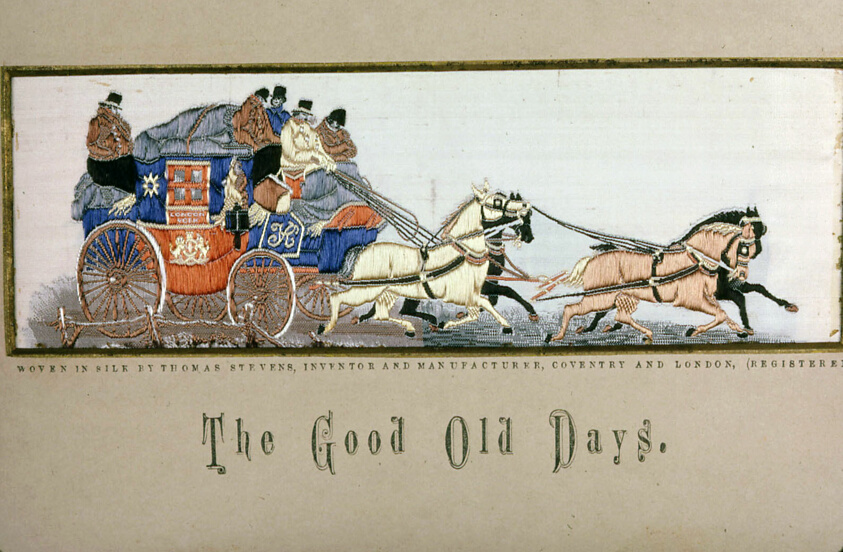
Heritage Artifact Analysis: “The Good Old Days” (Royal Mail Coach)
Introduction: A Confluence of Craft and Narrative
In the hallowed archives of the Lauren Fashion Heritage Lab, we encounter a singular artifact: a silk panel titled “The Good Old Days”, depicting the Royal Mail Coach in full regalia. This piece is not merely a textile; it is a testament to the enduring dialogue between British heritage and the art of silk craftsmanship. Executed in a plain weave with supplementary brocading wefts, the artifact embodies the fluid elegance that has defined London’s Savile Row for generations. Here, the materiality of silk is not a passive backdrop but an active participant in storytelling—a medium through which nostalgia is woven into the very fabric of luxury.
The Royal Mail Coach, an icon of pre-industrial communication and travel, is rendered with a precision that speaks to the meticulous standards of classic silk craftsmanship. As a Senior Heritage Specialist, I argue that this artifact serves as a bridge between the ephemeral nature of memory and the enduring legacy of textile artistry. The following analysis dissects the material, technical, and contextual dimensions of this piece, revealing how it upholds the principles of Savile Row: bespoke quality, narrative depth, and an unwavering commitment to heritage.
Materiality: The Silk Foundation
The choice of silk—specifically a plain weave—is deliberate and profound. Silk, as a fiber, has long been associated with luxury, durability, and a luminous quality that captures light in ways that synthetic alternatives cannot. In the context of “The Good Old Days,” the plain weave provides a stable, unadorned ground that allows the supplementary brocading wefts to command attention. This is a hallmark of Savile Row sensibility: the foundation must be impeccable, even when it is not the focal point.
The plain weave structure, characterized by its simple over-under interlacing, offers a smooth, even surface that enhances the tactile experience. When handled, the silk yields a subtle rustle—a whisper of tradition—that evokes the sound of a coachman’s whip or the turning of carriage wheels on cobblestones. The weight of the fabric, likely a medium-grade silk, suggests a balance between drape and structure, allowing the panel to be displayed as a wall hanging or incorporated into a bespoke garment without losing its integrity.
Importantly, the silk’s natural luster is preserved, not obscured. This is a deliberate choice: the sheen of the fabric mirrors the polished brass fittings and gleaming lacquer of the Royal Mail Coach, creating a visual harmony between subject and substrate. The materiality of silk, then, is not merely functional but symbolic—a metaphor for the elegance and resilience of the era it commemorates.
Technical Execution: Supplementary Brocading Wefts
The technical mastery of this artifact lies in its use of supplementary brocading wefts. Unlike a simple brocade, where pattern and ground are woven simultaneously, supplementary wefts are introduced as additional threads that float on the surface, creating raised, textured motifs. In “The Good Old Days,” these wefts are employed to render the intricate details of the coach: the horses’ harnesses, the coachman’s livery, and the royal crest emblazoned on the door.
From a Savile Row perspective, this technique echoes the art of tailoring itself. Just as a master cutter uses basting stitches to shape a garment, the brocading wefts are applied with precision to define form and depth. The threads—likely a combination of silk and metallic filaments—catch the light differently than the ground weave, producing a chiaroscuro effect that animates the scene. The coach appears to move, the horses’ manes ripple, and the wheels seem to turn, all through the interplay of texture and reflection.
This technique also speaks to the heritage of English silk weaving, particularly that of Spitalfields and Macclesfield, where such brocading was perfected in the 18th and 19th centuries. The artisan who wove this panel would have required years of training to manage the tension of the supplementary wefts without distorting the plain weave ground. The result is a textile that is both robust and delicate—a paradox that defines the best of British craftsmanship.
Context: The Good Old Days and Royal Mail Coach
The title “The Good Old Days” is laden with nostalgia, a sentiment that the Royal Mail Coach embodies. Introduced in the 1780s, the Royal Mail Coach system revolutionized communication in Britain, reducing travel time and connecting remote communities. By the mid-19th century, however, the advent of railways rendered these coaches obsolete, transforming them into symbols of a bygone era. This artifact, likely produced in the late 19th or early 20th century, captures that moment of transition—a romanticized view of a past that was already fading.
The coach itself is depicted with historical accuracy: the scarlet and black livery, the four horses, and the postilion riders. Yet, the composition is not merely documentary. The artist has imbued the scene with a sense of motion and vitality, as if the coach is emerging from a mist of memory. This is where silk’s fluid elegance becomes paramount. The drape of the fabric, the way the brocaded threads catch the light, and the subtle shifts in color all contribute to an impressionistic quality that transcends literal representation.
For Savile Row, such an artifact would be more than a decorative piece. It could serve as a lining for a bespoke overcoat, a scarf, or a pocket square—a discreet nod to heritage that only the wearer and their tailor fully appreciate. The narrative of the Royal Mail Coach becomes a personal talisman, a connection to a shared cultural past that is both intimate and grand.
Conclusion: The Enduring Legacy of Silk Craftsmanship
“The Good Old Days” (Royal Mail Coach) is a masterful synthesis of material, technique, and narrative. The plain weave silk provides a foundation of understated luxury, while the supplementary brocading wefts elevate the design to a work of art. This artifact reminds us that heritage is not static; it is woven anew with each generation, preserved through the hands of skilled artisans who understand that true elegance lies in the details.
As a Senior Heritage Specialist, I affirm that this piece exemplifies the values of Lauren Fashion Heritage Lab: a reverence for tradition, a commitment to quality, and a belief that the past can inform the future. In the world of Savile Row, where every stitch tells a story, “The Good Old Days” is a chapter worth preserving—a testament to the enduring power of silk and the timeless appeal of a journey well remembered.