The Fragment as Archive: A Study of Gimp Lace in Silk and Silk-Wrapped Linen
Introduction: The Silent Eloquence of the Fragment
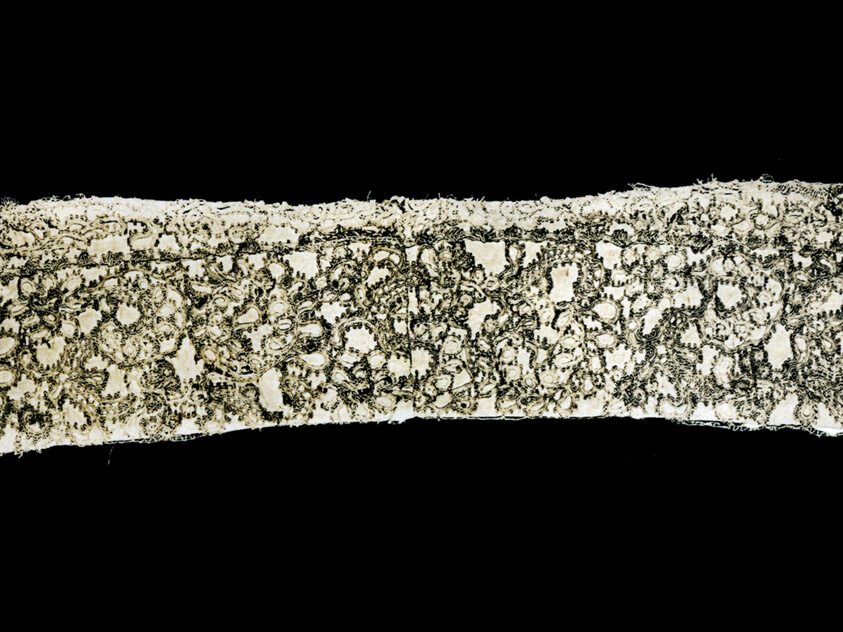
In the hallowed ateliers of London’s Savile Row, where the whisper of shears and the scent of fine cloth define an unbroken lineage of craftsmanship, the fragment is not merely a remnant. It is a testament. It is a condensed narrative of skill, material provenance, and the fleeting elegance of a bygone era. This heritage research artifact—a fragment of bobbin straight lace, specifically a type known as “Gimp,” composed of silk and silk-wrapped linen—offers a singular window into the technical and aesthetic sophistication of classic silk craftsmanship. At first glance, it appears as a delicate, almost incidental piece of textile history. Yet, upon closer examination, it reveals the rigorous geometry, the fluid elegance, and the profound material intelligence that define the highest echelons of heritage textile production. This paper will deconstruct the fragment’s materiality, its technical construction, and its contextual significance within the lexicon of luxury, drawing upon the precise, understated language of Savile Row’s enduring tradition.
Materiality: The Dual Nature of Silk and Silk-Wrapped Linen
Silk—the very word evokes a legacy of opulence, of a lustrous filament spun by the Bombyx mori silkworm, harvested with a patience that borders on reverence. In this fragment, the silk is not a singular entity. It is a dialogue between two distinct material expressions. The primary thread is a fine, high-twist silk filament, exhibiting a characteristic sheen that catches light with a soft, almost liquid radiance. This is the silk of classic craftsmanship: smooth, resilient, and imbued with a natural elasticity that allows for intricate manipulation. Its presence in the Gimp lace speaks to a deliberate choice—a desire for a surface that is both visually refined and tactilely luxurious.
However, the fragment’s true complexity emerges in the use of silk-wrapped linen. Here, the artisan has employed a technique of material alchemy. A core of linen—a bast fiber known for its strength, durability, and slight irregularity—is meticulously encased in a sheath of silk. This construction is not arbitrary. The linen core provides structural integrity, a hidden backbone that prevents the delicate silk from collapsing under the tension of the lace-making process. The silk wrapping, meanwhile, bestows a uniform, lustrous exterior, masking the linen’s natural coarseness. This duality—strength concealed beneath elegance—is a hallmark of heritage craftsmanship. It is a philosophy that values both performance and presentation, a principle that resonates deeply with the Savile Row ethos of a garment’s internal structure being as impeccable as its outward appearance.
Technical Construction: The Geometry of Bobbin Straight Lace
Bobbin lace, at its core, is a system of threads manipulated over a pillow, with pins marking the pattern. The term “straight lace” denotes a specific category where the ground and pattern are worked simultaneously, without the addition of a separate, pre-made mesh. This technique demands a rigorous, almost mathematical discipline from the lace-maker. The fragment under study is a Gimp lace, a term that refers to a thicker, often textured thread used to outline or emphasize the pattern. In this artifact, the Gimp thread is formed by the silk-wrapped linen itself, creating a raised, corded effect that defines the lace’s floral or geometric motifs.
The construction process would have involved dozens of bobbins, each wound with either the fine silk or the thicker Gimp thread. The lace-maker, working with a precision honed over years, would cross, twist, and pin the threads in a sequence dictated by a pricked parchment pattern. The resulting fabric is a study in contrasts: the fine silk forms a delicate, open ground—a net-like structure of twists and crosses—while the Gimp thread weaves a bolder, more pronounced pattern, often in the form of scrolling vines, stylized leaves, or abstract arabesques. The tension must be perfectly calibrated; too loose, and the lace loses its definition; too tight, and the silk may snap or the linen core may distort. This fragment, with its intact structure and crisp delineation, speaks to a master’s hand.
Context: Fluid Elegance and Classic Silk Craftsmanship
To understand this fragment fully, one must place it within the broader context of classic silk craftsmanship and the aesthetic of fluid elegance. This is not the stiff, ornate lace of courtly ceremony. Rather, it is a lace designed for movement—for the gentle sway of a sleeve, the soft drape of a collar, or the delicate trim of a handkerchief. The fluidity is inherent in the materials: silk’s natural drape and the linen core’s flexibility allow the lace to follow the contours of a garment without rigidity. The Gimp technique, with its raised outlines, adds a subtle dimensionality, catching light and shadow as the fabric moves, creating a visual rhythm that is both dynamic and refined.
Historically, such lace would have been produced in the workshops of Flanders, Northern France, or Italy, regions renowned for their bobbin lace traditions. However, its presence in a Savile Row context suggests a cross-pollination of expertise. Savile Row tailors, known for sourcing the finest materials globally, would have commissioned or acquired such lace for bespoke garments—perhaps a waistcoat for a dandy, a dress for a debutante, or a ceremonial robe for a peer. The fragment is a relic of this global trade in luxury, a tangible link between the artisan lace-maker and the discerning client.
Conclusion: The Fragment as a Living Document
This fragment of Gimp lace, composed of silk and silk-wrapped linen, is far more than a decorative scrap. It is a living document of material science, technical mastery, and aesthetic philosophy. It embodies the tension between strength and delicacy, between structure and fluidity, that defines the finest heritage textiles. In the language of Savile Row, where every stitch is a statement of intent, this fragment reminds us that true elegance is not merely seen—it is felt, understood, and preserved. It is a silent archive, waiting for those with the patience to read its threads.