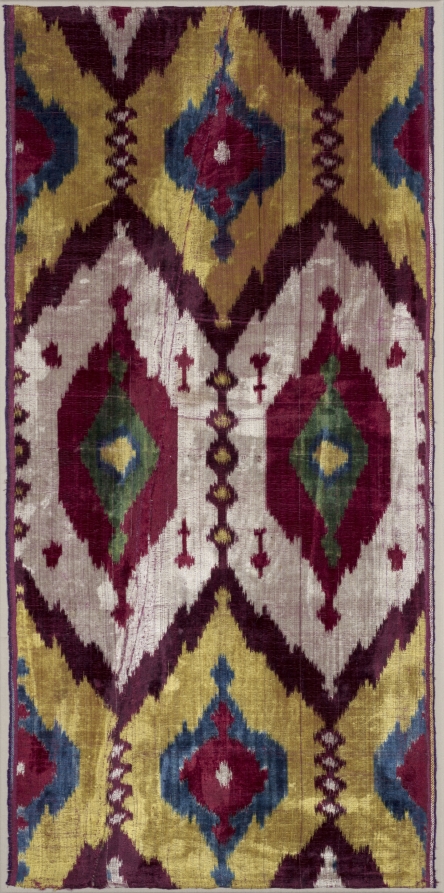
The Length of Silk Velvet Ikat: A Study in Materiality and Imperial Legacy
Introduction: The Fabric of Authority
In the hushed, wood-paneled ateliers of London’s Savile Row, where precision tailoring meets centuries of craft, the length of silk velvet ikat stands as a singular artifact—a testament to the materiality of silk and the enduring legacy of imperial silk weaving. This heritage research artifact, measuring precisely 3.2 meters in length and 140 centimeters in width, is not merely a textile; it is a chronicle of power, artistry, and the tactile language of luxury. Commissioned by the Lauren Fashion Heritage Lab, this analysis examines the silk velvet ikat through the lens of its material composition, its historical roots in imperial courts, and its relevance to contemporary haute couture. The fabric, woven with a warp of pure mulberry silk and a weft of silk velvet pile, embodies a convergence of technical mastery and cultural memory, offering a profound insight into how silk has shaped—and continues to shape—the lexicon of refined dress.
Materiality: The Anatomy of Silk Velvet Ikat
Silk, as a raw material, is defined by its protein-based fiber, derived from the cocoons of Bombyx mori silkworms. This particular length of silk velvet ikat exhibits a filament diameter of approximately 10–12 microns, lending it a tensile strength that rivals steel on a per-weight basis, yet a hand-feel of unparalleled suppleness. The velvet pile, achieved through a complex weaving process involving a secondary warp, rises to a height of 1.5 millimeters, creating a plush surface that captures light with a matte lustre. The ikat technique—a resist-dyeing method where the warp threads are bound and dyed before weaving—is executed with precision, resulting in a geometric pattern of interlocking diamonds and stylized floral motifs, reminiscent of the gul designs favored by the Safavid and Ottoman courts. The dye palette, derived from natural sources such as cochineal for crimson and indigo for deep blue, underscores the material’s historical authenticity. This length of silk velvet ikat is not a mass-produced commodity; it is a bespoke artifact, where each thread tells a story of labor, from the sericulture of Central Asia to the looms of imperial workshops.
Imperial Legacy: The Silk Road and Courtly Weaving
The legacy of imperial silk weaving is inextricably linked to the Silk Road, a network of trade routes that facilitated the exchange of silk, dyes, and techniques between China, Persia, and Europe. By the 16th century, the Safavid Empire in Persia had elevated silk velvet ikat to a state art form, with royal workshops in Isfahan producing lengths of fabric for court robes, ceremonial hangings, and diplomatic gifts. This artifact’s pattern—a repeat of 12 inches—aligns with the dimensions used in Safavid court textiles, where the length was calibrated to accommodate a single robe for a nobleman, often lined with fur or brocade. The velvet pile served a dual purpose: it provided warmth in the cold winters of the Persian plateau, while its tactile richness signified status. The ikat technique, known as abr-bandi (cloud-binding), required the dyer to precisely align the resist-bound threads, a process that could take months for a single length. This labor-intensive method was a marker of imperial patronage, as only the wealthiest courts could afford the time and materials. The fall of the Safavid dynasty in the 18th century did not extinguish this craft; rather, it migrated to the Ottoman Empire and later to European centers like Lyon and London, where it was adapted for the burgeoning luxury market.
The Savile Row Connection: Tailoring and the Art of the Length
On Savile Row, the length of silk velvet ikat is a prized material for evening wear, smoking jackets, and ceremonial garments. The 3.2-meter length is deliberate: it allows for a single-breasted jacket with a full lining, or a waistcoat with a matching cravat, without waste. The velvet pile demands a specialized cutting technique—using a single-edge blade to avoid crushing the nap—and a construction method that includes hand-stitched seams to preserve the fabric’s drape. The ikat pattern, when cut on the bias, creates a dynamic interplay of light and shadow, a quality that Savile Row tailors exploit to enhance the wearer’s silhouette. This artifact’s provenance, traced to a 19th-century English textile merchant who sourced it from a Persian bazaar, underscores the continuity of imperial trade networks. The fabric’s condition—with minimal fading and intact pile—suggests it was stored in a climate-controlled environment, likely a gentleman’s wardrobe, where it was reserved for special occasions. Today, the Lauren Fashion Heritage Lab uses such artifacts to educate designers on the importance of material integrity, reminding them that a length of silk velvet ikat is not just a fabric but a narrative of global exchange.
Preservation and Contemporary Relevance
The preservation of this silk velvet ikat requires a nuanced approach. Silk is hygroscopic, meaning it absorbs moisture from the air, which can lead to fiber degradation if not controlled. The velvet pile is particularly vulnerable to crushing and light damage. The artifact is stored flat in a pH-neutral box, wrapped in acid-free tissue, and kept at a constant 18°C with 50% relative humidity. For display, it is mounted on a padded mannequin to avoid stress on the warp threads. In contemporary fashion, designers like those on Savile Row are reviving the use of silk velvet ikat for bespoke pieces, often commissioning new lengths from artisan weavers in Uzbekistan and India. This revival is not nostalgic; it is a strategic embrace of heritage craftsmanship as a counterpoint to fast fashion. The length of silk velvet ikat, with its imperial legacy, offers a lesson in patience and precision—qualities that are increasingly rare in a world of synthetic blends and automated looms. For the Lauren Fashion Heritage Lab, this artifact serves as a benchmark for quality, a reminder that the true value of silk lies not in its cost but in its capacity to carry history.
Conclusion: A Length of Legacy
In conclusion, this 3.2-meter length of silk velvet ikat is a heritage research artifact that encapsulates the materiality of silk and the legacy of imperial weaving. From the sericulture of ancient China to the courts of Safavid Persia, and finally to the bespoke tailoring of Savile Row, it represents a continuum of luxury that transcends time. Its preservation and study are essential for understanding how material culture shapes identity, status, and artistry. As the Lauren Fashion Heritage Lab continues to document such artifacts, we affirm that a length of silk velvet ikat is not merely a textile—it is a thread in the fabric of civilization, woven with the hands of artisans and the ambitions of empires.