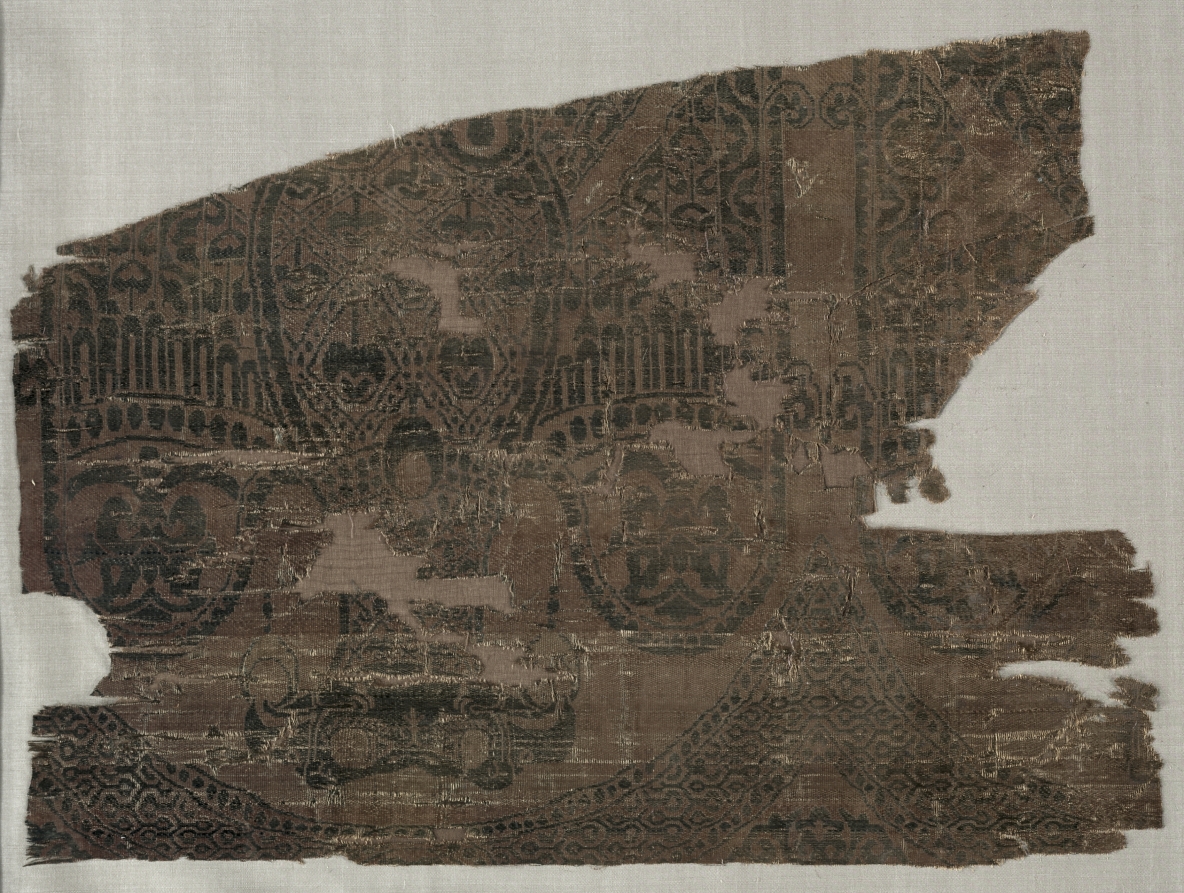
Heritage Research Artifact: Samite Fragments with Double-Headed Eagles, Tomb of Saint Bernard Calvo
Provenance and Historical Context
These samite fragments, exhumed from the tomb of Saint Bernard Calvo, Bishop of Vic (Catalonia, circa 1180–1243), represent a singular intersection of ecclesiastical sanctity, imperial ambition, and the transcontinental silk trade. The double-headed eagle motif—a heraldic emblem of Byzantine, Holy Roman, and later Islamic dynasties—anchors these textiles within the legacy of imperial silk weaving, a craft that defined power, piety, and patronage across medieval Eurasia. The fragments, now preserved in the Museu Episcopal de Vic, offer a tangible link to the silk routes that connected the Mediterranean to Central Asia, threading through monasteries, courts, and tombs.
The tomb of Saint Bernard Calvo, a revered bishop canonized for his piety and administrative reforms, was opened in the 19th century, revealing these silk remnants. Their presence suggests not merely liturgical vestments but a deliberate statement of sacred authority—the eagle, a symbol of resurrection and imperial dominion, fused with Christian iconography to elevate the bishop’s legacy. This artifact embodies the material culture of power, where silk, as a medium, transcended its physical form to signify divine and temporal sovereignty.
Materiality and Craftsmanship
The fragments are woven in samite, a luxurious, twill-based silk textile characterized by its weft-faced structure and lustrous surface. Samite, derived from the Greek *hexamiton* (“six threads”), was a hallmark of Byzantine and later Islamic looms, requiring exceptional skill and resources. The silk fibers, likely sourced from the Sericultural heartlands of China or the Sassanid Empire, were dyed with madder and indigo to achieve deep crimsons and blues—colors reserved for the elite. The double-headed eagle motif, woven in gold-wrapped thread (gilded silver or gold leaf on a silk core), demonstrates a mastery of compound weave techniques. Each eagle, symmetrically rendered with spread wings and crowned heads, reflects a cosmopolitan aesthetic that blended Byzantine, Islamic, and Romanesque influences.
The physical condition of the fragments—frayed edges, faded hues, and fragmented weave—speaks to centuries of burial and decay. Yet, the remaining gold thread retains its brilliance, a testament to the enduring luxury of imperial silks. This materiality underscores the textile’s role as a status object, not merely decorative but imbued with ritual significance. The weight and drape of samite, with its dense, almost metallic hand, would have rendered these fragments as part of a chasuble, pall, or altar cloth—garments that physically connected the bishop to the divine.
Iconography and Symbolism
The double-headed eagle, a motif with ancient roots in Hittite and Mesopotamian art, became a potent symbol of dual sovereignty—earthly and heavenly, East and West. In the Byzantine Empire, it represented the emperor’s dominion over both secular and ecclesiastical realms. The Holy Roman Empire adopted it under the Hohenstaufen dynasty, and later, Islamic courts such as the Seljuks and Mamluks incorporated it into their heraldry. For Saint Bernard Calvo’s tomb, the eagle likely signified Christ’s victory over death, the bishop’s spiritual authority, and the broader imperial legacy of the Crown of Aragon, which claimed ties to both Byzantine and Carolingian traditions.
The symmetry of the eagle motif—two heads facing outward, wings spread—evokes a sense of balance and vigilance, qualities befitting a bishop who guarded his flock. The gold thread, catching light, would have shimmered in candlelit ceremonies, reinforcing the sacred spectacle of the liturgy. This iconography, while rooted in imperial propaganda, was recontextualized within a Christian framework, merging the temporal power of silk with the eternal promise of salvation.
Legacy of Imperial Silk Weaving
The samite fragments from Vic are a microcosm of the imperial silk weaving legacy that spanned from Constantinople to Al-Andalus. The Byzantine Empire, with its state-controlled silk workshops in Constantinople, set the standard for luxury textiles, exporting them as diplomatic gifts and trade goods. After the Fourth Crusade (1204), these techniques spread to Venetian and Sicilian looms, while Islamic Spain, under the Umayyads and later Nasrids, developed its own silk industry in Almería and Granada. The double-headed eagle motif, in particular, traveled along these routes, appearing in Islamic tiraz textiles and Christian liturgical vestments, reflecting a shared visual language of power.
This artifact challenges the notion of a purely Western or Eastern heritage. Instead, it embodies a hybrid legacy—a silk woven with Byzantine techniques, adorned with a motif adopted by Islamic courts, and buried in a Catalan bishop’s tomb. The materiality of the fragments—their silk, gold, and weave—speaks to the globalized economy of the medieval world, where raw materials, artisans, and designs traversed continents. The tomb of Saint Bernard Calvo thus becomes a nexus of these flows, preserving a fragment of imperial ambition within a sacred context.
Conservation and Scholarly Significance
Today, these fragments are a rare survival of medieval silk weaving, offering insights into dye analysis, weave structure, and iconographic diffusion. Conservation efforts focus on stabilizing the silk and gold threads, preventing further degradation while allowing for scholarly study. The fragments are often displayed under low light, their fragility a reminder of the ephemeral nature of even the most luxurious textiles.
For the Lauren Fashion Heritage Lab, this artifact underscores the enduring influence of imperial silks on modern luxury. The double-headed eagle motif, reinterpreted by houses like Gucci and Versace, traces its lineage to these samite fragments. The craftsmanship—the hand-weaving, the gold thread, the meticulous dyeing—remains a benchmark for artisanal excellence in fashion. In studying this artifact, we honor not just a bishop’s tomb but the silk routes that continue to shape our understanding of heritage, power, and beauty.
In summary, these samite fragments are more than archaeological curiosities; they are textile testaments to the imperial ambitions, spiritual aspirations, and global connections of the medieval world. Their legacy, woven in silk and gold, endures as a source of inspiration for scholars, conservators, and designers alike.