← BACK TO ARCHIVES
Heritage-Black
Heritage Synthesis: Vue des propylées du palais de Karnac, prise du Sud-Est
Curated on May 17, 2026 // Node: LDN-01
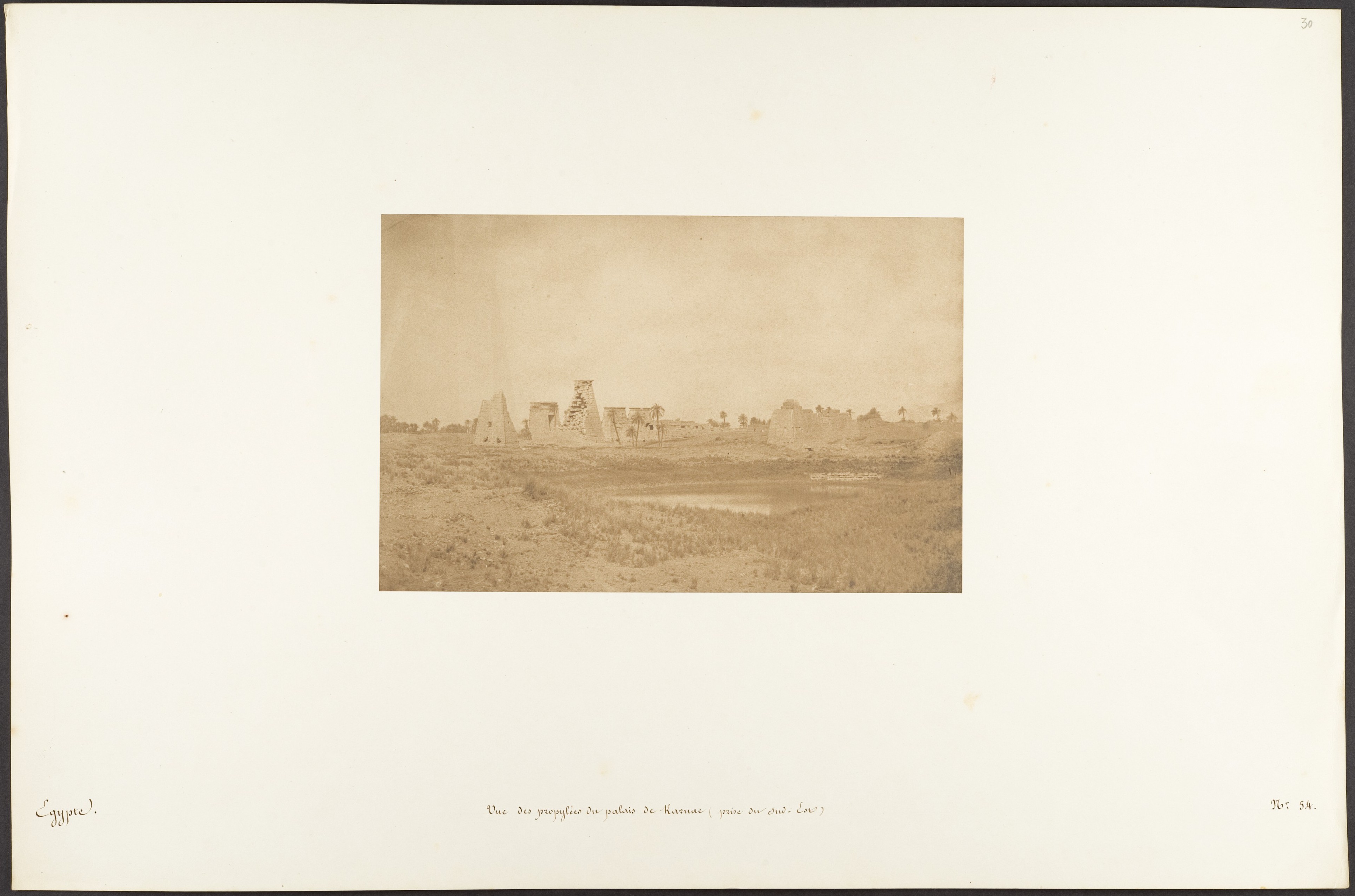
The Architectural Sublime: From Karnak’s Propylaea to the 2026 Old Money Silhouette
In the Lauren Fashion Heritage Lab, we operate at the intersection of archival precision and aesthetic archaeology. Our internal genetic code, a dialectic between Renaissance agony and modern vapor, finds an unexpected third term in the *Vue des propylées du palais de Karnac, prise du Sud-Est*—a salted paper print from a paper negative, circa 1850s, now held in the museum’s visual archive. This artifact, a ghostly record of ancient Egyptian stone, does not depict a human form. Yet it speaks directly to the core tension outlined in our internal research: the negotiation between the visible and the invisible, the solid and the evanescent, the monumental and the fleeting. For the 2026 Old Money silhouette, this image is not a mere historical curiosity; it is a blueprint for a new kind of restrained power—one that derives its authority not from ostentation, but from the gravitas of absence and the weight of shadow.
The Salted Paper Print: A Medium of Vaporous Certainty
The technical nature of the artifact is itself a philosophical statement. The salted paper print, one of photography’s earliest processes, produces an image that is matte, soft, and deeply embedded in the paper’s fibers. Unlike the sharp, glossy precision of later silver-gelatin prints, the salted paper print retains a tactile, almost textile-like quality. The *Vue des propylées* is not a crisp architectural drawing; it is a memory of stone, rendered in sepia and shadow. The massive pylons of Karnak—those monumental gateways to the sacred precinct—appear not as solid blocks, but as vaporous masses, their edges dissolving into the sky. This is the “虚薄的崇高” (the sublime of the thin and evanescent) made photographic. The image captures the threshold—the propylaea themselves are a liminal space, a passage between the profane world and the divine interior. The photograph, by its very imprecision, emphasizes this state of becoming, of crossing, of existing between two states of being.
This aesthetic resonates profoundly with the 2026 Old Money silhouette. The contemporary iteration of Old Money style has moved beyond the literal re-creation of 1980s preppy or 1920s Gatsby-esque opulence. It now embraces a heritage of restraint, where the value of a garment is not in its logo but in its weight, drape, and the history of its construction. The salted paper print teaches us that authority can be atmospheric. The silhouette for 2026 is not about sharp shoulders or aggressive tailoring; it is about volumes that suggest rather than declare. Think of a double-breasted overcoat in a dense, undyed wool—its silhouette is monumental, like a Karnak pylon, but its surface is matte, absorbing light, creating a vaporous contour around the wearer. The power lies in the negative space, in the shadow that the garment casts, in the unseen structure that holds the form.
From Monumental Stone to Monumental Fabric
The *Vue des propylées* offers a direct lesson in architectural proportion applied to the human form. The propylaea are not a single, monolithic block; they are a composition of massive, rectilinear forms—the central doorway, the flanking towers, the sloping walls. Each element is simple, but their relationship creates a sense of enduring scale. For the 2026 Old Money silhouette, this translates into a renewed focus on the “block” and the “column.” The suit is no longer a second skin; it is a habitable structure. Jackets are cut with a longer, straighter torso, often with a suppressed waist that is less about cinching and more about creating a clear, architectural silhouette. Trousers are wide-legged, falling straight from the hip to the hem, creating a vertical line that echoes the fluted columns of Karnak. The shoulder is soft but defined, not by padding, but by the inherent structure of the cloth—a heavy cavalry twill or a dense worsted flannel.
This is a direct rejection of the deconstructed, fluid forms of recent avant-garde fashion. The 2026 Old Money silhouette returns to structure, but with a modern, almost archaeological sensibility. It is as if the garment has been excavated from a site of timeless elegance, its form worn smooth by centuries of use. The color palette is drawn directly from the salted paper print: sepia, taupe, stone, charcoal, and heritage-black. These are not colors that shout; they are colors that absorb history. A cashmere turtleneck in a deep, dusty umber, worn under a single-breasted jacket in a dark, heathered grey, creates a monochromatic composition that is both severe and serene. The effect is one of quiet monumentality.
The Liminal Garment: Between Agony and Vapor
Returning to our internal genetic code, the *Vue des propylées* mediates between the 具象的崇高 (concrete sublime) of *The Agony in the Garden* and the 虚薄的崇高 (vaporous sublime) of the modern human form. The photograph is concrete in its subject—the stone is real, the architecture is historical. Yet its presentation is vaporous—the image is soft, the details are lost, the stone seems to breathe. This duality is the core of the 2026 Old Money aesthetic. The garments are concrete in their construction—they are made from the finest materials, with impeccable tailoring. But their effect is vaporous—they do not cling to the body; they envelop it in a cloud of refined presence.
Consider the overcoat as the key garment for this season. It is the propylaeum of the wardrobe, the threshold garment that one passes through to enter the world. For 2026, the overcoat is long, often reaching the mid-calf or ankle, with a generous, almost architectural silhouette. It is cut from a heavy, felted wool that has a matte, almost dusty surface, like the salted paper print itself. The collar is not a sharp lapel but a soft, rolled shawl or a wide, notched collar that lies flat against the chest. The sleeves are set with a natural, slightly dropped shoulder, allowing the fabric to fall in soft, vertical folds. This is not a coat that announces its presence; it is a coat that creates a field of gravity around the wearer. It is a visible manifestation of the invisible—the weight of tradition, the authority of lineage, the quiet confidence of belonging.
Conclusion: The Enduring Gaze
The *Vue des propylées du palais de Karnac, prise du Sud-Est* is not a fashion plate. It is a philosophical artifact that teaches us how to see. It reminds us that true luxury is not about addition, but about subtraction—about the power of the void, the eloquence of the shadow, the weight of the unspoken. The 2026 Old Money silhouette, informed by this image, is a silhouette of thresholds. It is for the man or woman who understands that presence is not about being seen, but about being felt. The garments are monuments to a quiet, enduring power, their forms softened by time, their surfaces absorbing the light of history. In the end, the most powerful statement is the one that is almost invisible, a vaporous contour of a human form, moving through the world with the silent authority of ancient stone. This is the heritage of the future.
Heritage Lab Insight
Genetic Bridge: Archive node focusing on Heritage-Black craftsmanship.