← BACK TO ARCHIVES
Silk
Heritage Synthesis: Fragment (From an Orphrey Band)
Curated on May 17, 2026 // Node: LDN-01
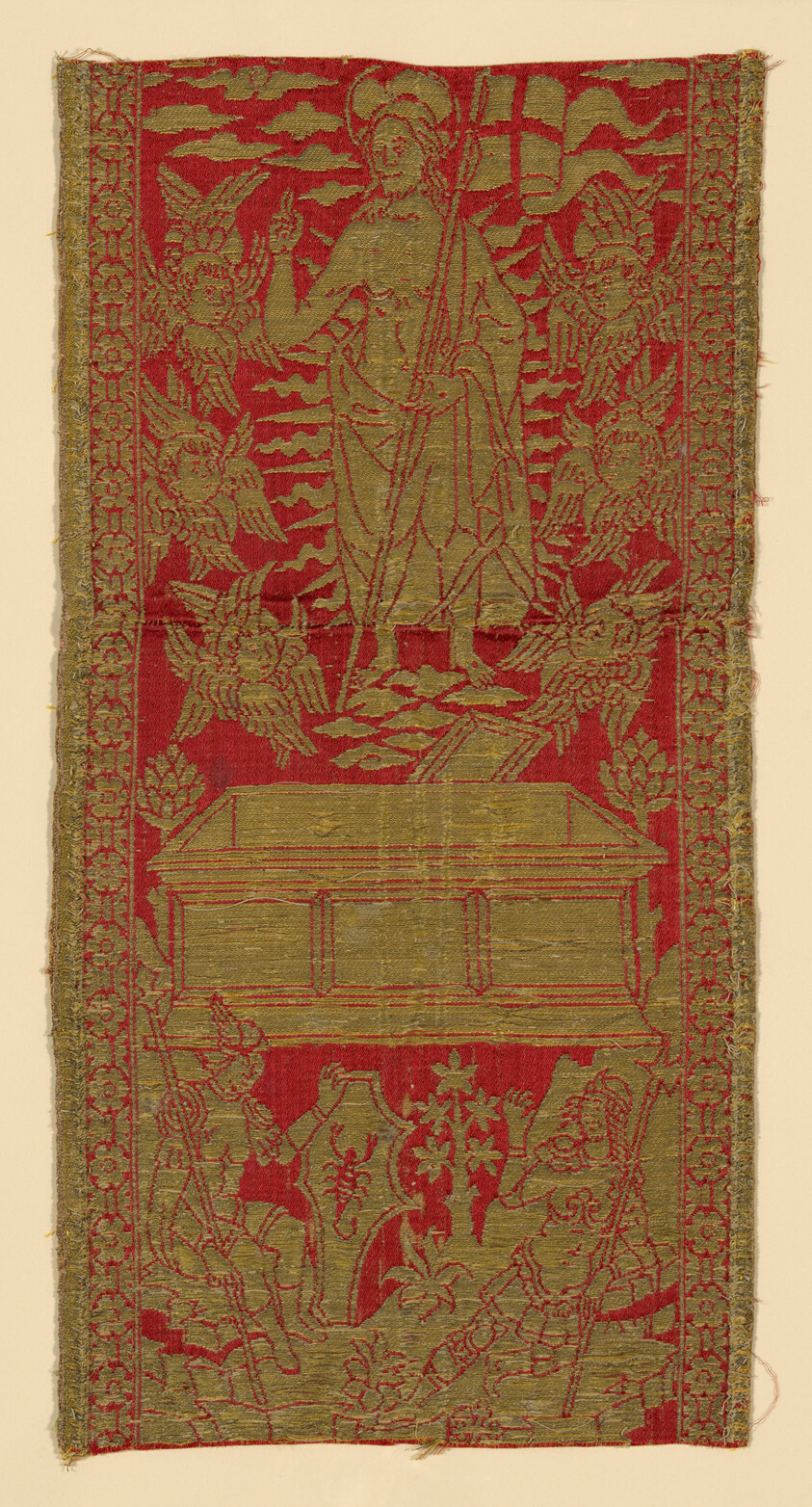
The Fragment as Archive: Deconstructing a Masterwork of Medieval Silk Craftsmanship
In the hushed, discerning atmosphere of a Savile Row atelier, where lineage is woven into every stitch, we understand that true luxury is not merely about the new, but the enduring. The object before us—a fragment from an orphrey band—is not a relic of a bygone era; it is a living document of technical mastery and aesthetic intention. Its materiality speaks a language of profound sophistication, a language that any connoisseur of fine cloth must learn to read. This fragment, a whisper of a larger liturgical garment, embodies the apogee of medieval silk weaving, a tradition whose echoes resonate in the warp and weft of our finest contemporary fabrics.
Materiality: The Grammar of Gilt and Silk
The foundation of this artifact is a warp-float faced 4:1 satin weave, a structure that immediately signals a commitment to surface brilliance. In a satin weave, the warp threads float over multiple wefts before interlacing, creating a smooth, lustrous face that catches and reflects light with an almost liquid quality. The 4:1 ratio—where a warp thread passes over four wefts before going under one—is a deliberate choice for opulence. It minimizes the interruption of the weft on the surface, allowing the silk warp to dominate. This is not a fabric built for brute strength, but for a luminous, almost ethereal presence. The silk itself, with its natural proteinaceous sheen, becomes a canvas for light.
Yet, the true virtuosity lies in the twill interlacings of secondary binding warps and supplementary patterning wefts. This is where the fragment transcends mere textile and enters the realm of high art. The secondary binding warps, often of a finer gauge, are introduced to secure the supplementary wefts. These wefts are the agents of pattern, and in this piece, they are crafted from gilt-animal-substrate-wrapped linen. This is a material of staggering complexity. A core of fine linen thread is first wrapped with a thin strip of animal membrane—likely vellum or goldbeater’s skin—and then overlaid with a layer of gold leaf or gilt. The result is a thread that possesses both the tensile strength of linen and the radiant, malleable quality of metal. The animal substrate provides a smooth, adhesive surface for the gold, while also imparting a subtle, organic warmth to the metallic sheen. This is not a cold, industrial gold; it is a living gold, one that breathes with the textile.
The interplay between the satin ground and the twill-bound patterning is a study in controlled contrast. The satin weave provides a deep, reflective field, while the twill interlacings of the secondary warps create a slightly raised, matte texture for the gilt patterns. This textural dialogue—the slick against the tactile, the luminous against the matte—is the hallmark of a master weaver. The pattern, though fragmentary, would have been a complex, often narrative, design. In an orphrey band, these patterns frequently depicted saints, biblical scenes, or intricate floral and geometric motifs. The gilt threads would have been used to highlight halos, architectural details, or the folds of drapery, creating a shimmering, three-dimensional effect that would have caught the candlelight in a cathedral, drawing the eye of the faithful.
Context: The Savile Row of the Medieval World
To understand this fragment, we must place it within its workshop context. The great weaving centers of the 14th and 15th centuries—Lucca, Venice, Florence, and later, the workshops of the Burgundian court—were the Savile Rows of their day. They were not merely producing cloth; they were producing status, piety, and power. An orphrey band, typically applied to a chasuble or cope, was the most prestigious element of a liturgical garment. It was the equivalent of a bespoke lapel, a statement of the wearer’s rank and the patron’s wealth. The technical demands of weaving such a band were immense. The weaver had to manage multiple warp systems—the main ground warps, the secondary binding warps—and a multitude of wefts, including the delicate, precious gilt threads. A single mistake, a broken thread, could ruin months of labor.
The fluid elegance of the design, even in this fragment, is a testament to the weaver’s ability to harmonize structure and expression. The curves of the pattern, likely a foliate or vine motif, are not stiff or mechanical. They flow with a natural rhythm, suggesting a deep understanding of how the fabric would drape and move. This is not a static image; it is a dynamic composition designed to be seen in motion, as the priest processed down the aisle. The gilt threads, catching the light from different angles, would have created a shifting, animated surface, a visual symphony of faith and craftsmanship.
Legacy: A Blueprint for Modern Luxury
For the contemporary practitioner on Savile Row, this fragment is not a distant curiosity; it is a masterclass in the principles of luxury textile design. The warp-float faced satin is the ancestor of the high-lustre silks used in evening wear and couture. The gilt-animal-substrate-wrapped linen is a precursor to the metal-wrapped threads used in today’s most exclusive brocades and jacquards. The twill interlacings for pattern definition are a lesson in how to introduce complexity without sacrificing drape or hand feel.
The fragment teaches us that true luxury is not about excess, but about intentionality. Every thread, every weave structure, every material choice was made with a specific purpose: to create a fabric that was not only beautiful but also meaningful. It was a fabric that told a story, that signified a belief, that elevated the mundane to the sacred. This is the same philosophy that drives the creation of a bespoke suit on Savile Row. We are not simply covering a body; we are crafting an identity, a narrative, a legacy.
In this fragment, we see the past as a living presence. It is a reminder that the most profound innovations in textile art are often born from a deep respect for tradition. The silk is still silk. The gold is still gold. The weaver’s hand, though long still, still guides our own. This is the heritage we carry forward—not as a museum piece, but as a blueprint for the future of fine cloth.
Heritage Lab Insight
Lab Insight: AIC Silk Archive Node #1871.