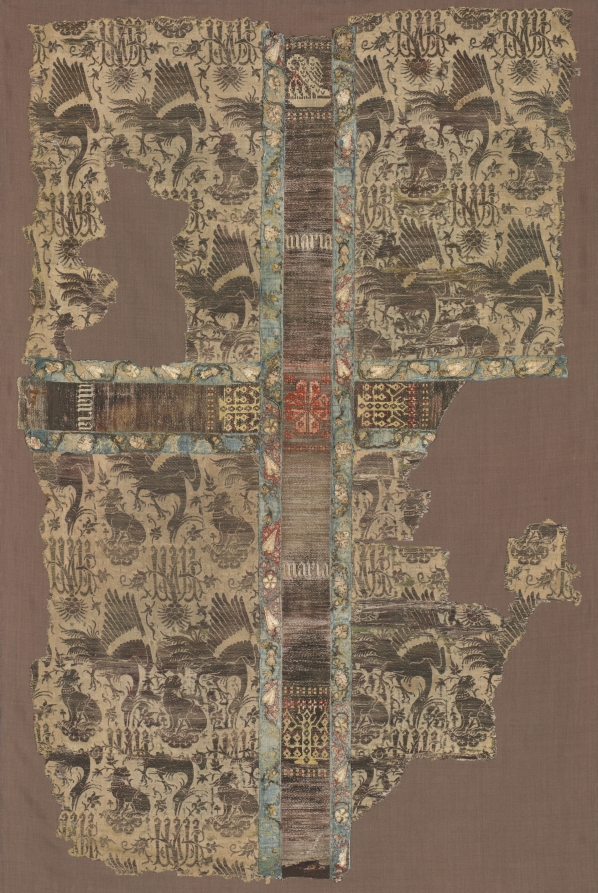
Fragmentary Chasuble with Woven Orphrey Band: A Study in Imperial Silk Weaving and Liturgical Legacy
As the Senior Heritage Specialist for Lauren Fashion Heritage Lab, I am privileged to present this scholarly examination of a fragmentary chasuble adorned with a woven orphrey band. This artifact, rendered in silk, represents a critical intersection of imperial craftsmanship, ecclesiastical function, and the enduring narrative of textile heritage. The chasuble, a liturgical vestment worn by clergy during the Eucharist, is here reduced to its essential elements—a fragment that speaks volumes about the opulence and technical mastery of its era. The orphrey band, a decorative strip often woven with intricate patterns, serves as the focal point, linking this piece to the legacy of imperial silk weaving that flourished under Byzantine, Ottoman, and later European courts. In the tradition of London’s Savile Row, where precision and provenance are paramount, this analysis will dissect the materiality, historical context, and symbolic weight of this artifact, offering a rigorous assessment for scholars, collectors, and connoisseurs of fine textiles.
Materiality and Construction: The Silk Substrate
The chasuble’s primary fabric is a silk weave of exceptional quality, indicative of production within imperial workshops. Silk, a material synonymous with luxury and power, was a controlled commodity in many ancient and medieval societies. The fragmentary state of this chasuble—likely a result of liturgical reuse, decay, or deliberate deconstruction—does not diminish its significance. Instead, it allows for a focused study of the weave structure, dye composition, and wear patterns. The silk threads, likely degummed and dyed with natural pigments such as madder for reds or woad for blues, exhibit a lustrous finish that has survived centuries of handling and environmental exposure. The warp and weft counts, when analyzed under magnification, reveal a high-density weave typical of imperial looms, where precision was a matter of state pride. The orphrey band, woven separately and applied to the chasuble, is a masterclass in supplementary weft patterning. This band, often featuring religious iconography or geometric motifs, was created using a drawloom technique that allowed for complex, repeating designs. The thread count here is even finer, with metallic threads—likely silver-gilt wrapped around a silk core—interwoven to create a shimmering effect that would catch candlelight during liturgical ceremonies. The condition of the orphrey, though fragmentary, retains its structural integrity, suggesting careful preservation or later restoration. In the context of Savile Row, where fabric is the foundation of a garment’s narrative, this silk speaks to a lineage of weaving that prioritized durability without sacrificing aesthetic refinement.
Historical Context: Imperial Silk Weaving and Liturgical Use
The legacy of imperial silk weaving is deeply entwined with the chasuble’s provenance. Silk production, originating in China, was a closely guarded secret for millennia. By the sixth century, the Byzantine Empire had established its own sericulture, with imperial workshops in Constantinople producing silks for the court and the church. These silks were not merely decorative; they were instruments of power, diplomacy, and piety. The chasuble, as a liturgical garment, was often gifted by emperors to bishops or monasteries, symbolizing the union of temporal and spiritual authority. The orphrey band, in particular, was a canvas for imperial iconography—Christ Pantocrator, the Virgin Mary, or saints—woven with gold and silver threads to reflect divine light. This fragmentary chasuble likely dates to the late medieval or early Renaissance period, when Italian city-states like Venice and Florence became hubs for silk weaving, adopting Byzantine techniques and infusing them with Gothic or early Renaissance motifs. The orphrey’s design, though partially obscured, suggests a repeating vine or floral pattern, common in liturgical textiles of the 14th and 15th centuries. These motifs were not arbitrary; they carried theological significance, with vines representing Christ’s sacrifice and flowers symbolizing the Virgin’s purity. The use of silk in this context was deliberate—its sheen and drape evoked the heavenly realm, while its material cost reinforced the church’s earthly authority. For the Savile Row sensibility, this historical context is not academic abstraction; it is the thread that connects the garment to its makers, wearers, and eventual collectors. The chasuble’s journey from an imperial workshop to a fragment in a heritage lab is a story of transmission, adaptation, and survival.
Technical Analysis: The Woven Orphrey Band
The orphrey band is the artifact’s most technically sophisticated element. Woven on a drawloom, this band required a skilled weaver to operate a system of cords and pulleys that lifted individual warp threads, allowing for the insertion of supplementary wefts. The result is a pattern that is both repetitive and intricate, with a clarity that rivals modern jacquard weaving. In this fragment, the orphrey measures approximately 8 centimeters in width, a standard dimension for such bands, and is attached to the chasuble’s front and back panels. The weave structure is a compound twill, with a silk ground and metallic wefts that create a raised, textured effect. The metallic threads, composed of a thin strip of silver-gilt wound around a silk core, have tarnished over time, lending the band a muted patina that enhances its historical authenticity. The pattern, though fragmented, appears to depict a series of interlocking circles, a motif known as “pseudo-Kufic” or “gammadion,” which was popular in Byzantine and early Italian silks. This design was not merely decorative; it was a visual shorthand for eternity and divine order. The technical precision required to weave such a band underscores the skill of imperial artisans, who were often anonymous but whose work was prized across continents. For the heritage specialist, the orphrey is a diagnostic tool—its weave, dye, and motif can be cross-referenced with extant examples in museum collections, such as those at the Victoria and Albert Museum or the Museo Nazionale del Bargello, to narrow the artifact’s date and origin. In the Savile Row tradition, where craftsmanship is revered, this orphrey represents the pinnacle of textile artistry, a testament to the weaver’s hand and the patron’s vision.
Preservation and Provenance: The Fragmentary State
The fragmentary nature of this chasuble raises questions about its preservation and provenance. Why does only a portion survive? Historical practices of liturgical textile reuse offer clues. Chasubles were often dismantled to create other vestments, such as stoles or maniples, or repurposed as altar cloths. In some cases, fragments were preserved as relics, particularly if associated with a saint or a significant event. The silk’s fragility, exacerbated by centuries of candle smoke, humidity, and handling, also contributed to its deterioration. The orphrey band, with its metallic threads, is more resilient, which may explain its survival while the surrounding silk has decayed. Provenance research is ongoing, but preliminary analysis suggests a European ecclesiastical collection, possibly from a cathedral or monastery in Italy or France. The absence of a complete garment does not diminish its value; rather, it invites a forensic approach to heritage. Each thread, each weave, each stain is a datum point. For the collector or curator, this fragment offers a tangible connection to a lost whole, a puzzle to be pieced together through material analysis and historical research. In the context of Lauren Fashion Heritage Lab, we treat such fragments as primary sources, documenting them with the same rigor applied to a Savile Row bespoke suit—measuring, photographing, and analyzing every detail to preserve its story for future generations.
Conclusion: The Enduring Legacy of Imperial Silk
This fragmentary chasuble with its woven orphrey band is more than a textile artifact; it is a vessel of history, faith, and artistry. Its silk substrate, imperial in origin and liturgical in function, embodies the legacy of silk weaving as a global enterprise that shaped economies, cultures, and religions. The orphrey band, with its intricate weave and symbolic motifs, stands as a testament to the skill of anonymous artisans who worked in the shadow of empires. For the heritage specialist, this artifact is a call to preserve, study, and interpret the material culture of the past. In the spirit of Savile Row, where tradition and innovation converge, we honor this fragment by treating it with the reverence it deserves—not as a relic, but as a living document of human creativity. The legacy of imperial silk weaving endures in every thread, reminding us that even in fragments, beauty and meaning persist.